


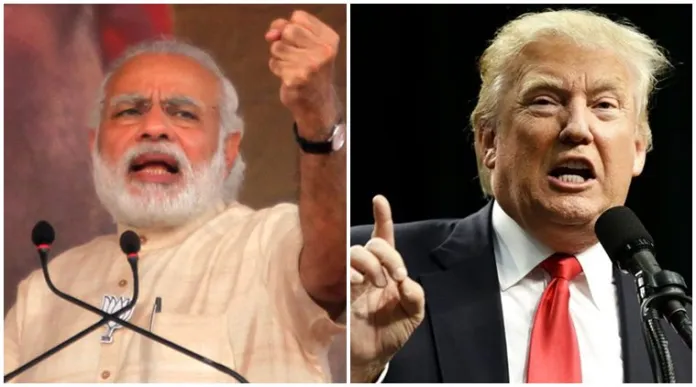
By Suresh Unnithan
The Television channels and media platforms in India have been vocally debating on the “perilous” aftermath of Trump’s tariff war on Indians. Surprisingly, the deliberations were one-sided; focussing on Uncle Sam’s enhanced import duty and its negative bearing on the Indian economy. While the fiscal pundits were proposing the Indian Administration, particularly Prime Minister Narendra Modi, to “work out a feasible deal with Donald Trump-led US administration to have a “compassionate” approach on the imposition excessive tariff, the financial experts conveniently circumvented focus on the fiscal jerk awaiting the global superpower that tries to intimidate the “less privileged” nations. Some Indian economists were signalling an impending economic slump, citing job losses, reduced exports, and weakened market sentiment. But they never said these concerns were valid for specific sectors, and the overall impact appeared overstated.
According to a business journalist who has been closely monitoring the fiscal health of the nation “India’s economy is diversified, with the U.S. accounting for only 22% of its exports in April-May 2025. Exemptions for pharmaceuticals and semiconductors, combined with India’s trade surplus with the US provide resilience. Moreover, India’s status as the world’s fastest-growing major economy suggests it can absorb localized shocks.”
Trump announced a 25% tariff on Indian goods, effective August 1, 2025, with an additional unspecified penalty for India’s continued purchase of Russian oil and arms. This was later escalated to a 50% tariff rate, set to take effect within 21 days from August 6, 2025. The tariff hikes are partly seen as a response to India’s continued trade with Russia, particularly for discounted oil, which accounts for 35-40% of India’s crude imports since the Russia-Ukraine war began in 2022.
India exports to the U.S goods worth $87 billion annually, constituting about 2.25% of India’s GDP. Of this, only around 20% of India’s total goods exports, roughly 2% of the GDP are directly exposed to the US market. Key sectors affected by the tariff war include gems and jewelry, apparel, textiles, chemicals, and auto components. However, critical sectors like pharmaceuticals, semiconductors, and electronics are exempt from these tariffs, reducing the overall economic exposure. Over $8 billion worth of exports are most vulnerable, which is roughly 1.1% of India’s GDP. This suggests that while certain sectors may face challenges, the broader macroeconomic impact is likely to be limited.
In fact Trump’s inconsiderate tariff war is likely to boomerang. The hiked duty (the 25% plus an additional 25% for India’s Russian oil purchases, totalling up to 50%) will act as taxes on imported goods. US companies importing Indian goods like pharmaceuticals, textiles, jewelry, and auto parts, will face higher costs. These will be passed on to US consumers resulting in prise rise for everyday items like clothing, medicines, and electronics. In fact US retailers have warned that tariffs on other countries (like China) already led to price increases and product shortages, and similar effects are certain if higher tariffs are imposed on Indian goods. “Low-income American households, in particular, bear the brunt of these price hikes.”
An Indian Businessman doing business with US firms on domestic consumables points out, “U.S. consumers may face higher prices for everyday goods, as Indian exports like textiles and apparel become costlier. This (price hike) could reduce consumer purchasing power and dampen demand, potentially offsetting any gains in domestic manufacturing.”
As per the data available from US Bureau of Labor Statistics (BLS) on consumer expenditure for households (2024) The average U.S. family of four spends approximately $1,200 annually on clothing and textiles. With a 50% tariff and a 30% pass-through rate (accounting for retailer absorption), prices could rise by $360, increasing annual spending to $1,560.
Assuming a hypothetical scenario where pharmaceutical exemptions are lifted, a family spending $600 annually on generic drugs could see a $120 increase (20% pass-through rate), totaling $720.
The combined additional cost for textiles and pharmaceuticals is estimated at $360 per year, representing a significant burden for lower- and middle-income families.
According to an Indian exporter operating from Kochi, “India is a significant supplier of generics (pharmaceuticals) and tech services to the US. Higher tariffs could disrupt these supply chains, especially for critical goods like medicines, where India accounts for $11 billion in US-bound exports. If Indian exporters absorb some costs to stay competitive, their margins shrink, but if they pass costs to US buyers, it could lead to shortages or higher healthcare costs.”
Financial Analysts of international repute note that “tariffs are feeding into US inflation, with prices rising 2.7% year-over-year by June 2025, up from 2.4% the prior month. Items like clothing and appliances are already seeing price hikes due to tariffs on other countries (e.g., Vietnam, Indonesia). Adding India to the mix could exacerbate this, as 84% of US business leaders express concern about tariff-driven economic impacts. While US GDP grew at 3% annualized from April to June 2025, tariffs could dampen this by increasing costs for businesses and consumers, potentially slowing consumption.”
Its welcome, India has also signaled the possibility of imposing reciprocal tariffs on US goods, potentially targeting the $45 billion in US exports to India (energy, defense equipment). This could hurt US exporters, particularly in agriculture or tech, where India is a growing market. India’s offer to lower tariffs on 55% of US imports ($23 billion worth) was contingent on US tariff relief, and without a deal, US firms could lose market share.
The US knows its economy benefits from Indian imports, especially in services (IT, where the US has a surplus). Disrupting this could harm US firms indirectly, as Indian IT giants like TCS and Infosys serve global clients, including US companies. “A global economic slowdown triggered by tariffs could further hit US growth, as India’s role in US supply chains is less substitutable than, say, China’s”.
While discussing the consequences of Trump’s tariff war, an Indian economist working in the US pointed out “The US faces a higher risk of self-inflicted economic damage. Tariffs across multiple countries could compound inflationary pressures, reduce consumer demand, and disrupt global supply chains. The US’s tariff strategy may backfire if higher costs deter investment and consumption.”
He added further, “The US risks significant inflationary pressures and supply chain disruptions, which could outweigh the intended benefits of tariff-induced manufacturing growth. Both nations have incentives to resume trade negotiations to mitigate these impacts, with India better positioned to weather the storm due to its economic resilience and global trade options.”
Prime Minister Narendra Modi’s statement against in response to US President Donald Trump’s imposition of a 50% tariff on Indian goods on August 6, 2025, that India will not compromise on the interests of its farmers, fishermen, and dairy sector, even at personal cost, amply explains the counties resolve against Trump’s tariff aggression. Modi has emphasized that “Farmers’ interest is our top priority. India will not bow to pressure or compromise the welfare of its farmers, fishermen, or dairy farmers.”
It is now clear, Trump, entwined in his own aggressive trade policies, is facing domestic hostility and economic stress. “The battle of tariffs revealed a blatant reality that Trump gambled with high stakes, India played a steadier hand, emerging not just unscathed but stronger on the global stage.” As a senior journalist noted, “The tariff tussle exposed, Trump is (or was) never a Dear Friend of India.”
H L Mencken, an American journalist had on July 26, 1920 wrote in the Baltimore Sun,”As democracy is perfected, the office of the president represents, more and more closely, the inner soul of the people. On some great and glorious day, the plain folks of the land will reach their heart’s desire at last, and the White House will be adorned by a downright moron.”
