


By Nanditha Subhadra
Welcome to the world’s largest democracy, where the electorate doesn’t just get fooled — they line up enthusiastically, pay for the ticket, cheer the magician, and then beg for an encore while the magician empties their pockets. From dusty village panchayats to the grand halls of Parliament, Indian voters have perfected the art of enthusiastic self-deception. They are not mere victims of political conmen; they are willing, repeat customers at the greatest confidence trick in human history.
Henry Louis Mencken must be laughing in his grave: “Democracy is the theory that the common people know what they want, and deserve to get it good and hard.” In India, the “good and hard” part is delivered with clockwork precision every five years, and the common people keep coming back for more, smiling like freshly slapped infants.
Politicians campaign like demigods — helicopters whirring on public money, cavalcades blocking highways, leaders hugging babies and promising paradise while their own families enjoy private jets and overseas assets. They dangle shiny new jumlas — “Achhe din aa rahe hain!”, “15 lakh in every account”, “Two crore jobs”, “Farm income will double”, “NYAY for the last person” — and the voter, bless his infinitely gullible heart, swallows it hook, line, and sinker. Every single time.
The voter’s memory is shorter than a TikTok video. He rants bitterly about broken promises over chai, forwards angry memes calling all netas thieves, yet when the election bugle sounds, he transforms into a wide-eyed devotee. “This time will be different!” he tells himself, as he proudly displays his inked finger on WhatsApp like a badge of honour. Different? The only thing different is the freshness of the lie and the colour of the kurta delivering it.
Winston Churchill once said democracy is the worst form of government except for all the others. Indians seem determined to extract every ounce of “worst” from it. They know politicians are turncoats, dynasts, and opportunists who switch parties faster than actors change costumes. They know candidates with criminal cases often win. They know wealth mysteriously multiplies once someone occupies the kursi. Yet they vote with record turnout — 75% here, 80% there — as if their sacred ink will magically transform wolves into shepherds.
The mockery peaks during campaign season. Leaders crisscross states, burning crores in public funds, playing every emotional card available: temple, mosque, caste, reservation, freebies for women (Ladli Behna cash raining like manna from heaven), laptops, cycles, and whatever else the marketing team dreams up. The voter claps, dances to the slogans, and dreams of Ram Rajya or socialist utopia, conveniently forgetting that the last set of promises evaporated faster than alcohol at a dry-state wedding.
Post-election, reality hits like a hangover. Schemes are delayed, diluted, or diverted. Potholes remain. Jobs stay scarce. Inflation bites. The same leaders who swore “service” now focus on “consolidating power.” And what does the noble voter do? He shrugs, mutters “sab chor hain”, and starts preparing for the next round of self-flagellation.
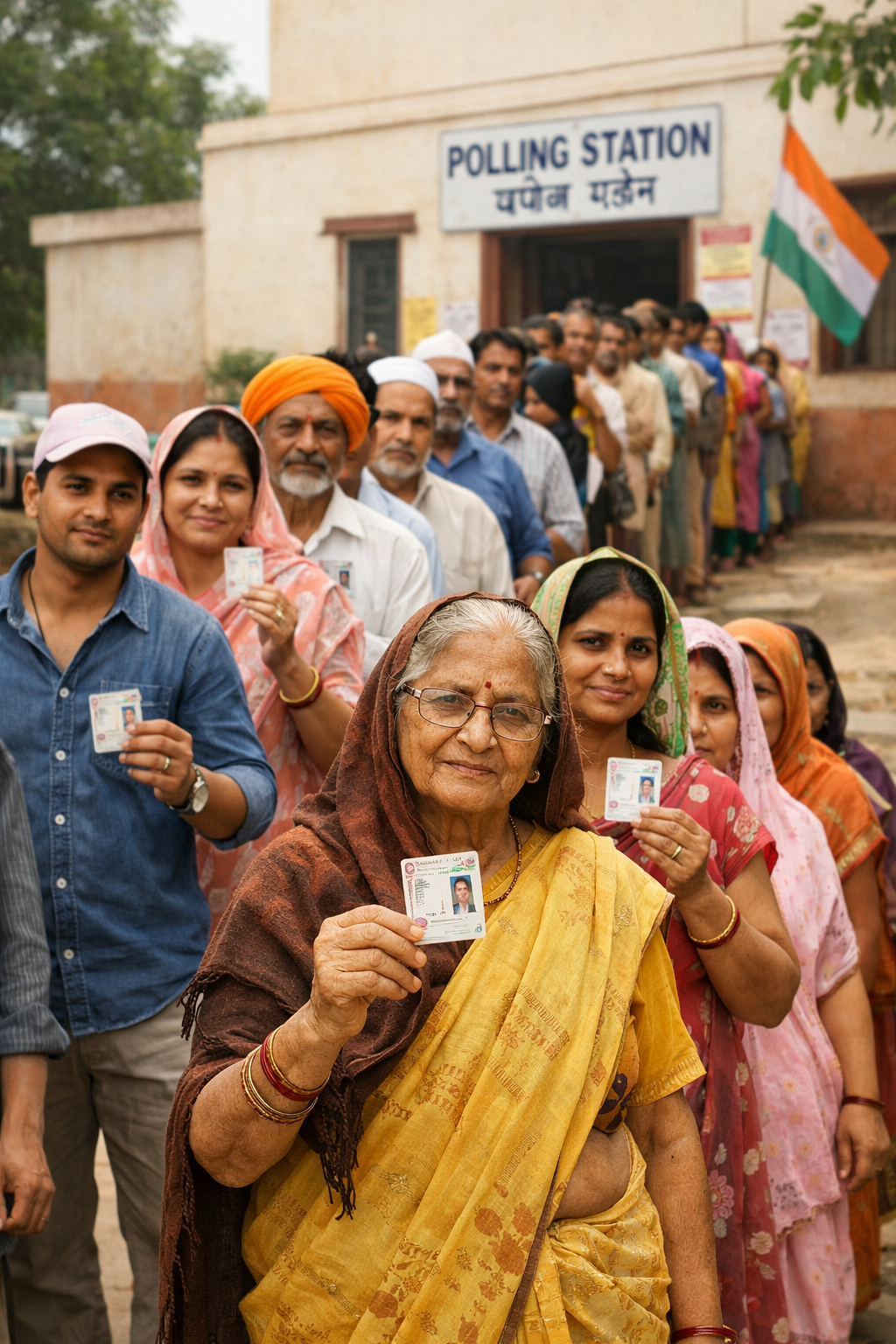
The greatest joke is how voters celebrate their own fleecing. High turnout is hailed as “vibrant democracy” when it is actually vibrant proof of collective gullibility. They queue for hours under scorching sun or pouring rain, believing one day of voting grants them sovereignty. In truth, they grant sovereignty to professional deceivers for 1,825 days. The kursi is so lucrative that aspirants spend crores to win it, knowing the returns will be astronomical — contracts, influence, immunity, and that sweet, sweet power high.
Even grassroots panchayats, sold as empowerment tools, often become tiny empires of siphoned funds where newly “empowered” sarpanches learn to mimic their bigger counterparts. Women voters, the latest prized suckers, are wooed with direct transfers, turning them into reliable vote banks while deeper change remains cosmetic.
NOTA? A symbolic middle finger used by a microscopic minority while the enthusiastic majority chooses the least terrible liar or the one offering the biggest immediate bribe disguised as welfare.
As fresh elections unfold in 2026, the circus is back in town. Prime Ministers and Chief Ministers descend like saviours, promising moon, stars, free electricity, and zero poverty. The voter, that eternal optimist with the memory of a goldfish, buys the act again. He knows the drill. He has been fooled before — repeatedly, spectacularly, humiliatingly. Yet here he is, chest puffed with democratic pride, ready for another thorough bamboozling.
Mencken had it right: the people get exactly what they deserve — good and hard. In India, they don’t just deserve it; they demand it, celebrate it, and vote for seconds.
The politicians aren’t the real villains in this satire. They are merely opportunistic performers doing what predators do. The real comedy lies in the audience — the endlessly gullible electorate that keeps returning to the same tent, paying with their taxes, their future, and their dignity, convinced that this time the clowns in designer attire genuinely care about them.
The seat of power remains obscenely attractive because the fools keep making it so. They play any card — fear, hope, caste, religion, freebies — and the voter happily folds.
Until the day Indian voters develop the memory of an elephant instead of a goldfish, the spine to punish failure instead of rewarding performance art, and the wisdom to see through the oldest con in the book, the masochistic march will continue.
Ink will flow. Slogans will echo. Helicopters will fly. And the biggest losers will keep showing up with bright eyes and open wallets, proudly declaring, “Main votar hoon!”
The joke isn’t on the netas.
The joke is you, dear voter.
And you keep laughing — all the way to your own ruin.
