


From Our National Desk
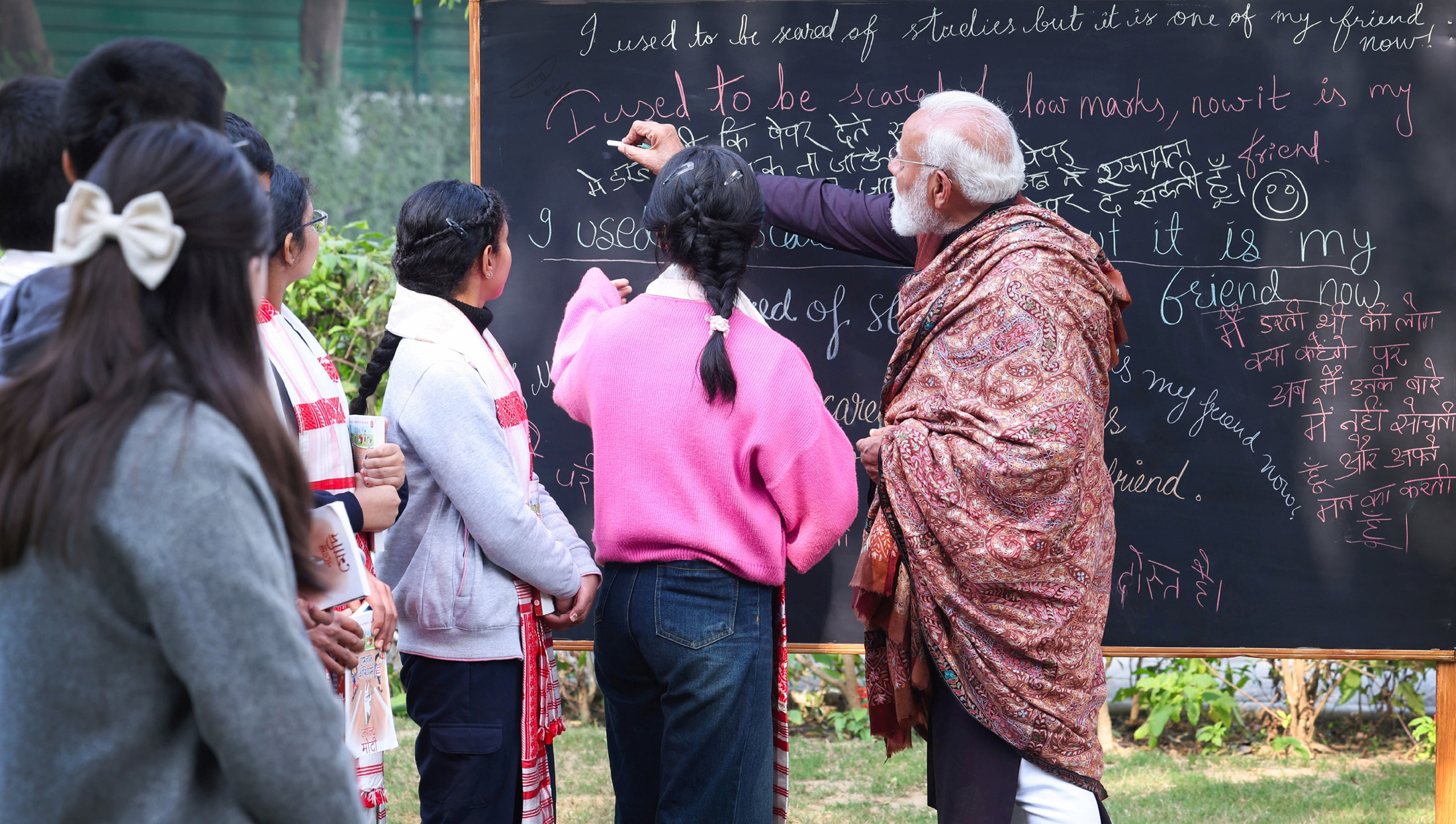
In Narendra Modi’s carefully constructed political universe, communication is often as important as governance. Each year, Pareeksha Pe Charcha is presented as a national moment of reassurance—televised interactions where students are encouraged to remain calm, stay focused, and trust the system.
But beyond the stage-managed calm, a far more consequential examination is underway—one that the system itself appears to be failing with unsettling regularity.
The cancellation of NEET-UG 2026 on May 12, following allegations of a large-scale paper leak now under investigation, has once again shaken confidence in India’s most critical testing infrastructure. More than 22 lakh candidates, according to official registration data released by the National Testing Agency (NTA), suddenly found themselves caught in uncertainty—not because of performance, but because of process.
If Pareeksha Pe Charcha seeks to reduce stress, the examination system risks institutionalising it.
From Exception to Pattern
India’s examination system is no stranger to controversy. But what was once episodic now appears structural.
Between 2017 and 2024 alone, multiple high-profile breaches have been documented: the NEET leak controversies flagged in 2017 and revisited in 2024 through petitions before the Supreme Court; the 2018 CBSE Class 10 and 12 paper leaks that forced re-examinations; the SSC CGL 2017 scam that led to nationwide protests; and the cancellation of UPTET 2021 after question papers surfaced on messaging platforms hours before the test.
In June 2024, the NEET-UG controversy escalated to the point where the Supreme Court of India sought responses from the Centre and the NTA over alleged irregularities, including claims of question paper leaks and inflated scores. While the Court stopped short of cancelling the exam at the time, it acknowledged that the “sanctity of the examination” must remain paramount.
These are not isolated administrative lapses. They point to recurring vulnerabilities—logistical, technological, and institutional.
An Ecosystem of Exploitation
Opposition figures such as Rahul Gandhi and Arvind Kejriwal have described the phenomenon as the work of an “organized paper leak network.” While political language tends toward exaggeration, investigative findings across states lend partial weight to these concerns.
Police investigations in states like Bihar, Uttar Pradesh, and Rajasthan in past cases have uncovered patterns: leaks originating from printing or distribution nodes, dissemination through encrypted platforms such as WhatsApp and Telegram, and the use of proxy candidates. In several recruitment exam scams, including those probed by state Special Task Forces, money trails running into lakhs per candidate have been documented in charge sheets.
In the ongoing NEET-UG 2026 probe, preliminary reports cited by multiple media outlets have referred to the circulation of “highly predictive” question sets prior to the exam. Whether these constitute a full breach or a sophisticated fraud remains under investigation—but the pattern is by now familiar.
The persistence of such breaches raises an uncomfortable possibility: that weaknesses in the system are not merely accidental, but repeatedly exploited.
Accountability and the Burden of Promise
Prime Minister Modi’s anti-corruption pledge—“na khaunga, na khane doonga”—was central to his political appeal. Yet, the recurrence of examination scandals presents a quieter but equally serious test of that promise.
When irregularities recur across years and jurisdictions, accountability cannot remain episodic. It must become structural.
The response of the Ministry of Education, led by Dharmendra Pradhan, has often been measured, but at times reactive. In earlier controversies, including NEET-UG 2024, official statements initially downplayed the scale of irregularities before investigations expanded their scope. While caution in public communication is understandable, delayed acknowledgment risks eroding trust.
To its credit, the government has in recent months moved toward stricter anti-paper leak legislation and transferred high-profile cases to central agencies such as the CBI. Arrests have been made in several state-level exam scams, and digitalisation efforts have been proposed to secure future tests.
Yet, these responses underline a deeper truth: enforcement has been inconsistent, and reform has lagged behind innovation in malpractice.
The Human Cost of Institutional Failure
Lost in institutional language are the students—millions of them—whose lives are directly shaped by these examinations.
For a NEET aspirant, the test represents years of preparation, often involving significant financial strain on families. Coaching fees, relocation, and repeated attempts are not uncommon. When an exam is compromised, the damage is not merely procedural—it is psychological.
A re-examination is not a reset; it is an extension of uncertainty. A cancellation is not a correction; it is a disruption of carefully laid plans.
In 2024, student protests in cities like Patna and Delhi highlighted this emotional toll, with candidates demanding transparency and timely action. The scenes repeated in 2026 suggest that the underlying anxieties remain unresolved.
A System Being Tested
The crisis is no longer about individual exams. It is about institutional credibility. The National Testing Agency, created to professionalise and centralise entrance examinations, now finds itself at the centre of repeated controversies. Each breach chips away at the trust it was meant to build. For a government that has emphasised efficiency, transparency, and scale, the contradiction is stark. Messaging can inspire confidence—but only outcomes can sustain it.
Beyond Reassurance
Pareeksha Pe Charcha may continue to offer guidance and encouragement. But reassurance, however well-intentioned, cannot substitute for reliability.
Students do not need motivational speeches as much as they need a system that works—predictably, securely, and fairly.
Until that assurance is restored, every examination will carry a shadow, every result a question, and every success a quiet doubt.
Because in today’s India, the real test is no longer about who clears the exam—it is about whether the system conducting it deserves to pass at all.
