

Secondaries Emerge as Third Exit Route Alongside IPOs and M&A, Say Industry Leaders at IVCA Conference

Mumbai : The Indian Venture and Alternate Capital Association (IVCA) today hosted the IVCA Secondaries Conference 2026 in Mumbai, bringing together investors, fund managers, global experts, and industry participants to deliberate on the evolving role of secondaries in India’s private markets. The conference focused on mainstreaming liquidity and strengthening the secondary market as part of India’s broader private capital ecosystem.
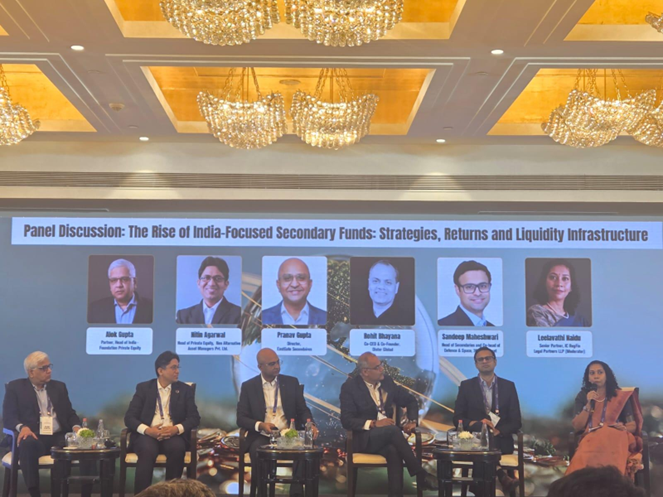
The opening panel discussion, titled “The Rise of India-Focused Secondary Funds: Strategies, Returns and Liquidity Infrastructure”, examined the range of strategies adopted by domestic secondary funds, including late-stage and pre-IPO transactions, employee stock ownership plan (ESOP) liquidity, private equity (PE) fund interest acquisitions, and general partner-led continuation vehicles.
The panel featured Alok Gupta, Partner, Head of India – Foundation Private Equity; Nitin Agarwal, Head of Private Equity, Neo Alternative Asset Managers; Pranav Gupta, Director, EastGate Secondaries; Rohit Bhayana, Co-CEO and Co-Founder, Oister Global; and Sandeep Maheshwari, Head of Secondaries and Co-Head of Defence and Space, 360 ONE Asset. The discussion was moderated by Leelavathi Naidu, Senior Partner, IC RegFin Legal Partners LLP.
Secondary transactions have emerged as an important component of India’s private capital exit landscape, accounting for 23.4% of total PE/VC exit value between 2020 and August 2026. During this period, secondary exits amounted to $38.7 billion across 305 transactions. The market continued to see transaction activity in 2025, with the number of secondary exits increasing 9% year-on-year to 58 deals, compared to 53 in 2024. In value terms, secondary exits stood at $4.02 billion in 2025, compared to $6.69 billion in the previous year, with the average transaction size moderating from $126 million to $69 million.
The panellists discussed how the different investment models compare in terms of risk-adjusted returns, deal sourcing, and competition among domestic secondary funds and global players active in India. The conversation also examined the challenges of underwriting transactions in a market characterised by limited valuation benchmarks, infrequent mark-to-market assessments, and information asymmetry.
Highlighting the growing opportunities across different secondary transaction structures, Nitin Agarwal, Head of Private Equity, Neo Alternative Asset Managers, pointed to the increasing relevance of direct single-asset transactions as fund managers seek liquidity and opportunities to redeploy capital. He said, “India’s secondary market is evolving, with opportunities emerging across direct single-asset transactions, portfolio buyouts, GP-led continuation funds and LP-led deals. At Neo, we expect 60–70% of our activity to come from direct single-asset transactions, as funds look to exit existing investments and redeploy capital. The focus remains on high-quality businesses with strong governance, sustained growth and credible exit prospects. In GP-led transactions, understanding the fund manager’s motivation is equally critical. Continuation funds can provide liquidity to existing investors while allowing managers to retain promising assets for further value creation. Ultimately, disciplined valuations, rigorous due diligence and trust between stakeholders will be essential to the success of these transactions.”
The discussion further examined investment holding periods, exit strategies, and the influence of India’s IPO pipeline on fund-level return expectations. Panellists also considered the requirements for building a self-sustaining secondary market, including greater participation from domestic institutional limited partners, regulatory clarity, reliable pricing benchmarks, and dedicated advisory platforms.
Drawing on the evolution of global secondary markets, Alok Gupta, Partner, Head of India, Foundation Private Equity, said, “The global secondaries market has grown into a mainstream segment of private markets, reaching approximately US$220 billion, or nearly 15% of the overall market, with growth of just under 20% over the past decade. GP-led transactions now account for nearly half of secondary activity, with single-asset continuation vehicles making up around 50% of this segment. Investors must assess underlying businesses, build their own financial models and determine pricing independently, rather than relying solely on reported NAVs. As the market develops, secondaries have the potential to become a credible third exit route alongside IPOs and M&A.”
Highlighting the expanding role of secondaries in India’s private capital ecosystem, Sandeep Maheshwari, Head of Secondaries and Co-Head of Defence & Space, 360 ONE Asset, underscored their growing relevance in facilitating liquidity, capital recycling and more efficient portfolio management for investors. He added, “India’s private equity market is entering a new phase of maturity, with secondaries playing an increasingly important role in capital recycling, liquidity creation and exit management. Beyond providing liquidity to existing investors, secondaries offer access to established, high-quality businesses and shorter-duration investment opportunities, while enabling GPs and LPs to optimise portfolio outcomes. As India’s private markets deepen, secondaries will become an increasingly integral part of the investment and exit ecosystem, complementing IPOs and strategic sales.”
The discussions reinforced the growing relevance of secondaries in India’s private capital landscape, both as a liquidity mechanism and an investment opportunity. As the market evolves, greater institutional participation, transparent valuations and strong governance practices will be key to supporting its long-term development.
The IVCA Secondaries Conference 2026 edition was supported by 360 ONE Asset, Gaja Capital, and Foundation Private Equity as Gold Partners; Blume and Oister Global as Silver Partners; and Kirkland & Ellis and Price Waterhouse & Co LLP as Knowledge Partners.
****
