


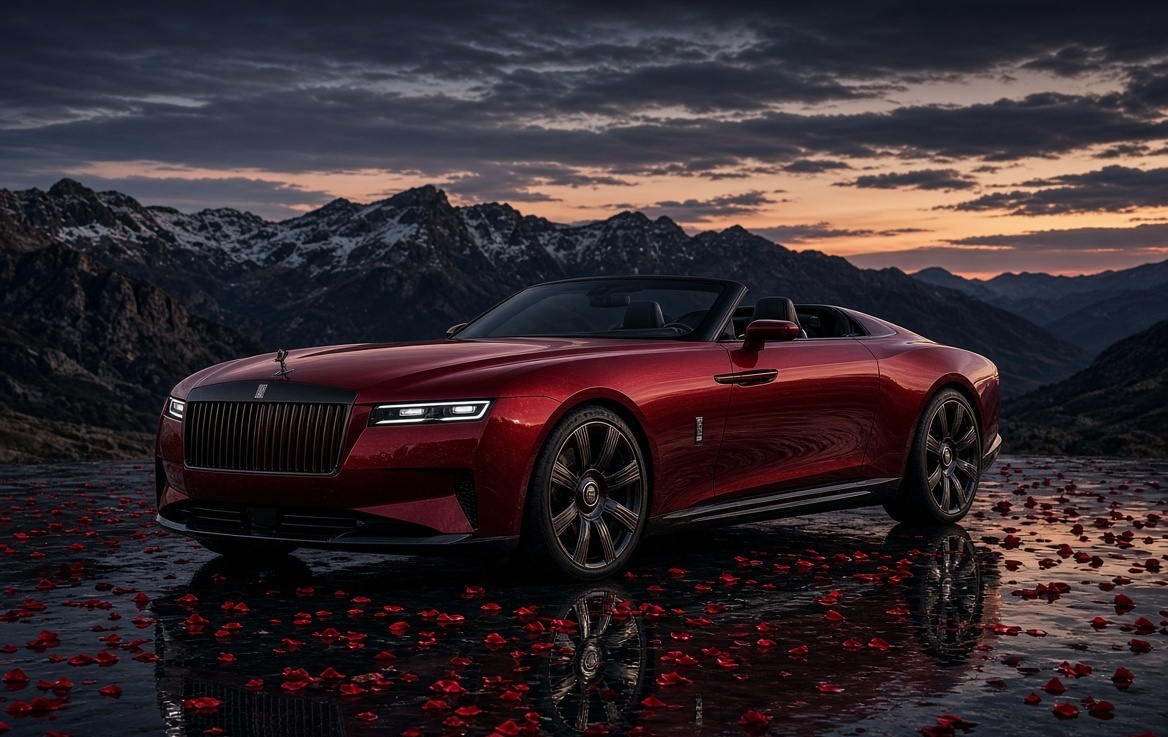
Some cars are built to be driven. A few are built to be remembered. Rolls-Royce’s La Rose Noire Droptail sits firmly in the second category. Unveiled in August 2023 at Monterey Car Week and quietly handed over near Pebble Beach, this two-seat roadster is widely regarded as the most expensive new car ever commissioned. Estimates place its price between $25 million and $32 million (roughly ₹211–285 crore). It is the first of only four unique Droptail expressions ever created by the marque’s Coachbuild division.
How many exist, and where are they?
Only one La Rose Noire Droptail has ever been built. It was a one-of-one private commission and has already been delivered. Rolls-Royce has never disclosed the identity or nationality of its owners, and no official or reliable report has ever linked the car to an Indian owner. In total, the entire Droptail programme is limited to four cars, each radically different in detail and each reserved for a separate private client:
- La Rose Noire — one car only
- Amethyst Droptail — one car only
- Arcadia Droptail — one car only
- A fourth Droptail — one car only, not yet fully detailed in public
There is no country-wise sales breakdown because these are not “sold” in the conventional sense. They are privately commissioned. Rolls-Royce maintains absolute privacy around Coachbuild clients and has never published a country-wise ownership list. No Droptail has been publicly associated with India.
The car began as a personal story. Its owners, a husband and wife who head a prominent international family with deep roots in France, art, fashion and champagne, wanted something that felt like a love letter. The Black Baccara rose—a dark, almost black flower with a sudden red shimmer when light hits it—became the thread that runs through every detail. The rose was a favourite of the family’s matriarch, and that single preference shaped the entire project over four years of design and construction.
“Rolls-Royce La Rose Noire Droptail is a love story, thoughtfully captured and stunningly projected onto the canvas of a Rolls-Royce motor car,” said Torsten Müller-Ötvös, then Chief Executive Officer of Rolls-Royce Motor Cars. “It is an expression of the deep and passionate partnership between a husband and wife… to be part of their remarkable story is a privilege.” He later described the car as “contemporary patronage in its truest form,” adding that both the vehicle and its clients “will be written into Rolls-Royce history forever.”
Outside, the paint alone took extraordinary effort. Called “True Love,” the deep red finish required a base coat followed by five layers of clear lacquer, each mixed with a slightly different tone of red. Getting the colour to behave the way the rose does in real life took 150 attempts. The Pantheon grille is finished in a custom dark coating named Hydroshade, and for the first time the vanes are angled rather than straight. Even the backs of those vanes are painted red, a detail that only appears in reflection. The car measures about 5.3 metres long and 2 metres wide and rides on a new monocoque chassis made of steel, aluminium and carbon fibre—the first time Rolls-Royce has built a Coachbuild car on a completely dedicated structure.
A single-piece carbon-fibre hardtop with electrochromic glass can be removed entirely, so the car can be driven as an open roadster or as a closed coupé. The glass itself can be switched from dark to nearly clear. At the rear, the deck slopes downward in a way that generates downforce without a traditional wing. Design Director Anders Warming has stressed that Droptail “is not a concept car or a design study—it is a motor car that has been built to be driven.”
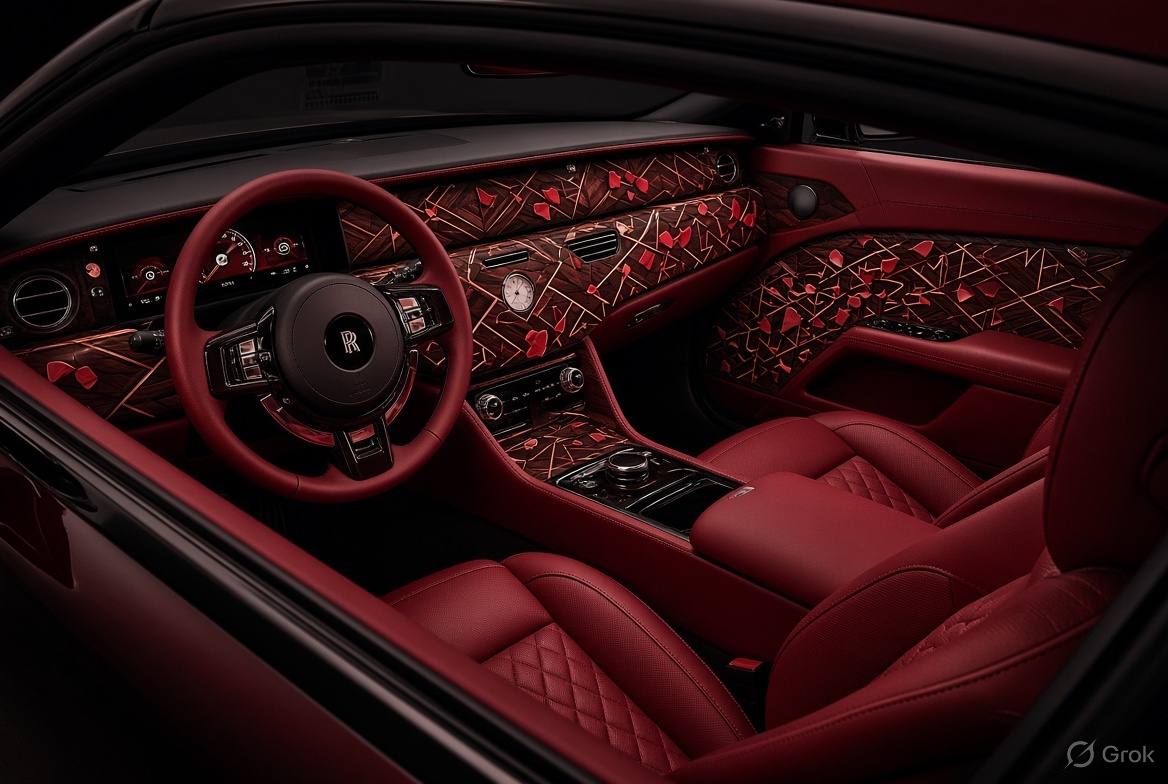
Inside, the most striking feature is the woodwork. The fascia, shawl panel and doors are covered in 1,603 individual pieces of Black Sycamore veneer, arranged to look like falling rose petals. One craftsman spent more than nine months placing them, working only in one-hour sessions and never more than five hours a day, often in complete silence so that concentration never slipped. Alex Innes, Head of Coachbuild Design, called the wood elements “a clear statement that time-honoured exquisite crafts have a place at the pinnacle of modern design.” He also described the finished car as “glamour distilled.”
The leather, in shades named Mystery and True Love, has a faint copper shimmer that catches the light the way rose petals do. The seats sit low, and the cabin feels deliberately intimate. In the centre of the dashboard sits a one-off Audemars Piguet Royal Oak Concept watch that can be lifted out and worn on the wrist. When the watch is removed, a titanium blank engraved with a rose remains in its place. There is also a small compartment designed to hold the owners’ own vintage champagne and crystal glasses. Nothing feels added on; every element was requested and then refined until it belonged.
Powertrain
Under the bonnet sits Rolls-Royce’s twin-turbocharged V12 (commonly cited as 6.75 litres, with some technical references listing 6.6 litres for the Droptail application). For this project the engine was specifically retuned to deliver an additional 30 bhp—the first time the company has ever increased power for a modern Coachbuild car. Output is reported at approximately 593 hp and 840 Nm of torque. Drive is sent exclusively to the rear wheels through an eight-speed automatic transmission, calibrated for the effortless, near-silent progress that defines the marque. Acceleration to 100 km/h is expected in under five seconds, with a top speed electronically limited to 250 km/h. Suspension and acoustic isolation have been refined so that the mechanical presence of the V12 remains a distant, refined undertone rather than an intrusion. The emphasis is on classic Rolls-Royce “waftability”: progressive power delivery and a sense of limitless reserve rather than outright drama.
Ownership is the strictest part of the story. La Rose Noire was never offered for sale. It was a private commission, already delivered. The other three Droptails were reserved in the same way for a handful of clients who already have long, quiet relationships with the company. There is no waiting list and no way for an outsider to buy one. Rolls-Royce does not name its Coachbuild clients, and the only people who ever receive such cars are those the marque already knows well enough to trust with a multi-year project of this scale.
In the end, La Rose Noire is less a car than a carefully finished conversation between a family and the people who build Rolls-Royces. For its owners it is a personal object. For everyone else it is simply out of reach—proof that at this level, the highest form of luxury is not something you order, but something you are invited to create.
