


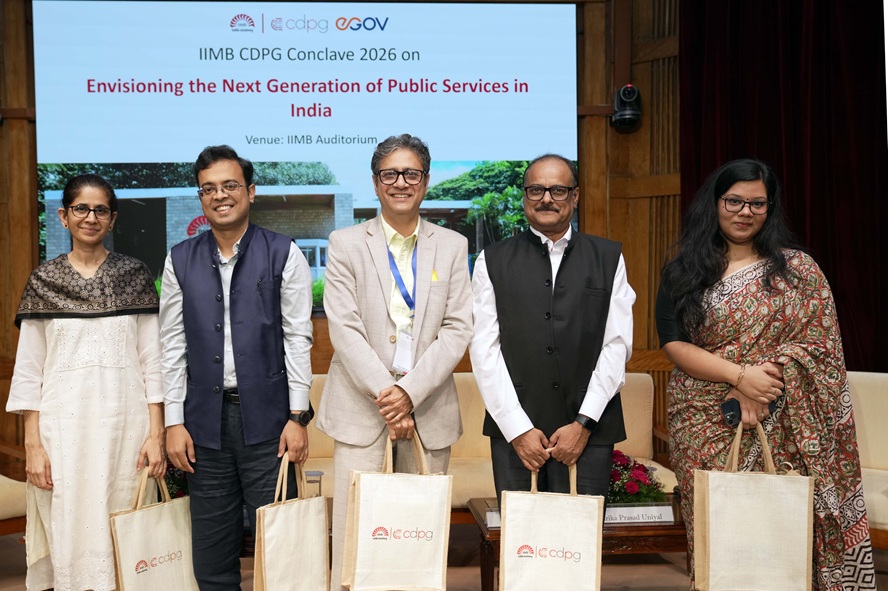
Bangalore: The Center for Digital Public Goods (CDPG) at the IIM Bangalore (IIMB), in partnership with the eGov Foundation, hosted the CDPG Annual Conclave 2026 today at the IIMB campus. Themed ‘Envisioning the Next Generation of Public Services in India,’ the conclave brought together policymakers, industry leaders and academics to examine how Digital Public Infrastructure (DPI), data and artificial intelligence are reshaping public service delivery.
Prof. U. Dinesh Kumar, Director-in-charge, IIMB, delivered the opening address with a call for scrutiny of AI’s promise versus its reality, noting that AI systems are fundamentally probabilistic and inherit the strengths and weaknesses of the data beneath them, citing the Dutch childcare benefits scandal as a reminder of how flawed data can produce serious social consequences.
Delivering the opening plenary, Mr. Viraj Tyagi, CEO, eGov Foundation, examined how trusted data and DPI can transform public services, citing Andhra Pradesh’s DigiT rollout, where service-delivery timelines fell from 114 days in 2016 to 12 days in 2025. “Tech alone is not enough; you need to build local capacity, catalyse the ecosystem, and use digital public goods to facilitate service delivery and co-creation at scale,” he said, adding that AI should support, not replace, human decision-making where welfare and access are concerned.
The day’s discussions unfolded across five sectoral panels.
The first panel discussion as part of the ‘Commerce’ track was moderated by Bachi Allamsetty from Networks for Humanity, with Karthikeyan Arumugam, DIGIIT Business Services; Ravi Haldipur, eSamudaay; and Rishi Agrawal, TeamLease RegTech. The panel coalesced around the view that open digital networks and shared infrastructure are lowering barriers to entry for smaller enterprises, while leaving product innovation and pricing to market forces. Discussions centred on the emerging concept of “Enterprise DPI”, arguing that India’s enterprises, unlike its citizens, still lack a single reusable digital identity, forcing them to navigate a maze of disconnected registrations and compliances.
The second panel on the ‘Education’ track, moderated by Prof. Mukta Kulkarni, Dean, Programmes, IIMB, with Anand Gautam, EkStep Foundation; Ayushi Khare, Indus Action; Prof. Dwarika Prasad Uniyal, RV University; and Harnam Shankar, RightWalk Foundation, shifted the focus towards using DPI and AI to improve scale, access, quality and inclusion in education. The speakers argued that digital academic records must be accompanied by opportunities, scholarships and institutional support that move with the learner, not just the records themselves, while cautioning that legacy government systems, privacy concerns and institutional differences continue to complicate true interoperability. “India needs a kind of revolution to create scale, access and value, a triangle that is very difficult to achieve in higher education,” said Prof. Uniyal.
The third panel on the ‘Agriculture’ track was moderated by Chaitrali Bhoi of CDPG, with Abhishek Sankritik, Finternet; Anilkumar SG, Samunnati; J Satyanarayana, C4IR India, World Economic Forum; and Prashanth Mehra, Platform Commons Foundation. The panel deliberated on how DPI could connect fragmented farmer, land, financial and market data while remaining sensitive to agriculture’s highly local nature. Discussions turned to why many promising agri-tech pilots stall before scaling, with the panel proposing a shift toward household-level data and farmer collectives to unlock greater value across the ecosystem. “Value, technology, ownership and legal support will be the ingredients of great scale,” said J Satyanarayana, calling for “scalability by design”.
The following panel discussion on ‘Healthcare/WASH’ featuring Divya Raj, eGov Foundation, as the moderator, in conversation with Amrita Agarwal, Bill & Melinda Gates Foundation; Johnson Topno, PHIA Foundation; and Prasad Sudhakar, TANUH AI-CoE for Healthcare, IISc, examined the gap between digital innovation and actual health outcomes, citing persistent last-mile challenges such as limited connectivity, workforce shortages and a trust deficit in rural India. The ideas discussed shifted from technology adoption to the design and financing of healthcare systems, with the argument that spending must be judged by outcomes rather than activity alone. “When we start obsessing less about the spend and the activity, and more about outcomes, then we will rewire how the funding is happening”, said Amrita.
The final panel discussion of the day on ‘Financial Services’, moderated by Prof. R Srinivasan, Chairperson, CDPG, IIMB, with Abhisar Sharma, NeSL Asset Data Limited; BG Mahesh, Sahamati; and Ramakrishna NK, Rang De, brought the focus to how account aggregation, combined with non-financial data such as gig-platform transaction records, could widen credit access for MSMEs and first-time borrowers with no formal credit history. Panellists, however, cautioned that these iterative public solutions must be matched by fair pricing and consumer awareness to avoid predatory lending. “For me, in five years, in any form of financial services, irrespective of the licence, it should happen only through AA by design, not through mandate,” said BG Mahesh. Summing up the discussion, Prof. R Srinivasan noted: “We’ve been so focused on responsible lending that we have not focused on responsible borrowing”.
Valedictory address
Mr. V.R. Govindarajan, Co-Founder & Executive Chairman, Perfios, addressed the gathering during a virtual valedictory address. He opened with a bold claim: “This is undoubtedly the best time to be an entrepreneur, especially in India”. Drawing on his own experience as a serial entrepreneur, he said that the DPGs already built in India provide proven and tested infrastructure on which innovative ideas can flourish.
At the same time, he cautioned that consent, privacy, data protection and accessibility must be incorporated by design, rather than addressed retrospectively. He urged innovators not to be discouraged by regulatory considerations and guardrails, but to view them as potential competitive moats and opportunities to discover unique advantages. He also underlined that today’s entrepreneurs can afford to experiment, fail, iterate and develop solutions rapidly.
The Conclave concluded with national student case competition elevator pitches, followed by a valedictory address and the presentation of awards to the winning teams.
