

CFTI Launches Integrated Rural School Transformation Initiative in Osmanabad Aspirational District to Address Dropout and Learning Gaps

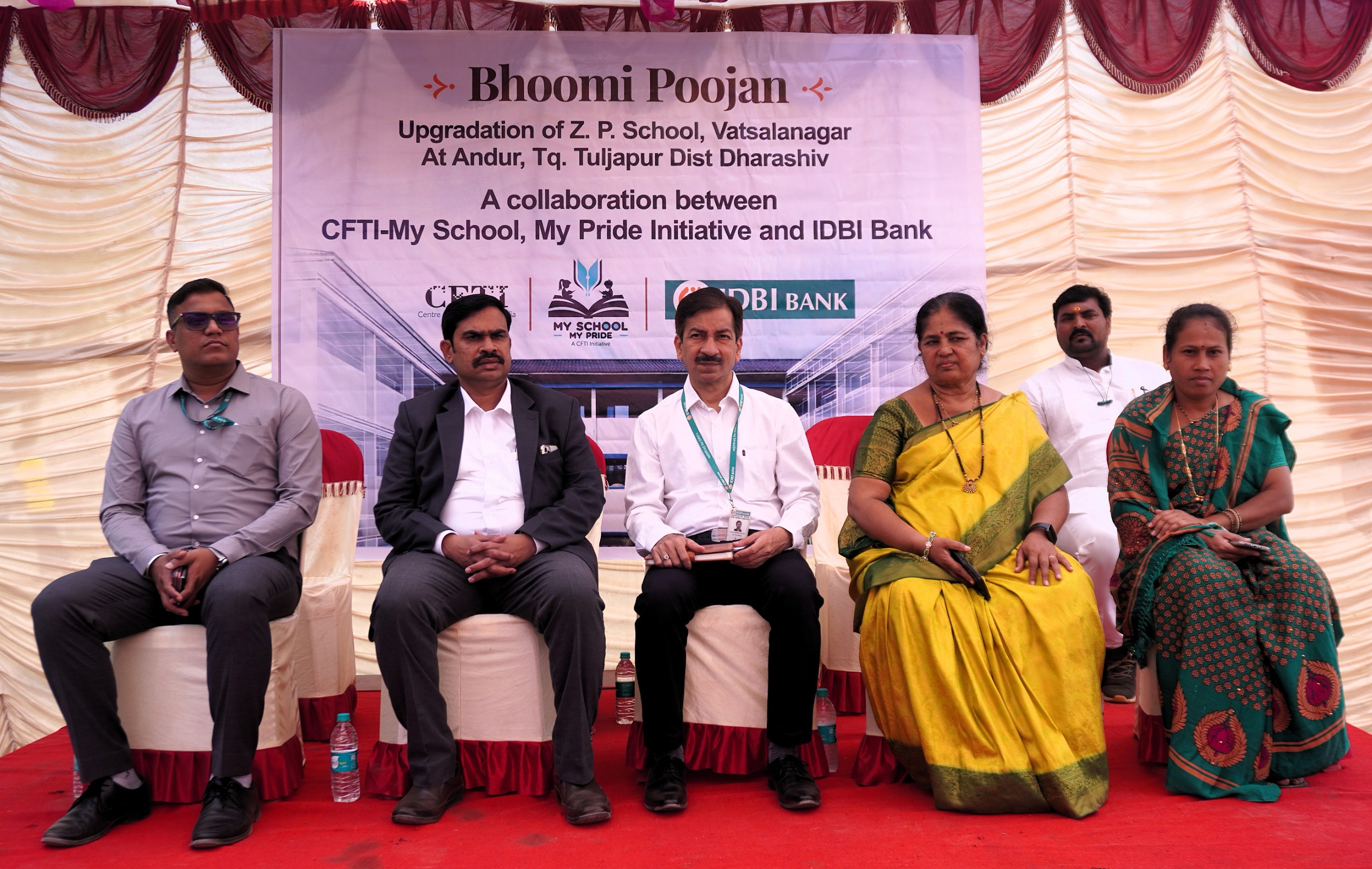
Mumbai, Maharashtra: Centre For Transforming India (CFTI) today announced the launch of its integrated rural education transformation initiative at the Zilla Parishad (ZP) School in Vatsalanagar, Andur, in Osmanabad, Dharashiv — one of India’s Aspirational Districts identified under NITI Aayog. The initiative has been launched in alignment with the key concerns highlighted in NITI Aayog’s recent report, School Education System in India: Temporal Analysis and Policy Roadmap for Quality Enhancement, which points to rising school dropout rates, declining government school enrollment, infrastructure gaps, and widening digital inequalities across India’s education ecosystem.
At the Andur school, students have faced longstanding challenges linked to inadequate educational infrastructure, limited digital learning exposure, sanitation gaps, and mobility barriers, with many children, especially girls, travelling 3–5 kilometers daily to access schooling. Through this intervention, CFTI will develop modern classrooms, science and computer labs, library facilities, sanitation blocks, clean drinking water systems, solar-powered educational infrastructure, and a multi-utility sports complex to create a safer, more inclusive, and future-ready learning environment. Additionally, nearly 300 students will receive bicycles and academic kits under CFTI’s flagship “Pedals of Hope” initiative to improve educational access and strengthen classroom continuity.
The intervention reflects a broader need identified by NITI Aayog’s report, which notes that while India’s school system serves over 24.69 crore students across 14.71 lakh schools, significant gaps continue to persist around foundational learning, retention, digital access, and educational infrastructure particularly across rural and aspirational districts. The Andur initiative has been designed through a structured community participation model involving Gram Panchayat authorities, school management committees, teachers, parents, and local stakeholders to ensure long-term sustainability and measurable impact on attendance, retention, and student participation.
Commenting on the initiative, Amit Deshpande, Chief Operating Officer at Centre For Transforming India, said, “The future of rural education depends on how effectively we bridge infrastructure, accessibility, and learning gaps at the grassroots level. The Andur initiative is designed as a holistic transformation model that combines educational infrastructure, mobility support, digital access, and community participation to create a meaningful and sustainable impact for students. Strengthening school ecosystems at the local level is critical to improving long-term learning outcomes and reducing dropout rates.”
Over the years, CFTI has emerged as a key grassroots implementation partner across education, healthcare, WASH, mobility support, women empowerment, and sports infrastructure development. The organization has supported 144 schools, upgraded more than 90 classrooms, distributed over 35,000 bicycles, provided 1,700+ academic kits, and enabled digital learning access through 100+ computers across multiple community-focused interventions. Through partnerships with corporates and PSUs. As India moves towards equitable and inclusive development, initiatives like these demonstrate how collaborative CSR partnerships and grassroots implementation can collectively transform the future of rural communities — one school, one child, and one village at a time.
About Centre For Transforming India (CFTI)
CFTI (Centre For Transforming India) is a registered non-profit trust established in 2009 under the Indian Trusts Act, 1882, and is recognized by NITI Aayog. Motivated by a core vision to transform the villages in India, the organization seeks to bring dreams to life and give wings to aspirations, thereby transforming their communities and country. CFTI is a grassroots movement organisation, staffed by an enthusiastic network of more than 700 volunteers and supported by a strong technical team, to focus its mission on social development across vital sectors: education, skill development, water and sanitation, women’s empowerment, health, and sports.
CFTI has successfully demonstrated measurable grassroots impact across India with a major focus on Aspirational Districts, through its holistic development approach to strengthen communities at many levels. Its education-focused work continues to remain at the core, with renovation of government schools through the My School, My Pride initiative with modern classrooms, rebuilt toilets, computer and science labs, solar panels, RO systems, sports material, and academic kits. Complementing this, CFTI is strengthening water security in drought-prone Coastal Maharashtra through the construction of check dams in Shenwai to provide year-round clean water, with plans to scale up this successful model to more than 100 villages to address the long-term issue of water scarcity.
Beyond education, CFTI drives community empowerment through women’s skill development programs and SHGs impacting over 5,000 women, alongside sports-led infrastructure initiatives benefiting more than 10,000 people collectively through projects such as the Veshvi basketball court, the Pondicherry court, and a full-fledged sports complex in Nagaon. Having been further strengthened by its COVID-19 relief outreach to 700,000 people, CFTI continues to bridge critical gaps in water, sanitation, livelihood, and infrastructure, delivering sustainable, village-level transformation. Through Project Dhristi, CFTI is restoring vision and dignity for underserved communities by distributing over 1 lakh spectacles and funding numerous cataract surgeries, ensuring clear sight for children, adults, and the elderly alike.
CFTI’s work is powered by a strong network of corporates, PSUs, foundations, and HNIs, enabling it to strengthen critical infrastructure, expand access to education and healthcare, and drive scalable, community-led transformation across underserved regions of India.
