

CPI(M)’s Brazen Assault on ED: Legal Hammer Must Fall on Perpetrators, Leaders and the Party Itself

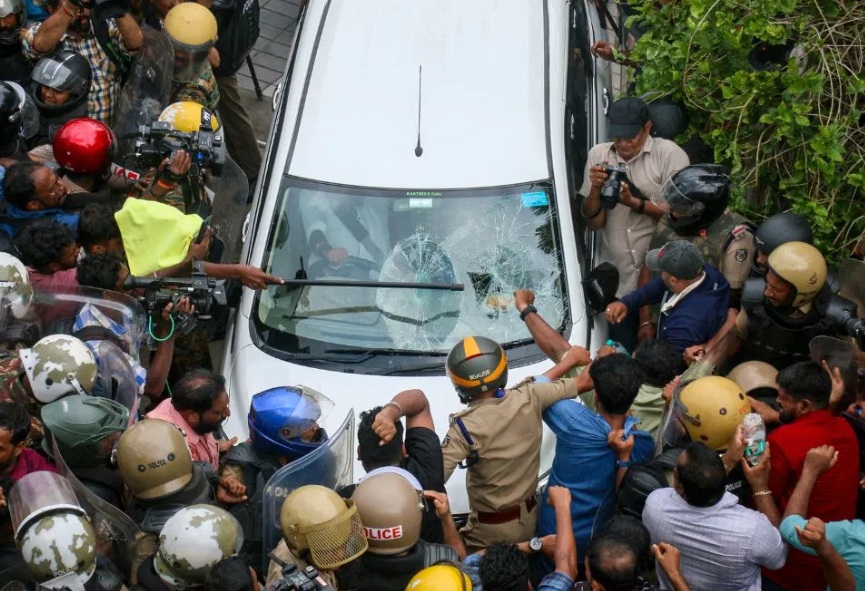
The violent attack on Enforcement Directorate (ED) officials and their vehicles by CPI(M) cadre on May 27, 2026, represents a serious challenge to the rule of law and the functioning of central investigating agencies mandated to probe corruption and money laundering. Reports indicate that party workers surrounded the officials’ convoy following raids connected to a financial probe, pelted stones and other objects, damaged multiple vehicles, and injured officials along with security personnel. This incident goes beyond legitimate protest and amounts to direct obstruction of statutory duties.
From a purely legal perspective, such actions undermine the federal structure of law enforcement in India. The ED operates under the Prevention of Money Laundering Act (PMLA), 2002, and allied statutes to investigate economic offences that frequently have inter-state and international ramifications. Physical assaults on its officers cannot be tolerated as they erode public confidence in anti-corruption mechanisms.
Legal Provisions Applicable to the Incident
Indian law provides clear remedies for such offences. The actions attract several stringent provisions of the Indian Penal Code (IPC):
Section 353 IPC: Assault or criminal force to deter a public servant from discharging official duty. ED officers and accompanying security personnel qualify as public servants.
Sections 332 and 333 IPC: Voluntarily causing hurt or grievous hurt to deter public servants.
Sections 427, 435, and 436 IPC: Mischief causing damage to property, with enhanced punishment where significant loss occurs.
Sections 147, 148, and 149 IPC: Rioting and unlawful assembly, particularly relevant when a group acts with a common objective to obstruct officials.
Under the PMLA, obstruction of officers carries additional consequences. While Section 62 of the PMLA primarily addresses vexatious actions by authorities (punishable with imprisonment up to two years, or fine up to fifty thousand rupees, or both), any deliberate hindrance, evidence tampering, or physical interference during PMLA proceedings can attract supplementary criminal liability. Courts often invoke general penal provisions alongside PMLA to address mob violence and obstruction, ensuring that such acts do not impede the enforcement of anti-money laundering laws. Indian jurisprudence emphasises that interference with central agencies performing lawful functions violates constitutional principles of cooperative federalism.
The reported inaction of state police during the violence on May 27, 2026, raises serious concerns. Under Section 149 of the Code of Criminal Procedure (CrPC), police are duty-bound to prevent cognizable offences. Dereliction in protecting central officers may invite departmental action, inquiries under the Police Act, 1861, or even contempt proceedings where judicial oversight exists. Precedents from various High Courts emphasise that state machinery cannot remain passive when central investigating agencies face mob obstruction.
Holding Individuals, Leaders, and the Party Accountable
Legal accountability must be pursued at multiple levels without political consideration.
Perpetrators at the ground level must face immediate and rigorous prosecution. Video footage, eyewitness testimonies, and forensic examination of damaged vehicles should form the core of the evidence. Given the brazen nature of the attack, investigating agencies must oppose bail strongly to prevent further intimidation. Swift filing of a chargesheet with all applicable sections is essential.
Party leaders carry significant responsibility where there is material to show incitement, mobilisation of cadre, or failure to exercise control despite foreseeable violence. Abetment provisions under Sections 107 and 108 IPC may apply to those whose public statements or organisational directions contributed to the unrest. Leaders present at or near the site who did not disperse the crowd could face liability under unlawful assembly laws. Indian jurisprudence, including rulings on public order, holds that those in positions of authority cannot distance themselves when cadre under their influence resort to violence.
The party as an organisation operates under the protections of Article 19(1)(c) of the Constitution, which guarantees the right to form associations. However, these freedoms are subject to reasonable restrictions in the interest of public order and sovereignty. While outright derecognition of a national party is an extreme measure exercised by the Election Commission under its powers, repeated instances of cadre violence against constitutional institutions provide strong grounds for scrutiny. The Representation of the People Act, 1951, allows action against parties and candidates involved in criminal activities. If investigations establish that the attack reflected an organisational pattern rather than isolated rogue elements, the Election Commission may examine whether the party’s functioning violates constitutional values. Legal experts note that such steps require robust evidence and judicial review, but the incident on May 27, 2026, supplies prima facie justification for a formal inquiry into the party’s role.
Recommended Actions and Broader Implications
To uphold the rule of law, the following steps are imperative:
Registration of a comprehensive FIR incorporating all relevant sections against identified individuals and unnamed persons.
Transfer of the case to an independent agency or court-monitored investigation to ensure impartiality, especially given the state police’s reported passivity.
Invocation of central agencies like the National Investigation Agency (NIA) if the incident is found to have anti-federal dimensions.
Disciplinary proceedings against police officials who failed to intervene.
Protection measures for ED officers and witnesses in the underlying money laundering case.
This attack on federal investigators carries dangerous implications for anti-corruption efforts across the country. When political parties use street power to obstruct probes into financial irregularities involving public figures, it signals that accountability can be thwarted through muscle. Such incidents weaken the federal structure and discourage honest enforcement of laws against economic offences.
The state government has a constitutional duty to facilitate, not hinder, lawful investigations. Failure to act decisively not only emboldens violators but may necessitate central intervention, including additional security deployment. All political parties, including the CPI(M) — which has governed the state in the past — must reaffirm commitment to constitutional norms by allowing agencies to function without physical intimidation.
In India’s democratic framework, no individual, leader, or party stands above the law. The assault on May 27, 2026, tests the commitment of institutions to this principle. Decisive legal action — including prosecution of perpetrators, examination of leadership roles, and organisational scrutiny — is essential to deter future attacks. Courts will ultimately determine guilt based on evidence, but the executive must demonstrate zero tolerance for hooliganism against authorities investigating corruption and money laundering. Anything less would undermine the foundational promise of equal justice and the integrity of federal investigative processes.
