

From the shopfloor to the university: Vijaybhoomi University and NTTF create a new pathway for India’s manufacturing workforce

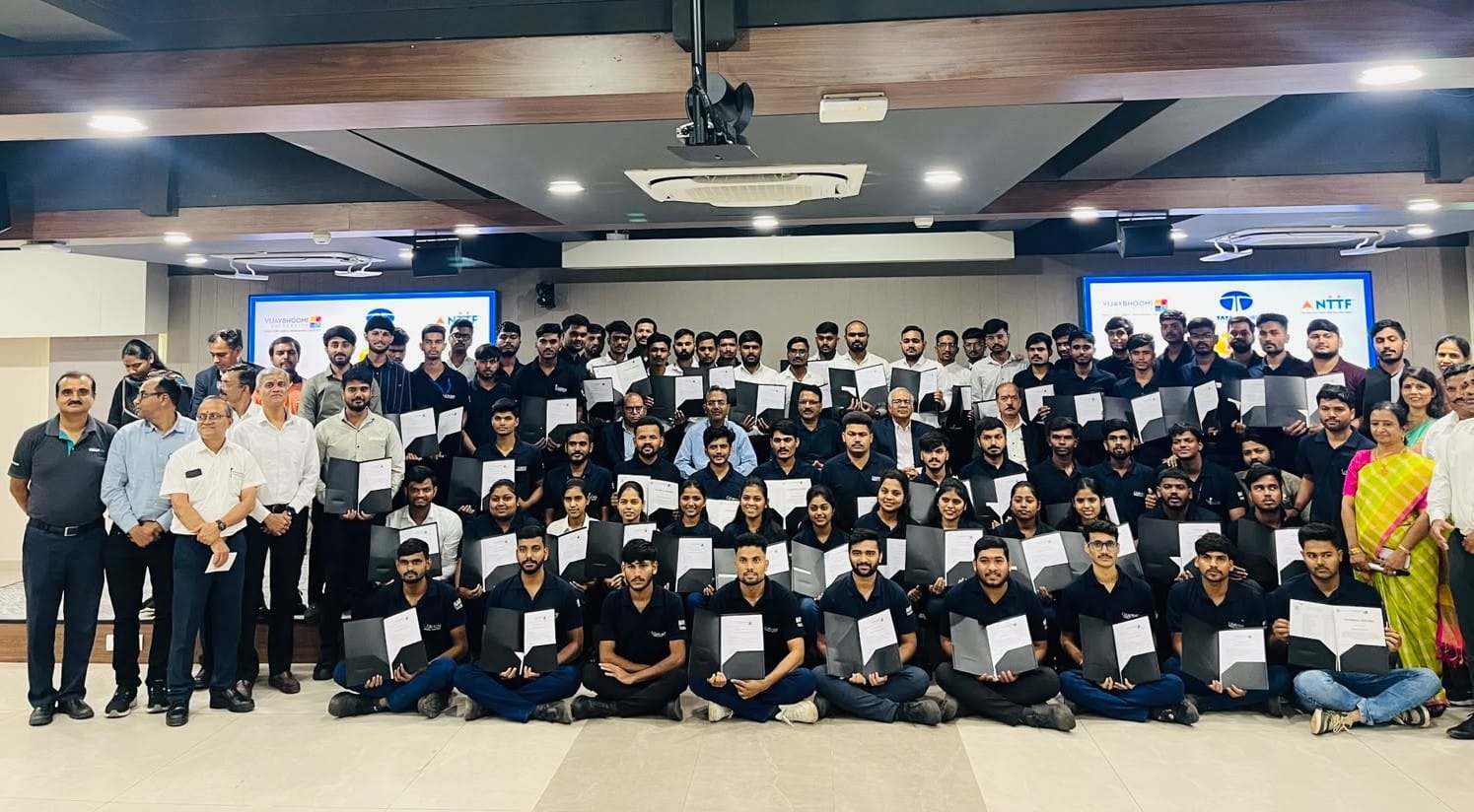
Pune; Inside Tata Motors’ Pimpri-Chinchwad manufacturing plant, the familiar sounds of production briefly gave way to an academic ceremony. Wearing the same safety helmets they use during their shifts, employees and apprentices walked across a convocation stage to receive their Technical Diploma in Mechatronics, jointly awarded through the partnership between Vijaybhoomi University and the Nettur Technical Training Foundation (NTTF).
The ceremony represented something larger than the award of diplomas.
For decades, vocational training and university education have largely existed as separate systems. Under the National Education Policy 2020, India has committed itself to bringing these two worlds together through credit recognition, flexible learning pathways and work-integrated higher education. The collaboration between Vijaybhoomi University and NTTF is one practical example of that vision becoming operational.
Under the academic partnership signed earlier this year, learners who successfully complete NTTF’s Mechatronics programme are awarded a university-recognised Technical Diploma aligned with the National Higher Education Qualification Framework. Those who wish to continue can progress to an Advanced Technical Diploma and subsequently to a B.Tech in Mechatronics through flexible study pathways while remaining in employment.
Rather than asking experienced technicians to leave their jobs to pursue higher education, the programme allows higher education to meet learners where they already are i.e. inside the workplace.
Speaking on the occasion, Mr. Sanjay Padode, President, Vijaybhoomi University, said:
“A university should recognise learning wherever it genuinely happens. Many of these learners have developed advanced technical capability on the shopfloor through structured training and disciplined practice. Our role is to connect that learning with nationally recognised higher education so that they can continue to grow academically without stepping away from their careers.”
Mr. Ravi Tennety, Managing Director, NTTF, said:
“For more than sixty years, NTTF has prepared young people for careers in manufacturing and technology. This partnership gives our learners an opportunity to build on that foundation through formal higher education while continuing to contribute to industry. It creates new possibilities for lifelong learning.”
Prof Ravikesh Srivastava, Vice Chancellor, Vijaybhoomi University added:
“India has spoken for many years about integrating skills, industry and higher education. What we are seeing today is one working model of how that integration can happen in practice. It is built on academic quality, industry relevance and learner mobility.”
Mr. Sitaram Kandi, Chief Human Resources Officer, Tata Motors, said: “Manufacturing is changing rapidly, and so must the way we develop our people. Technical skills acquired on the shopfloor deserve opportunities for continuous academic progression, without requiring employees to step away from work. This collaboration between Tata Motors, NTTF and Vijaybhoomi University creates a pathway where learning, work and career advancement reinforce one another. It recognises that capability is built not only in classrooms but also through disciplined practice, problem-solving and real production environments. By enabling our employees and apprentices to earn nationally recognised university qualifications while continuing to contribute on the shopfloor, we are investing not only in individual growth but also in building a future-ready manufacturing workforce for India.”
The partnership has been designed with long-term academic oversight. Vijaybhoomi University and NTTF have jointly established mechanisms for curriculum review, quality assurance and continuous progression, ensuring that industry training and university standards remain closely aligned as future cohorts enter the programme.
As India seeks to expand opportunities for lifelong learning and strengthen advanced manufacturing capabilities, collaborations of this nature demonstrate how universities, industry and specialised skill institutions can together create educational pathways that are flexible, credible and closely connected to the needs of the economy.
