

Gen Z Is Seeking Hair Transplants Earlier: Social Media and Early Hair Loss Drive Growing Demand — Experts Warn

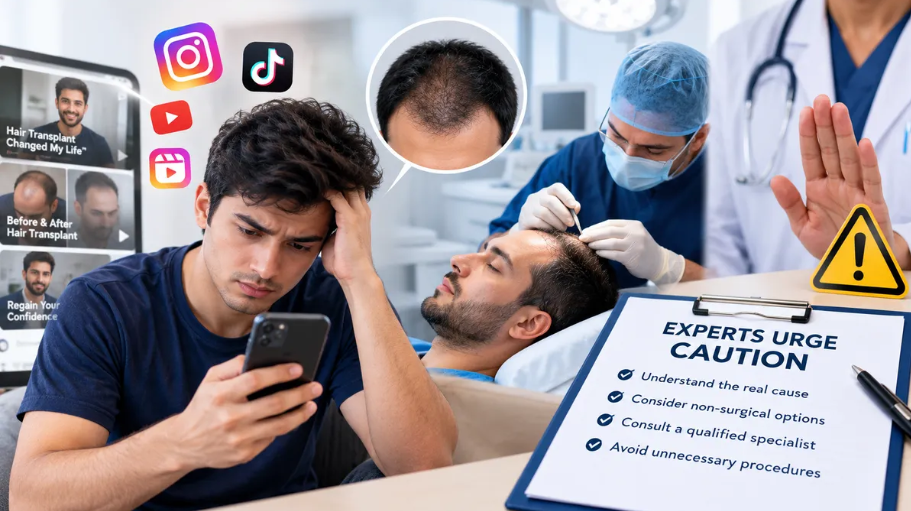
New Delhi: Hair loss, once largely associated with middle age, is increasingly becoming a concern among younger adults, with dermatologists and hair-restoration specialists reporting a growing number of enquiries from patients in their early 20s seeking solutions for receding hairlines, thinning hair and hair transplantation. Experts say the trend is being driven by two factors — genuine cases of early-onset hair loss and growing appearance consciousness fuelled by social media, where young people are constantly exposed to highly curated images of “perfect” hairlines.
Dr. Gaurav Garg, Senior Dermatologist, Hair Transplant Surgeon and Medical Director, Dermalife Skin and Hair Clinic, New Delhi, said . “We are seeing a clear increase in enquiries from younger patients, including those in their early 20s, asking about hairline restoration and hair transplantation. Social media has changed how young people perceive their appearance — a slightly receding hairline that may previously have been accepted as a normal variation is now noticed, photographed and compared with celebrities and influencers. At the same time, we are seeing genuine cases of early-onset hair loss. However, wanting a transplant does not automatically mean that a young patient is ready for one; the cause, pattern and likely progression of hair loss must first be assessed,”.
Research also indicates that androgenetic alopecia, commonly known as male-pattern hair loss, can begin considerably earlier than traditionally expected. A 2024 review reported prevalence estimates for early-onset androgenetic alopecia ranging from 19.2% to 57.6% across different populations, depending on the population and definition used. An Indian study published in 2025 involving 99 patients with early-onset androgenetic alopecia found that the 20–25-year age group represented the largest proportion, with a mean age of approximately 24.8 years. More than half of the participants also reported a family history of the condition.
The growing influence of social media may be adding another layer to the problem. Photographs, short-form videos, video calls and appearance-focused content have made hairlines an increasingly visible part of facial aesthetics. Highly styled or curated images of celebrities, influencers and peers can create unrealistic expectations about what a “perfect” hairline should look like. For some young people, even early recession or a naturally high hairline can therefore become a significant appearance concern, prompting them to explore permanent solutions at a much younger age.
Dr. Garg further said, “As a general principle, we are very cautious about recommending a hair transplant before the age of 25 because the hair-loss pattern may still be evolving. Once the pattern has stabilised, the outcome becomes more predictable and the hairline can be planned according to the patient’s long-term needs. A transplant should not simply recreate the hairline a young person wants today; it has to be designed for how it will look years later. In younger patients, diagnosis, monitoring and appropriate non-surgical treatment should therefore come before considering surgery.”
Hair-transplant guidelines similarly recommend careful assessment of younger patients because continued loss of non-transplanted hair can affect the long-term aesthetic result. Age alone is not the deciding factor; doctors also consider the diagnosis, stability and progression of hair loss, family history, donor-hair availability and the patient’s expectations.
