

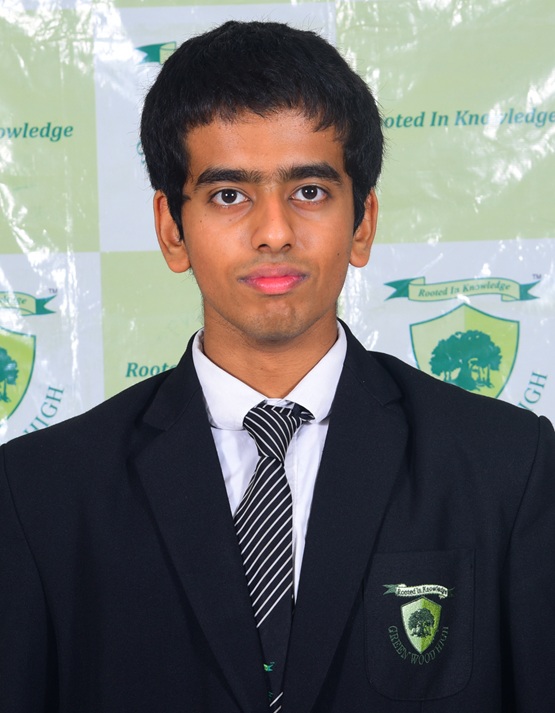
Bangalore : Greenwood High continues to celebrate the remarkable achievements of its alumni on the global stage. Demonstrating the spirit of innovation, academic excellence, and research-driven learning fostered at the school, its Alumni – Rishikesh Madhuvairy (Class of 2025), a freshman at Rice University, and Rahul Prabhu (Class of 2024), a sophomore at Purdue University – secured First Place in the Poster Competition at Purdue University’s AI Research Showcase 2026, held recently. The event brought together leading researchers, industry experts, and students to present groundbreaking advancements in artificial intelligence and its real-world applications.
The award-winning project focused on developing an AI-powered defect detection model for semiconductor wafers, addressing one of the most critical challenges in semiconductor manufacturing. By leveraging advanced artificial intelligence techniques, the model is designed to identify microscopic defects with greater speed and accuracy, helping improve chip quality, manufacturing efficiency, and overall reliability of semiconductor devices.
Semiconductors are the backbone of modern technology, powering everything from smartphones and computers to automobiles and advanced medical devices. As chip manufacturing becomes increasingly sophisticated, even the smallest defect can impact performance and production yield. AI-driven defect detection is emerging as a transformative solution for the industry, enabling faster and more precise quality control. Research and industry initiatives worldwide are increasingly exploring AI-based approaches to improve semiconductor inspection and manufacturing outcomes.
Rishikesh and Rahul’s paper “Fusing Handcrafted spatial descriptors with a lightweight CNN for Semiconductor wafer Map Detection Classification” explained the classification of defects in 2D semiconductor wafers and traces, where they originate in the manufacturing process.
“The premise for our entire project was to create a way to automate the prediction and classification of these defects that occur on a regular basis,” said Rishikesh Madhuvairy. Our model could further be integrated into a yield intelligence platform that can tell quality control engineers where and how, spatially speaking, defects are arising in silicon wafers.”
“Combining statistics with computer vision models is not new,” said Rahul Prabhu. “But applying it to semiconductor defect classification with this kind of industry dataset is.”
While current state-of-the-art defect detection technology uses complex algorithms with data processed offsite, Madhuvairy and Prabhu propose a high-accuracy, low-latency model that can be implemented onsite within the lab. A unique aspect of the model is its use of eight spatial descriptors that identify where defects appear on the wafer and whether they occur in clusters or isolation. By introducing these spatial descriptors and training a convolutional neural network – a deep learning model designed for processing visual data – they identified and classified semiconductor defects with nearly 13% more accuracy than the basic computer vision model.
Interdisciplinary collaboration was key to the success of this project. “I came to this project not knowing much about the computer vision aspect,” said Madhuvairy. I brought the theoretical knowledge of spatial classification, but to apply it in a commercial use model, then you need skills to develop the vision model. Rahul’s expertise really came through as he took the reins of that part of the project, and I learned a lot from him.”
“Congratulations to Rishikesh Madhuvairy and Rahul Prabhu on this outstanding achievement and for making Greenwood High proud on the international stage. The success of our students stands as a testament to Greenwood High’s vision of shaping future-ready leaders, innovators, and changemakers. Their accomplishment serves as an inspiration to current students, demonstrating how a strong educational foundation, combined with passion and perseverance, can lead to extraordinary achievements on the global stage” said Niru Agarwal, Managing Trustee, Greenwood High International School, Bengaluru.
For Madhuvairy, this semiconductor vision model project is rooted in his passion for device physics. He has a number of other projects on the horizon, with applications ranging from renewable energy to wearable medical devices.
Long-term plans for their project include elevating the capacity of their current model, integrating their model into a physical setup, and exploring pathways to commercialization.
As Greenwood High celebrates this milestone, the school takes immense pride in seeing its alumni contribute to advancements in emerging technologies that have the potential to shape the future of industries worldwide.
