


By Suresh Unnithan
In a seismic escalation of Middle East tensions, Iran has sealed off the Strait of Hormuz following devastating joint US-Israeli airstrikes that eliminated Supreme Leader Ayatollah Ali Khamenei and crippled key military assets. This bold Iranian retaliation threatens to choke 20% of the world’s oil supply, sending shockwaves through global markets and risking skyrocketing prices, inflation surges, and economic turmoil. Here’s a direct breakdown of the immediate and potential impacts, updated with the latest developments as of March 1, 2026.
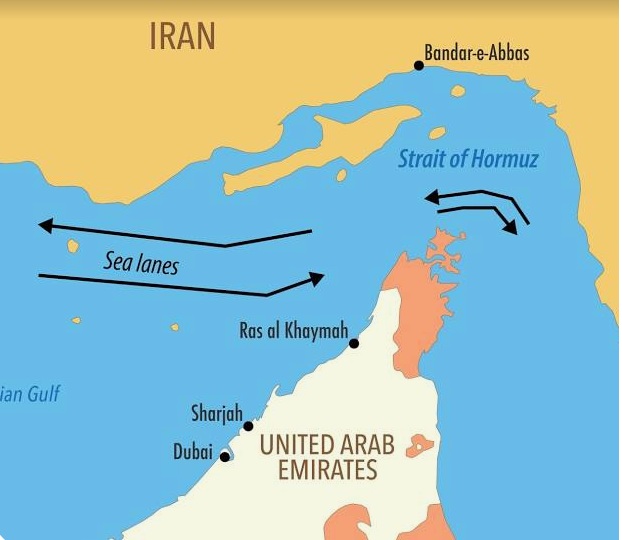
Following the escalation of joint military strikes by the United States and Israel, Iran has closed the Strait of Hormuz on February 28, 2026. The attacks, dubbed Operation Epic Fury by the U.S. and Roaring Lion by Israel, targeted Iran’s leadership, missile infrastructure, and military facilities, resulting in the confirmed killing of Supreme Leader Ayatollah Ali Khamenei and other key figures. Iran’s Revolutionary Guard Corps (IRGC) responded by broadcasting VHF radio warnings that “no ships would be allowed to pass,” leading to a sharp drop in vessel traffic, with tankers diverting and major shipping companies suspending operations. This narrow waterway, just 21 miles wide at its narrowest point, handles about 20% of global oil supplies and a significant portion of liquefied natural gas (LNG) exports. The closure threatens to unleash intense economic disruptions worldwide. This article examines the potential fallout, with a particular focus on India, the Gulf countries, Russia, and China, incorporating the latest reports on tanker diversions, price forecasts, and geopolitical responses.
Global Oil Market Shock
The Strait of Hormuz is the world’s most critical energy chokepoint, facilitating the export of roughly 20 million barrels per day (bpd) of crude oil, condensate, and refined products from major producers like Saudi Arabia, Iraq, the UAE, Kuwait, and Qatar. With the strait now “practically closed,” as described by Iranian media, oil tanker traffic has plummeted by 70%, trapping dozens of vessels inside the Persian Gulf. Analysts warn that a prolonged disruption could spike Brent crude prices to $120–$150 per barrel in the short term, potentially reaching $180–$200 if sustained, dwarfing the 2022 spike following Russia’s invasion of Ukraine. As of March 1, with markets closed for the weekend, Brent crude last settled at around $72-73 per barrel, but experts predict a $20+ jump when trading resumes on Monday unless de-escalation occurs.
Such price surges would accelerate global inflation by 2–4 percentage points, hitting transportation, manufacturing, and consumer goods hardest. In a worst-case scenario lasting over 30 days, the probability of a global recession exceeds 75%, with GDP contractions of 1.5–3% in major economies. Hoarding by importers, skyrocketing insurance premiums (up to 50% hikes), and rerouting via alternative pipelines—like Saudi Arabia’s East-West pipeline (capacity: 5–7 million bpd) or the UAE’s Abu Dhabi-Fujairah line (1.5 million bpd)—offer limited relief, covering only about 8 million bpd combined. Strategic petroleum reserves (SPRs) worldwide could buffer for up to two months, but exhaustion would exacerbate the crisis. LNG shipments are also severely impacted, with several tankers turning away and Qatar’s exports at risk.
India’s Vulnerability: A Blow to Energy Security and Growth
India, the world’s third-largest oil importer, relies on imports for about 90% of its crude needs, totaling 5.5 million bpd. Roughly 50% of these imports—2.5–2.7 million bpd—transit through the Strait of Hormuz, primarily from Iraq, Saudi Arabia, the UAE, and Kuwait. This dependence has grown recently as Indian refiners shifted away from Russian volumes due to sanctions, increasing reliance on Middle Eastern suppliers.
A closure could trigger immediate shortages, forcing India to diversify to costlier alternatives like West African or U.S. crude, inflating freight and insurance costs. Oil prices could surge 20–40%, exacerbating India’s trade deficit (already strained by energy imports) and fueling inflation. The Reserve Bank of India might delay interest rate cuts, stifling economic growth projected at 6.5–7% for 2026. Non-oil exports worth $47.6 billion, including to Gulf nations, could face delays and higher costs. Contingency measures, such as tapping India’s 5.3 million metric ton SPR or boosting Russian imports (despite logistical hurdles), may mitigate short-term pain, but prolonged disruption risks a broader economic slowdown. With the strait still closed as of March 1, Indian officials are monitoring for potential fuel price hikes that could hit consumers hard in regions like Kerala.
Gulf Countries: Export Paralysis and Revenue Crunch
The Gulf Cooperation Council (GCC) nations—Saudi Arabia, UAE, Kuwait, Qatar, Bahrain, and Oman—are the most directly exposed, as nearly all their oil and LNG exports pass through Hormuz. Saudi Arabia alone exports 6–7 million bpd via the strait, representing a massive chunk of its revenue. A full closure strands their spare capacity (2–3 million bpd combined for Saudi Arabia and UAE), halting shipments and causing immediate fiscal strain.
For oil-dependent economies, this means sharp revenue drops: Saudi Arabia could lose billions weekly, threatening Vision 2030 diversification projects. Qatar, the world’s third-largest LNG exporter, relies entirely on Hormuz for shipments, risking contracts with Asian buyers and economic contraction. Smaller states like Kuwait and Iraq, lacking bypass options, face total export halts. Tourism and finance sectors in the UAE and Bahrain could suffer from regional instability, with investors fleeing amid heightened risks. Ironically, higher global prices might offset some losses if partial flows resume, but prolonged closure could ignite domestic unrest and strain alliances with the U.S.
Russia’s Opportunity
Russia, a non-Gulf oil exporter producing over 10 million bpd, stands to benefit from elevated prices. With exports rerouted via pipelines to Europe and Asia, or tankers avoiding Hormuz, Russia could capture market share from stranded Gulf supplies. A $10–$20 per barrel increase could boost Russia’s revenues by billions, aiding its war economy in Ukraine and offsetting Western sanctions.
However, risks loom: A global recession from sustained high prices could dampen demand, hurting Russia’s export volumes. Geopolitically, Russia might support Iran diplomatically or militarily, but economic self-interest could temper involvement. Overall, short-term gains are likely, potentially strengthening the ruble and funding military efforts, but long-term volatility could undermine stability.
China’s Predicament
As the largest oil importer, consuming 15 million bpd, China receives about half its crude via Hormuz—primarily from Saudi Arabia, Iraq, and Iran (90% of Iran’s exports go to China). A closure disrupts 10% of its imports, including “shadow fleet” shipments from Iran. With a vulnerability score of 4.4 (behind Japan and South Korea), China faces higher factory and fuel costs, threatening its manufacturing-driven growth.
Diversification via pipelines from Russia and domestic production offers some buffer, but price spikes to $130 per barrel could fuel inflation and slow GDP growth. LNG imports, 83% of which transit Hormuz, add pressure on energy security. Beijing may accelerate SPR drawdowns or boost Russian ties, but antagonizing Iran risks diplomatic fallout. Long-term, this could hasten China’s shift to renewables, reducing Middle East dependence.
Pathways to Resolution or Escalation
The Hormuz closure marks a perilous turn in Middle East geopolitics, with economic stakes rivaling historic oil shocks. While U.S. and Israeli strikes aim for regime change, Iran’s asymmetric response could prolong the crisis, testing global resilience. Diplomatic interventions by China, Russia, or Gulf states may reopen the strait, but military escalation risks broader war. Some experts note that fully closing the strait is challenging, as shipping lanes pass through Omani waters, and Iran would harm its own exports to China. For India, the Gulf, Russia, and China, adaptation strategies—diversification, reserves, and alliances—will be crucial. The world watches as this chokepoint holds the global economy in its grip, with the U.S. Navy potentially enforcing freedom of navigation soon.
*Research by Nanditha Subhadra
