


By Suresh Unnithan& Nanditha Subhadra
President Donald Trump has thrust the United States into one of its most audacious military campaigns in decades, launching Operation Epic Fury on February 28, 2026, with a direct message to the Iranian people: the regime’s time is up.
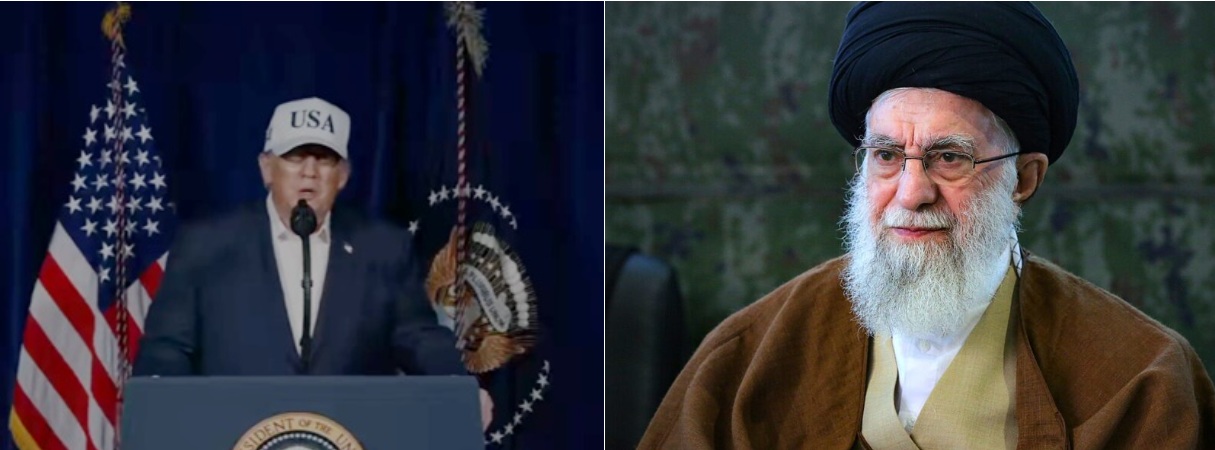
In an eight-minute video posted on Truth Social in the early hours of Saturday morning, Trump announced “major combat operations” against Iran, confirming the death of Supreme Leader Ayatollah Ali Khamenei in joint U.S.-Israeli strikes and urging Iranians to “take over your government.” He framed the assault as a necessary strike to eliminate “imminent threats” from a “vicious” regime, destroy its nuclear ambitions, missile arsenal, proxy networks, and navy—while explicitly calling for internal regime change. Iranian state media later confirmed Khamenei’s death, along with dozens of senior officials (including reports of his daughter and grandchild among casualties in some accounts), in attacks that targeted Tehran and other key sites. As of March 1, 2026, the Iranian cabinet has declared a 40-day mourning period and a week of public holidays.
The operation, coordinated with Israel (which dubbed its portion Operation Roaring Lion or Raging Lion in some reports), follows failed Geneva talks on February 26 and builds on earlier U.S. strikes against Iranian nuclear facilities in June 2025. It exploits domestic protests in Iran over economic hardship and clerical rule, aiming to pressure the regime into collapse from within. Trump has described having multiple “off ramps,” telling Axios he could “go long and take over the whole thing” or end it quickly, emphasizing recovery would take Iran years.
Historical and Strategic Context
This move echoes past U.S.-led regime-change efforts—such as Iraq in 2003, Syria’s civil war fallout, and the rapid ousting of Venezuela’s Nicolás Maduro in January 2026—but Iran presents far greater challenges. It boasts advanced precision missiles, drone swarms, uranium enriched to near-weapons-grade levels (60%, with U.S. estimates suggesting a potential nuclear device in 3-8 months), and alliances with Russia and China through frameworks like BRICS and SCO. Iran denies weaponization intent but pursues long-range ICBM capabilities projected by 2035.
Trump positions the strikes as fulfilling “America First” by neutralizing threats without endless occupation. However, critics—including some Republicans—argue it contradicts his no-new-wars pledges. Rep. Thomas Massie and Sen. Rand Paul have called the action unconstitutional without congressional approval, while Tucker Carlson labelled it “disgusting and evil.” Former Vice President Kamala Harris termed it an “unnecessary gamble.” Public polls show rising opposition if the conflict prolongs, with potential GOP fractures and protests in cities like Philadelphia. Congressional leaders plan war powers resolution votes next week, as Sen. Mark Warner warns of risks for broader regional war. As of March 1, bipartisan demands have intensified: Sen. Tim Kaine (D-VA), with support from Minority Leader Chuck Schumer and others, is pushing for an immediate Senate vote on a War Powers Resolution to block further unauthorized hostilities, citing zero advance notice beyond a brief Gang of Eight briefing.
In the first 12 hours alone, the U.S. military conducted nearly 900 strikes from land, air, sea, and drones, defending against hundreds of incoming Iranian ballistic missiles while targeting leadership, missile production, military installations, and nuclear remnants.
Economic and Global Impacts
U.S. national debt hit $38.43 trillion in January 2026 (over 101% of projected GDP), with FY2026 deficits at $1.9 trillion and climbing. A sustained conflict could add trillions, akin to Iraq’s costs. Buildup expenses already exceed $1 billion since December, with daily operations around $30 million.
Oil markets surged immediately—Brent crude reached $72.48 on launch day, closing at around $72.87-$72.80 pre-weekend amid war fears—and analysts now forecast sharper spikes when trading resumes. Barclays and others predict $80 per barrel on material disruptions, with potential jumps to $90-$100 or even $140 if Iran closes the Strait of Hormuz (20% of global oil flows, 20 million barrels daily). Eurasia Group and Rystad Energy warn of $5-10 immediate increases, or more with tanker traffic issues, pushing U.S. gas prices well above $3/gallon nationally. Inflation could rise 0.6-0.7%, stalling U.S. growth (projected 2.5-2.8% for 2026) and raising recession odds, per Goldman Sachs. Iran’s output (3.3 million bpd crude + 1.3 million bpd condensate, ~4.5% global supply) amplifies the stakes, reviving debates over resource motives tied to Trump’s past “take the oil” comments.
A fleeting diplomatic opening via Oman on February 28—where Iran reportedly agreed to zero enriched uranium stockpiling—collapsed hours before strikes began.
Potential Escalation and International Involvement
Iran retaliated February 28 with missiles targeting U.S. bases in Bahrain, Saudi Arabia, Iraq, Kuwait, Qatar, and the UAE (including Al Udeid), plus Israeli sites. As of March 1, no U.S. casualties reported yet, but explosions occurred in densely populated areas, with one death from debris in the UAE and reports of hits in Jordan. Kuwait warned of its “right to defend itself.” Iran has vowed “decisive” self-defense at the UN and the “most devastating offensive” yet. U.S. responses include naval escorts, asset strikes, and mine countermeasures, echoing 1980s Earnest Will operations, with carriers like USS Gerald R. Ford deployed and ongoing “heavy and pinpoint bombing” promised “as long as necessary.”
Russia and China supply Iran arms (drones, air defenses) and conduct joint exercises but lack binding defense pacts. Escalation could involve proxies, cyberattacks, or blockades, potentially globalizing the conflict. The UN warns of a “grave threat to peace,” and Israel declared a state of emergency.
If asymmetric warfare or Strait closure occurs, Saudi Arabia, UAE, and Israel face engulfment, with oil disruptions, refugee crises, and terrorism risks.
Supporters see the strikes as preventing a nuclear Iran and catalyzing change, highlighting targeted pressure on a resilient but vulnerable state. Detractors stress historical regime-change pitfalls, economic strain, and risks of isolation or quagmire. With no confirmed Iranian nuclear warheads, success depends on rapid containment and diplomacy.
