


By Nanditha Subhadra
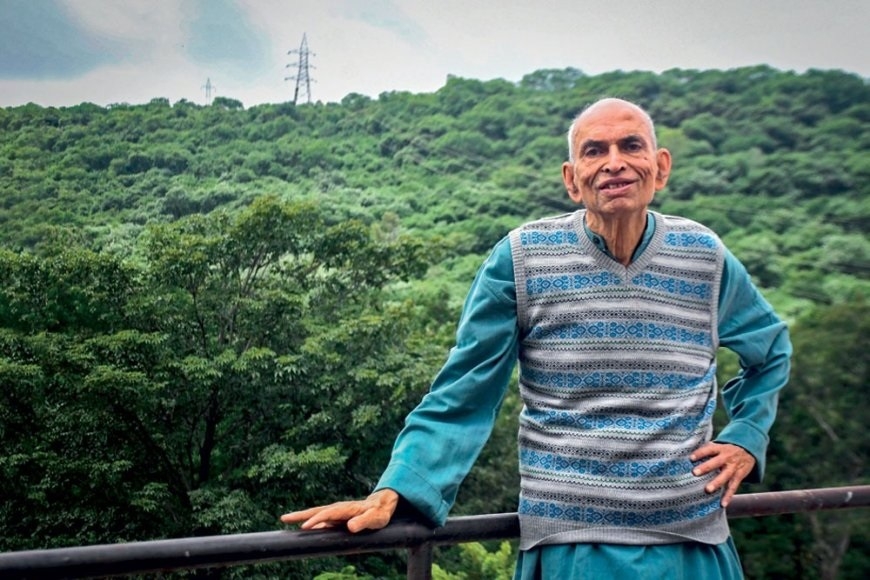
In the annals of India’s environmental history, few names resonate with the intellectual rigour, moral courage, and unwavering commitment to democratic principles as that of Dr. Madhav Gadgil. A pioneering ecologist, a distinguished academic, and a public intellectual par excellence, Gadgil has spent over half a century not just studying India’s natural world, but fighting to give it—and its most vulnerable human custodians—a voice.
Born in 1942 in Pune, Maharashtra, into a family of science (his father was a renowned mathematician and mother a doctor), Gadgil’s path seemed destined for academic excellence. After a B.Sc. and M.Sc. from Pune’s Fergusson College, he earned his Ph.D. in biology from Harvard University, where he was exposed to a new, emerging field: theoretical ecology. He returned to India not just with a doctorate, but with a revolutionary question: How could scientific understanding of ecosystems be merged with the traditional wisdom of the communities who lived within them?
The answer would shape his life’s work. Joining the Indian Institute of Science (IISc), Bangalore, where he would serve for decades, Gadgil moved beyond the confines of the laboratory. He championed a radical idea: that the people most dependent on an ecosystem were not its exploiters, but its most knowledgeable and rightful protectors. This philosophy found its most powerful expression in his concept of the “People’s Biodiversity Register” (PBR), a grassroots initiative to document local ecological knowledge, from medicinal plants and crop diversity to sacred groves and water sources. The PBR was a masterstroke, democratizing science and empowering communities to become active participants in the conservation of their own environment.
Gadgil’s most defining—and contentious—contribution to national policy came as the Chairman of the Western Ghats Ecology Expert Panel (WGEEP) in 2010. The resulting “Gadgil Report” was a landmark document. It proposed a scientifically robust, granular, and sensitive model for conserving the fragile Western Ghats, a UNESCO World Heritage site. Its core recommendation was to classify the region into different ecological sensitivity zones based on a ground-up, consultative process, giving local communities (Gram Sabhas) a decisive say in its management.
The report was met with fierce political and corporate resistance, with powerful lobbies branding it as “anti-development.” In a move that environmentalists saw as a tragic dilution, the government appointed another panel, which produced the less stringent Kasturirangan Report. Yet, the Gadgil Report remains a gold standard for environmental governance in India—a testament to what is possible when science is guided by conscience and a deep respect for democracy. For Gadgil, it was another chapter in a long battle against the “resource grab” by the powerful at the expense of the poor and the planet.
His contributions have been decorated with the nation’s highest honours, including the Padma Shri and the Padma Bhushan, along with the Shanti Swarup Bhatnagar Prize for Biological Sciences. But his true legacy lies not in awards, but in the minds he has influenced and the debates he has forced upon the nation. He has mentored generations of ecologists who now carry forward his unique blend of scientific inquiry and social justice.
Today, as India stands at a critical juncture in its development journey, grappling with climate change and biodiversity loss, the work of Madhav Gadgil is more relevant than ever. He is a living reminder that ecology is not just about flora and fauna; it is intrinsically linked to equity, livelihoods, and the very soul of our democracy. He is the scientist who listens to the whisper of the forest and the voices of its people, translating them into a language of urgent, actionable truth. For as long as there are ecosystems to protect and communities to be heard, the work of Madhav Gadgil will remain not just a memory, but a living, urgent mandate.
