

Maruti Suzuki commissions its first green hydrogen plant at its Manesar facility in Haryana

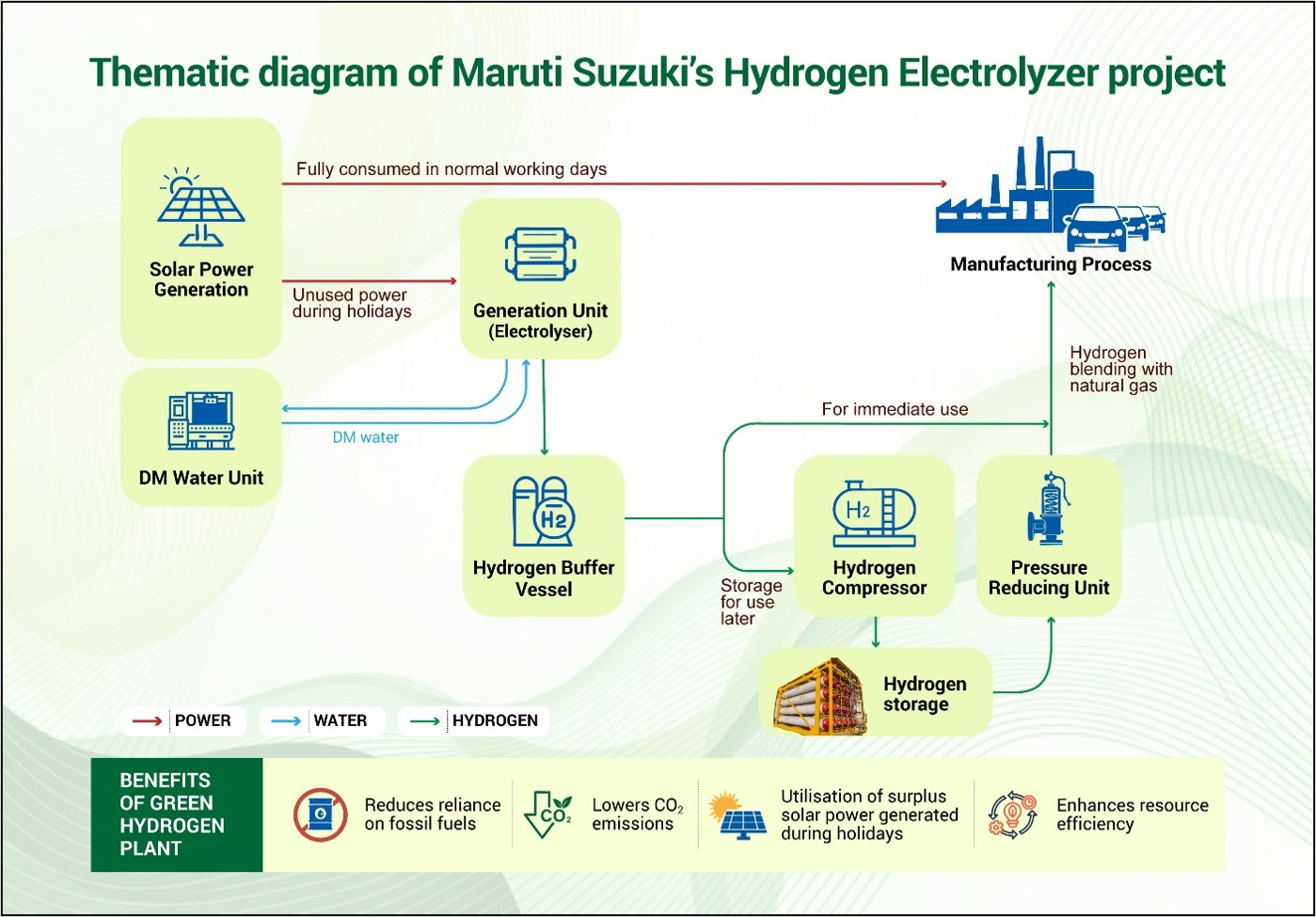
Chennai: Maruti Suzuki India Limited (“Maruti Suzuki”) today announced the commissioning of 300 kW Green Hydrogen (GH₂) electrolyzer plant, set up as pilot, at its Manesar facility. The Green Hydrogen produced is blended with natural gas to be utilized as process fuel in the Company’s manufacturing operations.
The Green Hydrogen plant helps maximise the utilisation of solar energy generated at the Company’s Manesar facility. Solar energy produced during holidays, which would otherwise remain unutilised, is used to generate Green Hydrogen. The hydrogen is stored and subsequently used in manufacturing operations. Based on the learnings from this pilot project, the Company plans to scale up the adoption of green hydrogen technology across its manufacturing facilities in Haryana and Gujarat.
Drawing inspiration from the parent company Suzuki Motor Corporation’s (“SMC”) core philosophy of Sho-Sho-Kei-Tan-Bi, which translates to smaller, fewer, lighter, shorter and more beautiful, Maruti Suzuki continues to improve resource efficiency and optimise energy requirements.
Speaking on the pilot initiative, Mr. Hisashi Takeuchi, Managing Director & CEO, Maruti Suzuki India Limited, said, “Just like we have adopted a multi-pathway approach for products, we have also embarked on a journey of multiple renewable energy solutions for manufacturing operations. The commissioning of our 300 kW Green Hydrogen plant is aligned with the Government of India’s Green Hydrogen Mission. This, along with expansion of solar, biogas and installation of battery energy storage system reflects our commitment to transition to cleaner and sustainable energy solutions.”
He added, “India is emerging as a manufacturing powerhouse, and its competitive position may not depend solely on cost and quality, but also on CO2 intensity. With such initiatives, we are building capability today so that we can support a low-carbon and more energy-efficient manufacturing ecosystem tomorrow. Through multiple clean technologies, we aspire to reduce our carbon footprint in manufacturing operations from the present 615,000 tonnes to 266,000 tonnes in FY 2030-31.”
