

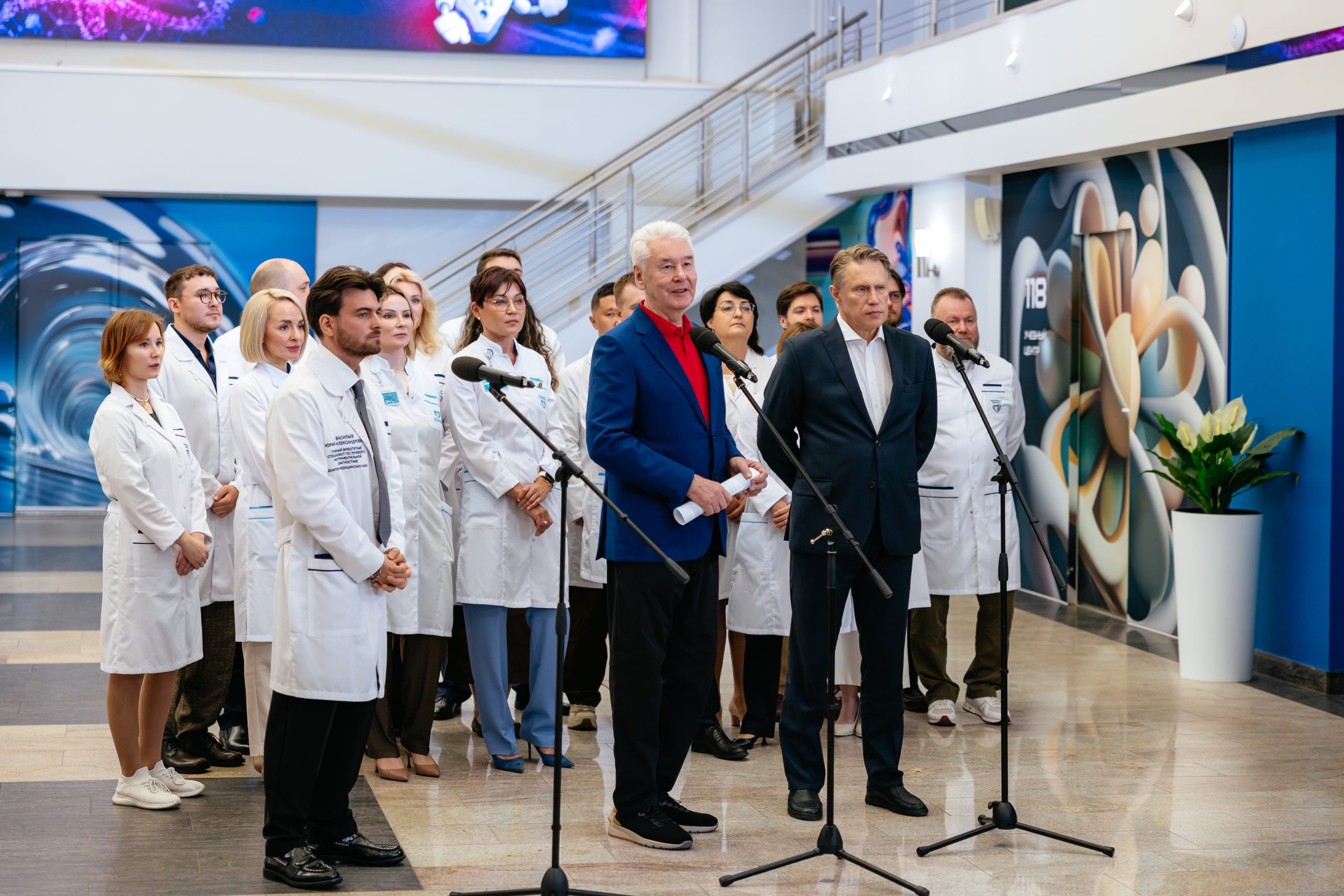
Moscow Mayor Sergei Sobyanin and Russian Health Minister Mikhail Murashko have visited the Moscow Center for Diagnostics and Telemedicine, a leading facility dedicated to advancing radiology and instrumental diagnostics and integrating AI technologies into clinical practice. The Center is home to Russia’s first and one of the world’s largest reference centers for radiology.
During the visit, Sergei Sobyanin conducted a videoconference with the heads of four Russian regions on the implementation of the MosMedAI digital platform in regional medical institutions. The discussion focused on how the platform supports remote interpretation of radiology studies using AI services, enabling faster and more accurate diagnostics without the need for independent regional development.
According to Sergei Sobyanin, the MosMedII platform was launched in 2024 under the directive of Russian President Vladimir Putin. In less than three years, it has processed over 18 million studies nationwide, with more than 1.1 million radiology studies analyzed monthly. The platform has significantly improved the quality of patient care and accelerated the digital transformation of Russian healthcare.
Currently, over 2,400 medical organizations from 75 Russian regions, as well as several federal medical centers, including the Almazov National Medical Research Center, Kuban State Medical University, and the Federal Medical and Biological Agency (FMBA), have access to the platform.
The MosMedAI platform offers regions access to 18 AI-powered diagnostic services for interpreting CT scans, X-rays, fluorograms, and mammograms. The majority of these services are complex, capable of detecting up to 14 different pathologies in a single image. These include diagnostic capabilities for socially significant and prevalent conditions such as coronary heart disease, ischemic stroke, intracranial hemorrhage, pneumothorax, malignant lung tumors, pulmonary emphysema, chest opacities, breast cancer, rib fractures, and aortic aneurysm, among others.
Regional medical organizations across the Russian Federation are connected through a single access point. Use of the platform is free, and the executive authority responsible for healthcare in each region can independently select which AI services to activate.
The platform is designed for simplicity, convenience, and effectiveness. A patient undergoes an imaging examination at a regional clinic, after which the digital image is transmitted to the AI service integrated into MosMedAI. A neural network processes the image, highlighting signs of pathologies with color cues. Results are sent first to the MosMedAI platform and then routed to the regional medical institution. The entire AI processing cycle takes only minutes, with the final diagnostic decision and responsibility remaining with the attending physician.
Drawing on extensive practical experience, Moscow specialists are developing national standards (GOSTs) to regulate the use of artificial intelligence in healthcare. A subcommittee of Technical Committee No. 164, “Artificial Intelligence,” operates within the Center for Diagnostics and Telemedicine.
To date, 28 national standards have been implemented (six in 2026), covering the entire technology lifecycle – from data and algorithm requirements to technical and clinical testing procedures, as well as safety and quality assurance.
The Center for Diagnostics and Telemedicine of the Moscow Health Department is a leading scientific and practical organization within the Social Development Complex of the Moscow City Hall, founded in 1996. It specializes in implementing AI technologies in medicine, advancing radiology, organizing medical departments, conducting scientific research, and educating healthcare professionals.
