

By the Editorial Team
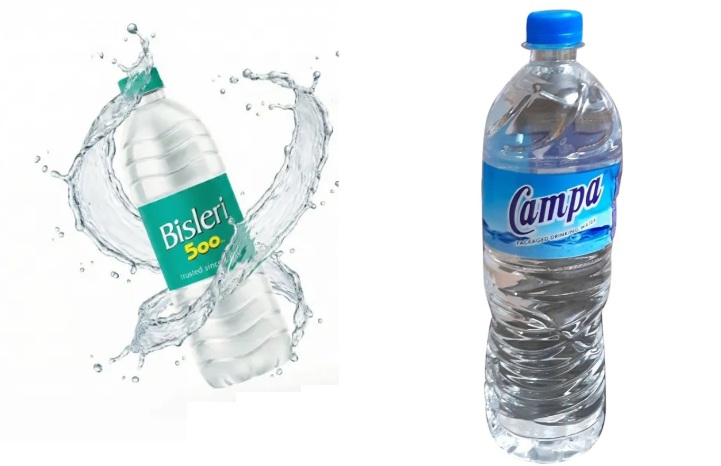
In late November 2026, the Food Safety and Standards Authority of India (FSSAI) announced that it had sanctioned prosecution against Bisleri International under the Food Safety and Standards Act, 2006. The trigger was a single packaged drinking water sample from one batch manufactured at the company’s Goa facility. Out of six samples drawn on 30 September 2025, five met standards. The sixth, from Batch GO 270 produced on 27 September 2025, initially showed bromate at 12 micrograms per litre against a 10 µg/L limit. After Bisleri’s appeal in November 2025, a referral laboratory found bromate within limits but detected polynuclear aromatic hydrocarbons (PAHs) at levels that FSSAI standards treat as not permitted when detectable. The regulator ordered a prohibition on the sale of that specific batch, directed a root-cause analysis, and clarified the next day that the non-compliance was limited to one sample from one batch. No plant was shut, no nationwide recall was ordered, and Bisleri stated that the batch was already out of the market, that its 143 plants continued operating, and that subsequent testing showed no adverse findings.
The episode would have remained a routine regulatory matter were it not for the timing and the brand’s position. Bisleri, present in India since the mid-1960s and under the Parle/Chauhan group since 1969, holds roughly a third of the organised packaged drinking water market. It produces tens of thousands of batches annually. The sampling on 30 September 2025 occurred days after the GST rate on packaged drinking water was cut from 18 per cent to 5 per cent with effect from 22 September 2025 under GST 2.0, and precisely around the time Reliance Consumer Products launched Campa Sure.
Reliance positioned Campa Sure as a mass-market disruptor. Trade reports from late September and early October 2025 detailed aggressive pricing: 250 ml bottles at ₹5, one-litre bottles at ₹15 (against the prevailing roughly ₹20 for Bisleri, Coca-Cola’s Kinley and PepsiCo’s Aquafina), and two-litre packs at ₹25 (versus ₹30–35 for rivals). The brand was slated for a northern India rollout within weeks, with Reliance partnering with regional bottlers for production and distribution. A parallel brand, Independence, was also introduced at slightly higher price points. The strategy explicitly undercut established players by 20–30 per cent and was tied to the GST reduction that lowered costs across the category. Industry observers noted the move echoed Reliance’s earlier playbook of using scale and pricing to capture volume quickly in competitive markets.
Key Timeline of Events
The following chronology places the FSSAI action against Bisleri in the context of the GST cut and the launch of Campa Sure.
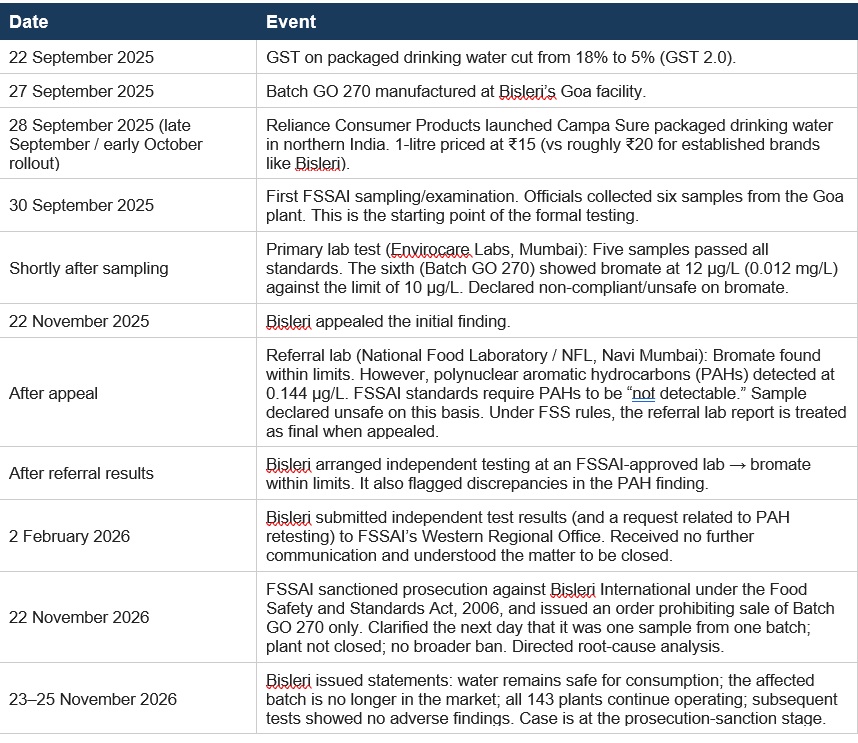
Social media and commentary quickly linked the FSSAI action to Campa Sure’s entry, suggesting the regulatory move would damage trust in the category leader and create space for the new, cheaper brand. There is no public evidence on record connecting Reliance to the sampling or the prosecution decision. The chronology, however—the GST cut on 22 September, Campa Sure’s launch and northern rollout in late September/early October, sampling of Bisleri’s Goa plant on 30 September, and the public prosecution sanction 14 months later—has left a lasting impression of selective intensity applied to a long-established market leader at the precise moment a deep-pocketed conglomerate entered the category with an aggressive price undercut.
What makes the FSSAI action appear selective is not the existence of a failed sample—regulators must act on non-compliance—but the combination of delay, narrow focus, publicity, and comparative silence on far larger systemic problems. Fourteen months elapsed between the September 2025 sampling and the November 2026 prosecution sanction. Bisleri has said it submitted independent laboratory results in February 2026 showing bromate within limits, flagged discrepancies on the PAH finding, and received no further communication, leading it to treat the matter as closed. Only in November 2026 did the regulator publicly sanction prosecution and issue the limited sale prohibition. Under the rules, a referral laboratory report is treated as final on appeal, yet the prolonged silence after the company supplied additional data invites the question of why decisive action arrived so late and so publicly for one batch of a brand that accounts for a large share of the organised market—especially when a major new competitor had just launched at a 25 per cent lower price point on the one-litre pack.
Equally striking is the isolation of Bisleri. India has thousands of packaged drinking water brands, many operating at far smaller scales with weaker testing regimes. PepsiCo’s Aquafina and Coca-Cola’s Kinley together hold substantial shares, yet no comparable public prosecution sanction against them has drawn similar attention for a single batch. After the Bisleri announcement, FSSAI directed states to intensify inspections and risk-based sampling of packaged drinking water and mineral water across the industry, covering PepsiCo, Coca-Cola, Tata Consumer, and Reliance Consumer as well. That broader order, issued days later, looks like an attempt to restore the appearance of even-handedness after the initial spotlight fell almost exclusively on Bisleri. Consumers and observers are left asking why the regulator “woke up” so forcefully against one 57-year-old Indian brand while the same vigour has not been consistently visible against other major water brands—including the newly launched Campa Sure—or against the far more widespread adulteration of everyday foods.
The contrast with other food categories is sharp. Spurious and adulterated ghee, paneer, and cheese remain persistent public-health problems. Recent enforcement drives have seized thousands of tonnes of non-compliant dairy products during festive periods, raided units using laundry whitener, caustic soda, or vegetable oils to manufacture fake paneer, and prohibited sales of certain ghee brands after repeated non-compliance. States have imposed temporary bans on analogue paneer sold under the genuine dairy name. These actions are welcome, yet they occur against a backdrop of chronic adulteration that affects staples consumed daily by millions. Soft drinks and other packaged beverages have also faced notices for labelling and claims. The question is one of priority and consistency: why does a marginal exceedance in one batch of a major water brand, detected and then re-tested with mixed findings, generate national headlines and a prosecution sanction, while the scale of dairy adulteration and the quality of countless smaller water brands—and the new entrant priced to capture volume—receive less sustained public attention from the same regulator? FSSAI’s mandate is consumer protection, not market restructuring. When enforcement intensity appears to track the commercial fortunes of large players—an established leader under pressure from a cheaper new brand and a deep-pocketed entrant—the agency’s credibility suffers.
The optics of the episode reinforce perceptions of monopolising tendencies among big corporates and of regulatory processes that can be read as arm-twisting. Reliance has a track record of aggressive pricing and rapid scale in categories it enters. Campa Sure’s launch, timed with a GST cut that lowered costs for all players and priced at ₹15 per litre against ₹20 for the leader, was explicitly positioned to undercut Bisleri, Kinley, and Aquafina. A regulatory action that publicly questions the safety of the category leader, even if narrowly confined to one batch already out of circulation, can damage brand trust far beyond the factual scope of the finding. Bisleri has repeatedly stated that its water meets standards, that it conducts extensive internal checks, and that it will cooperate while defending itself. The damage, however, is already done in the public mind. Meanwhile, FSSAI’s subsequent clarifications—that the action is limited, that bromate was within limits on re-testing, that only one batch is affected—and its order for wider industry checks have the appearance of an agency trying to wriggle out of a controversy of its own making. The initial announcement of prosecution against “Bisleri” without immediate equal emphasis on the single-batch limitation created the controversy; the walk-back and broader sampling drive have not fully erased the impression of selective targeting at a moment when a major new competitor was entering with a clear price advantage.
No evidence has been presented of direct collusion or instructions from any corporate group to the regulator. The criticism is of process and perception. A regulator that takes 14 months to move from sampling to public sanction, that highlights one major brand while thousands of others and higher-risk adulteration problems persist, and that acts at a moment of significant competitive entry by a conglomerate offering a one-litre bottle at ₹15 versus ₹20 invites legitimate public scepticism. Food safety enforcement should be risk-based, transparent, and even-handed. It should not leave observers wondering whether the intensity of scrutiny correlates with the identity and market position of the company involved, or whether it coincides with the arrival of a new player backed by one of India’s largest business groups. When an agency appears more energetic against a long-standing domestic leader than against the systemic adulteration that actually reaches dinner tables every day, or when its public communications create a larger controversy than the underlying single-batch finding warrants, it undermines confidence in the entire regulatory framework.
The packaged drinking water market is large, fragmented, and growing, partly because municipal supplies remain unreliable for many consumers. Trust is the product. An established brand that has built that trust over decades is entitled to the same standards of evidence, speed, and proportionality as any other. New entrants, however well-capitalised and however aggressively priced, are entitled to compete on price and quality without regulatory actions that can be read as clearing the field. FSSAI’s duty is to protect consumers from genuine hazards, not to become an instrument—intentional or otherwise—of competitive realignment. The Bisleri episode, with its delayed action, narrow factual basis, dramatic public announcement, awkward subsequent clarifications, and precise coincidence with Campa Sure’s lower-priced entry, fails that test of consistency. Until the regulator demonstrates sustained, even-handed vigilance across all brands—including the new ones—and all high-risk categories, the perception will remain that big guns are sometimes helped and long-standing ones are sometimes singled out. That is not the food-safety regime Indian consumers deserve.
Summary
• First FSSAI examination/test: Sample collection on 30 September 2025, followed by the primary laboratory analysis that flagged elevated bromate in one of the six samples.
• Reliance Campa Sure launch: Around 28 September 2025 (with northern India rollout shortly thereafter), priced aggressively at ₹15/litre after the GST cut.
• Status till date: Prosecution sanctioned (22 November 2026) against the company over the single Goa batch. No conviction yet. Bisleri maintains the product is safe and that the batch is out of circulation. The close timing with the Campa Sure launch and GST cut fuelled speculation, but the regulatory action came ~14 months later and is narrowly limited to one batch.
— End of Investigation —
