


By Nanditha Subhadra
In the late 19th century, Kerala was a society deeply entrenched in caste hierarchies, where the Ezhava community faced systemic oppression and exclusion from education, temples, and social mobility. It was against this backdrop that Sree Narayana Guru, a visionary philosopher and social reformer, founded the Sree Narayana Dharma Paripalana (SNDP) Yogam in 1903. Guru’s primary aim was to foster equality, self-respect, and universal brotherhood, encapsulated in his timeless ideals of “One Caste, One Religion, One God for Man.” The Yogam was envisioned as a platform to uplift backward communities through education, spiritual reform, and economic empowerment, free from the shackles of superstition and division. Under the early leadership of luminaries like the great poet Kumaran Asan, who served as its first general secretary from 1904, the organization thrived as a beacon of progressive change, promoting literature, social justice, and Guru’s teachings. However, over a century later, the SNDP Yogam stands at a crossroads, marred by internal factions, allegations of corruption, and political opportunism that have eroded its foundational ethos, turning it into a battleground for power struggles rather than a unified force for reform.
Sree Narayana Guru’s Legacy of Social Reform
Sree Narayana Guru (1856–1928) was a philosopher, spiritual leader, and social reformer who challenged the rigid caste hierarchies of 19th- and early 20th-century Kerala. Born into the Ezhava community, which faced severe social exclusion under the Brahmin-dominated system, Guru advocated for universal brotherhood, education, and self-respect. His famous dictum, “One Caste, One Religion, One God for Man,” encapsulated his vision of a casteless society.
In 1903, with the support of Dr. Padmanabhan Palpu, a physician and activist, Guru established the SNDP Yogam in Aruvippuram, Kerala. The organization was registered as a company under the Indian Companies Act of 1882, with the primary objectives of promoting Guru’s teachings, establishing temples, schools, and institutions for the upliftment of backward communities, and fostering social and economic progress. Initially, it focused on practical reforms: building educational institutions, advocating for temple entry rights for lower castes, and encouraging entrepreneurship among Ezhavas. By the mid-20th century, the Yogam had grown into a significant force, managing numerous schools, colleges, and microfinance units aimed at community welfare.
Guru’s emphasis was on spiritual and social enlightenment rather than political power or personal profit. He envisioned the Yogam as a democratic body where members could participate actively, aligning with his broader philosophy of empowerment through self-reliance. However, over the decades, shifts in leadership and governance structures opened the door to exploitation.
Vellappally Natesan: From Liquor Baron to SNDP Strongman
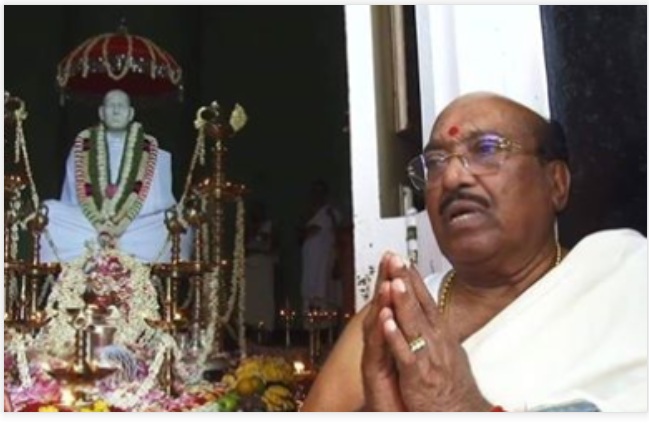
Vellappally Natesan, born in 1937, began his career as a bar owner and contractor in the liquor industry, amassing considerable wealth through his business ventures. He entered the SNDP Yogam in the 1970s and rose to become its general secretary in 1980, a position he has held for over four decades. Natesan’s tenure marked a pivot from pure social reform to a blend of community mobilization and political influence. Supporters credit him with modernizing the organization, expanding its educational and financial institutions, and positioning Ezhavas as a key voting bloc in Kerala’s politics.
However, critics argue that Natesan manipulated the Yogam’s structure to consolidate power. A key enabler was a 1974 Government of India order that exempted the Yogam from certain provisions of the Companies Act, 1956. This exemption, under Sections 172(2), 219, and Article 14 of Table C in Schedule I, restricted direct voting rights to members, allowing only union representatives to vote in general body meetings. This led to the insertion of Article 44 in the Yogam’s articles of association, which further centralized control by depriving ordinary members of participatory rights. Natesan allegedly used this framework to run the Yogam like a family enterprise, with his son Thushar Vellappally also holding influential positions.
Under Natesan, the Yogam expanded into microfinance, education, and real estate, but these ventures became mired in allegations of corruption. He is accused of treating the organization as a “fiefdom,” where decisions favored his business interests and political alliances rather than community welfare.
Manipulation for Personal and Political Gains
Natesan’s critics, including rival factions within the SNDP and opposition leaders, have leveled serious charges of financial irregularities and abuse of power. One prominent allegation is a Rs 600 crore scam involving the Sree Narayana Trust (SN Trust), an educational arm of the Yogam. According to the Sree Narayana Dharma Vedi, a rival group, Natesan illegally siphoned funds through manipulated appointments in SNDP institutions. Fees and donations from students were not properly accounted for in the trust’s books, with discrepancies leading to unrecorded income that allegedly benefited Natesan personally. A reported variation between the trust’s budget and actual income amounted to hundreds of crores, with no transparency in how these funds were utilized.
In the microfinance sector, Natesan faced probes for borrowing funds from banks at low interest rates (around 5%) and lending them through SNDP units at exorbitant rates (up to 18%), without ensuring repayment. Former Chief Minister V.S. Achuthanandan alleged in 2016 that the Yogam availed Rs 15 crore from the state government for microfinance but diverted it for personal gain, leading to a vigilance court case that continues to this day. Former DGP T.P. Senkumar, a Yogam member, claimed in 2020 that Natesan had amassed Rs 1,600 crore illegally through such schemes.
Politically, Natesan leveraged the Yogam’s influence over the Ezhava community, which constitutes about 23% of Kerala’s population, to form alliances. In 2015, he launched the Bharat Dharma Jana Sena (BDJS) party, allying with the Bharatiya Janata Party (BJP) to tap into Hindu consolidation efforts. This move was seen as a departure from Guru’s secular ideals, with Natesan accused of using the Yogam to mobilize votes for his son’s political career. Internal dissenters, like Gokulam Gopalan, resigned in protest, claiming Natesan misused the organization for personal gains, including organizing events that promoted his family’s interests. Allegations of tampering with voters’ lists and suppressing opposition within the Yogam further painted a picture of autocratic control.
These manipulations have led to multiple court cases, including charges of fund misappropriation in SN Colleges and abetment to suicide in a related aide’s death. Natesan’s family is accused of swindling hundreds of crores from the Yogam and SN Trust over 25 years, turning a reformist body into a vehicle for wealth accumulation and political bargaining. The once-unified organization, guided by Kumaran Asan’s poetic vision and reformist zeal, is now fractured into factions, with rival groups like the Sree Narayana Dharma Vedi and others engaging in legal battles over leadership and assets, reflecting deep internal rifts fueled by accusations of authoritarianism and ideological deviation.
The Recent Kerala High Court Judgment: A Turning Point?
The latest twist came in a December 2025 Kerala High Court division bench ruling by Justices Devan Ramachandran and M.B. Snehalatha. The bench set aside a single judge’s earlier decision that had invalidated the 1974 government order and Article 44, ruling that the Yogam should be governed by the Travancore-Cochin Literary, Scientific and Charitable Societies Registration Act (NTC Act) of 1961 instead of the Companies Act. The single bench had argued for greater democracy under the NTC Act, which would grant voting rights to all members and potentially dismantle the representative-only system that favored Natesan’s control.
Instead, the division bench deferred the matter to the Union Government, directing it to decide within three months whether the Yogam falls under the Companies Act or the NTC Act. This follows a 2009 Delhi High Court order that had already instructed the Centre to revisit a 2005 concession acknowledging NTC Act governance. The bench emphasized that assessing the Yogam’s objects—whether confined to Kerala or universal based on Guru’s teachings—requires governmental expertise, including analysis of membership demographics and assets. It also noted that the 1974 exemption might be inoperative under the Companies Act, 2013, which limits exemptions to classes of companies, not individuals.
Impact on Natesan and the Yogam
This judgment has intensified infighting within the SNDP Yogam, as it maintains uncertainty over governance while pressuring for a resolution. For Natesan, who has relied on the 1974 exemption to limit member participation and maintain monopoly, a shift to the NTC Act could be devastating. Under the NTC Act, the Yogam would be treated as a charitable society, mandating broader voting rights, transparent elections, and possibly a court-framed administrative scheme—as upheld in earlier 2022 rulings. This would empower ordinary members, diluting Natesan’s family dominance and exposing financial dealings to greater scrutiny.
If the Centre rules in favor of the Companies Act, the status quo persists, allowing Natesan to continue his influence. However, the three-month deadline, backed by an undertaking from the Additional Solicitor General, ensures swift action, potentially leading to reforms. Rival factions, already vocal about fraud and manipulation, see this as an opportunity to challenge Natesan’s “fiefdom.” Recent cases, like the ongoing microfinance fraud probe and a 2024 Supreme Court stay on labeling the Yogam a public charity trust, add to the pressure. The Kerala High Court judgment could catalyze a democratic overhaul, restoring member rights and curbing centralized control, though its ultimate impact hinges on the Centre’s decision amid ongoing political tensions.
The decision could also ripple into Kerala’s politics, weakening BDJS’s leverage if the Yogam’s base fragments. Ultimately, the judgment revives Guru’s democratic ideals, potentially restoring the Yogam to its reformist roots while curbing decades of alleged personal exploitation. As the Centre deliberates, the infighting underscores a broader struggle: whether the SNDP Yogam remains a tool for empowerment or a relic of centralized control.
In conclusion, the SNDP Yogam’s descent into factionalism and exploitation under figures like Vellappally Natesan, a liquor baron whose business directly contradicts Guru’s staunch opposition to alcohol—”Liquor is poison; do not produce it, do not distribute it, do not consume it”—betrays the very soul of its founding. To honor Sree Narayana Guru’s vision, the organization must reject such manipulations and realign with his profound words: “ജാതിഭേദം മതദ്വേഷം ഏതുമില്ലാതെ സര്വ്വരും സോദരത്വേന വാഴുന്ന മാതൃകാസ്ഥാനമാണിത്” (This is a model place where all live in brotherhood without caste distinctions or religious hatred). Only by purging personal greed and embracing true equality can the Yogam reclaim its legacy as a force for societal harmony.
