


By Nanditha
On Gandhi Jayanti in 2014, Prime Minister Narendra Modi pledged to make India dirt-free by 2019. The date was deliberate, and the spectacles of the man who called sanitation more important than independence became the logo. The promise was sweeping: toilets for every household, drains that no longer stank, and dignity for those who had cleaned other people’s filth for generations. More than a decade later, the photographs from that day and every subsequent anniversary remain spotless. The drains do not. Gandhi’s birthday is still marked with brooms raised for cameras, while the people who empty the pits are still dying in them.
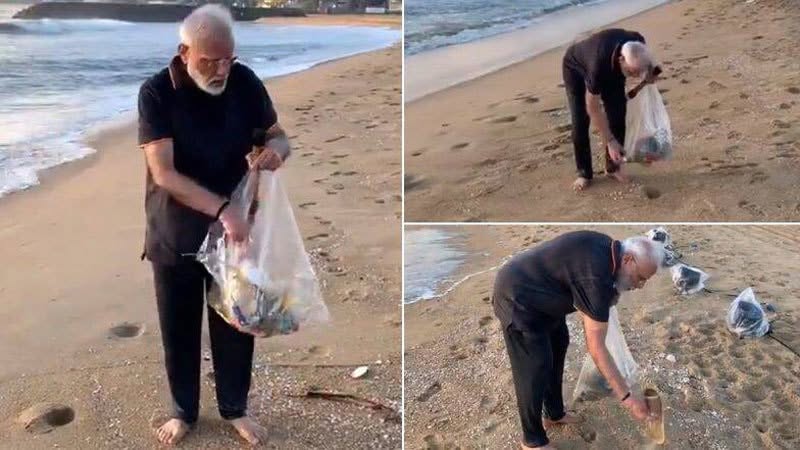
For a few energetic weeks, and on carefully chosen anniversary days, the nation witnessed a remarkable spectacle. The Prime Minister, ministers, film stars, and influencers were photographed holding brooms. Delhi’s already-swept stretches received ceremonial attention while celebrities posted images in spotless kurtas. For a brief, brightly lit interval, the nation appeared to be sweeping itself into modernity. However, the real sanitation workers—those who remove human faeces from dry latrines, clear septic tanks, and stand knee-deep in toxic waste—received no invitations to the photo sessions. When the cameras left, the same workers returned to the same drains, the same pits, and the same health risks. The official declaration of an Open Defecation Free (ODF) India arrived on schedule, but the actual modernization of the wastewater infrastructure did not.
Mahatma Gandhi was unambiguous: “Sanitation is more important than independence.” He insisted a lavatory must be as clean as a drawing-room, demanding that everyone take up the broom and bucket. Instead, the spectacles stayed on the posters, the brooms stayed in the hands of those posing for a day, and the people performing the actual, hazardous labor remained invisible.
The human cost of this aesthetic focus is stark. On 26 June 2026, three men—Chand (42), Arun (38), and Sandeep (32)—entered a septic tank at a printing press in Delhi’s Mundka Industrial Area. Initially hired to operate a pumping machine, they were pressed by the contractor to remove the remaining sludge by hand. They entered without gas detectors, harnesses, or oxygen. Sandeep went in first and collapsed; Arun went in to pull him out and collapsed; Chand followed to save both and lost consciousness. All three died. Police later booked the factory owner and the contractor under negligence and the 2013 Anti-Manual Scavenging Act.
Their deaths are part of a grim, systemic tally. Activist groups like the Dalit Adivasi Shakti Adhikar Manch place the death toll well above 1,700 since the 2013 law came into force. Yet, government replies in Parliament frequently state that “no death has been reported due to manual scavenging,” separating technical definitions from the reality of hazardous sewer cleaning. Furthermore, grieving families wait years for the statutory compensation of ₹30 lakh, and many receive nothing. The men who died in Mundka were never part of any Swachh Bharat photograph.
Similarly, in July 2024, a temporary railway sanitation worker named Joy was swept away and drowned while cleaning a choked section of the Amayizhanjan Canal in Thiruvananthapuram during heavy rains. His decomposed body was recovered two days later. These are not isolated tragedies; they are the ordinary cost of a system that relies on human bodies to enter toxic spaces because mechanization and proper utility networks remain incomplete.
Statistically, the program’s infrastructure expansion is massive. Since 2014, over 12 crore rural toilets and 63 lakh urban household toilets have been constructed, leading to widespread official “ODF Plus” declarations. Yet, independent data reveals a more restrained story. The Household Consumption Expenditure Survey 2022-23 found that 12.5 percent of households—roughly 163 million people—still lacked a toilet, with independent estimates placing residual open defecation around 7 percent. Many built toilets remain unused due to acute water shortages, poor construction, or cultural preferences.
More crucially, building a toilet does not automatically manage the waste it collects. In large parts of India, faecal sludge management remains rudimentary. Untreated sludge is routinely dumped into fields, open drains, and water bodies. The Central Pollution Control Board identified 296 polluted river stretches across 271 rivers in 2025. Despite billions spent on the Namami Gange Programme, the Ganga and its tributaries still carry heavy loads of untreated sewage. The Yamuna frequently registers zero dissolved oxygen at critical points. In Kerala, major water bodies like Akkulam-Veli Lake, Ashtamudi Kayal, and the Periyar river continue to choke on industrial effluents, plastic pollution, and faecal contamination, including E. coli.
The public health consequences are severe. Between 2005 and 2022, India reported over 20 crore cases of major waterborne diseases and over 50,000 deaths, with acute diarrhoeal disease driving the vast majority of casualties. While increased toilet coverage has helped reduce infant mortality, incomplete sludge systems and open drains keep the disease burden high.
Phase II of the rural mission and the urban mission 2.0 carry combined outlays exceeding ₹1.9 lakh crore. While the political return on these investments has been high—with toilet numbers frequently cited as proof of absolute success—the incentive structures have consistently rewarded physical construction and media campaigns over long-term functional outcomes.
Until the labor that happens after the cameras leave is fully mechanized, properly funded, and legally protected, Swachh Bharat will remain a story of declarations rather than structural transformation. The brooms can be put away for the photos, but the toxic pits, the choked drains, and the vulnerable people who clean them will still be there the next morning. The photographs cannot bridge the gap between image and reality. The drains still do.
