


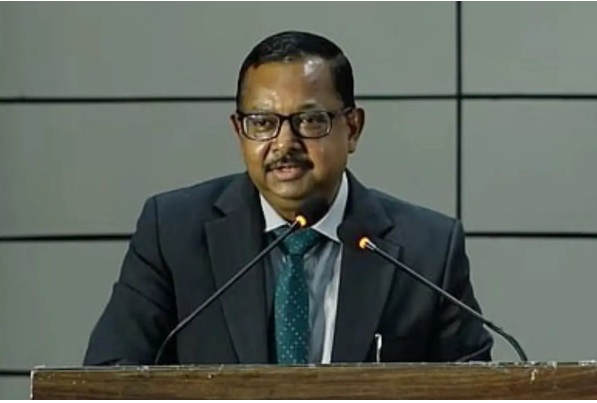
Hyderabad: Supreme Court judge Justice Ujjal Bhuyan on Sunday said the right to vote cannot be detached from the persona of an Indian citizen, and that doing so would be “like taking out the soul from the body.” Delivering the valedictory address at NALSAR University of Law, he warned that any process which disenfranchises millions, and leaves them citizens without voting rights, is intrinsically arbitrary, strikes at the heart of the Constitution, and amounts to a negation of the constitutional order India adopted in 1950.
Justice Bhuyan spoke at the 19th Justice Bodh Raj Sawhney Memorial Moot Court Competition on the NALSAR campus. He did not name the Election Commission’s Special Intensive Revision (SIR) of electoral rolls. The remarks nevertheless landed in the middle of a national row over large-scale deletions, petitions pending before the Supreme Court, and protests demanding the resignation of Chief Election Commissioner Gyanesh Kumar.
“From the persona of an Indian citizen, the right to vote or right to be included in the voters’ list cannot be detached. It will be like taking out the soul from the body,” he said. He added that he asked himself “what is the worth of a citizen, without her voting rights.” Citizenship and franchise, he argued, are theoretically intertwined; one cannot be divorced from the other without emptying citizenship of its democratic content.
He was equally direct on scale. “If any process results in disenfranchising millions and millions of Indian citizens, making them second-class citizens in their own country in the sense of being citizens without voting rights, such a process is intrinsically arbitrary. No amount of whataboutery can justify it. It strikes at the very heart of the Constitution, and I would go to the extent of saying that it is a negation of the constitutional order which we have adopted under the Constitution of India.”
The Constitution, he said, does not provide for two classes of citizens — one with voting rights and another without them. Wholesale disenfranchisement would, in his view, violate Article 326, which mandates elections to the Lok Sabha and every State Legislative Assembly on the basis of adult suffrage, and Article 14, which guarantees equality before the law. “Article 326 cannot be tinkered with at all. No authority can do it and no court can endorse or condone it. No one is above the Constitution,” he said.
Under Article 326, every citizen not less than 18 — the threshold was 21 until March 28, 1989 — and not disqualified on the permitted grounds of non-residence, unsoundness of mind, crime, or corrupt or illegal practice, is entitled to be registered as a voter. Any law infringing those parameters would be void. Administrative exercises, he added, must not irrationally or unreasonably curtail the right. The right to cast a vote, he said, is central to the basic structure itself. Franchise is the essence of citizenship, and the only way an ordinary citizen participates in governance.
On procedure he drew a line that goes to the present controversy. Except in the case of a dead voter, a name once entered in the electoral roll cannot be deleted without notice and a hearing. Critics of the SIR have argued that short windows, documentary burdens and bulk “logical discrepancy” flags have worked, in practice, as deletion without a real chance to be heard. Justice Bhuyan did not adjudicate those disputes. He stated the constitutional minimum: enlistment creates a right that cannot be withdrawn in silence.
He placed the argument in the history of the franchise, tracing an early articulation of adult suffrage to the Constitution of India Bill of 1895, the Swaraj Bill. Draft Articles 289A and 289B in the Constituent Assembly became Articles 325 and 326. Article 325 requires one general electoral roll for every territorial constituency and bars exclusion on grounds only of religion, race, caste or sex. Article 326, he said, gives meaning to the equality principle in Article 14.
Quoting Dr B.R. Ambedkar, he recalled that universal adult suffrage was a decision which “practically nullifies the past,” and that Ambedkar insisted the entitlement be written into the Constitution rather than left to parliamentary whim. Its adoption, Justice Bhuyan said, was the Constituent Assembly’s determined view that the freedom struggle made adult suffrage a natural choice and an essential ingredient of Indian democracy — an act of faith in the common man, and the first step toward equality.
He illustrated that equality without abstraction. “One may be a billionaire, and one may be a rickshaw-puller. Yet both will have their votes, and the value of their votes would be equal. Likewise, a socially high-placed temple priest on the one hand and a person belonging to the lowest strata of the society compelled to work as a manual scavenger have an equal vote with equal value. This is the transformational vision of the Indian Constitution.” The vote, on this reading, is not a reward for literacy, property or standing. It is the instrument that holds those hierarchies to a single measure.
The address comes as the SIR remains under political and legal fire. Reports have put deletions in the region of 13.3 crore names nationally. In Delhi, petitioners have told the court that about 47.56 lakh names were excluded from the draft roll of August 31, while another 33.13 lakh electors were flagged for notices over “no mapping” or “logical discrepancies,” with a heavy backlog of appeals. In West Bengal, former Supreme Court judge Justice Rohinton F. Nariman has cited about 90 lakh disenfranchised voters and asked why that figure did not prompt a stay. Commission figures for the state have recorded about 27.16 lakh deletions through adjudication, with lakhs of appeals both against exclusion and against inclusion. The Supreme Court is seized of the challenges.
Opposition leaders treated the speech as an indictment. Congress leader Jairam Ramesh said Justice Bhuyan had exposed the Chief Election Commissioner “lock, stock and barrel,” and that Gyanesh Kumar “must quit right away.” Trinamool Congress MP Mahua Moitra also backed the remarks. Student and youth groups have been agitating for the Commissioner’s resignation, arguing that eligible voters are being reduced to citizens on paper.
The Election Commission has maintained that intensive revision is a statutory cleaning of dead, shifted and duplicate entries, and that claims and objections remain open. Critics say the burden of proof and the pace of the exercise have filtered out poor, migrant and minority voters. Justice Bhuyan did not enter that defence. He set a constitutional test: a process that leaves millions as citizens without a vote fails Articles 326 and 14, cannot be saved by whataboutery, and cannot be condoned by any authority, because no one is above the Constitution.
He closed by congratulating the NALSAR students for “being what students, especially law students, should be.” The line that travelled beyond the campus was the one about the soul. In a season when rolls are being rewritten at scale, a sitting judge has said the vote is not a privilege an administration may detach at will. It is inseparable from the citizen — and a citizen without it is a citizen in name alone.
