

TEXMiN, IIT Dhanbad and University of Pretoria Forge Strategic Indo–South Africa Partnership to Advance Critical Minerals, Rare Earths & Sustainable Mining Innovation

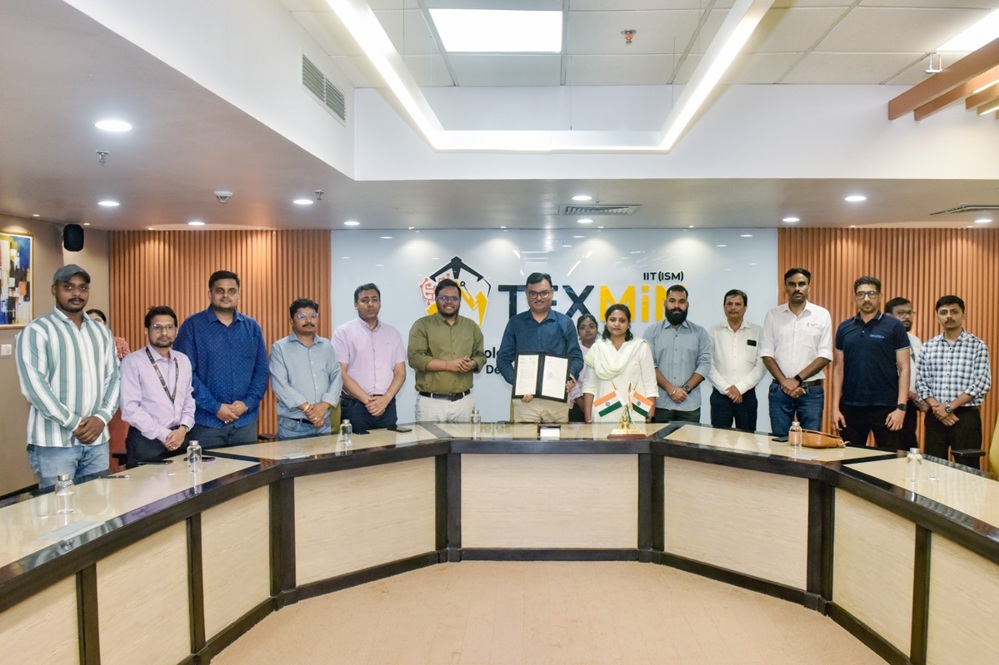
New Delhi : TEXMiN Foundation (Technology Translation Research Park, Department of Science & Technology, Government of India), IIT (ISM) Dhanbad, and the University of Pretoria, South Africa, a public higher education University and a juristic person, signed a Memorandum of Understanding for the development of Research Collaboration.
The strategic collaboration brings together TEXMiN’s research and technology innovation expertise with the University of Pretoria’s academic and research advancements in mining, metallurgy, and engineering sciences. The partnership aims to jointly explore and develop technological solutions across the mining value chain while strengthening global cooperation in emerging critical mineral ecosystems.
Under the collaboration, both institutions will undertake joint research and technology development programs focused on critical mineral targeting, advanced geophysical methods, digital subsurface analytics, mineral processing, recycling systems, and mining innovation. The partnership will also include joint asset development, access to facilities and infrastructure for stakeholders and research partners, implementation of collaborative programs related to critical minerals, and translational innovation initiatives aligned with evolving global mineral and energy transition priorities. The collaboration also opens opportunities for future Centre of Excellence (CoE)-led initiatives across both countries in advanced R&D, skilling, and technology translation.
The signing ceremony witnessed the presence of dignitaries and academic leaders from both India and South Africa, including Mrs. Banu Prakash, Deputy High Commissioner at the Indian Embassy; Shri Shyam Chand, First Secretary, Indian Embassy; Prof. Wynand Steyn, Dean, EBIT Faculty; Prof. Natasha Naude, Head of Department, Metallurgy; Prof. Tinus Otto, Mining Engineering; and Dr. Vinod Kurup from the Department of Metallurgy, University of Pretoria.
Speaking on the collaboration during the event, Prof. Sukumar Mishra, Director, IIT (ISM) Dhanbad and Chairman, Hub Governing Board, TEXMiN Foundation, said, “This partnership reflects the growing importance of international cooperation in securing the future of critical minerals and sustainable mining technologies. By bringing together complementary expertise from India and South Africa, we aim to create meaningful research outcomes, technology-led solutions, and knowledge-sharing platforms that can support industrial transformation and responsible resource development. We are excited to work with such a reputable university. With this, we aim to explore deeper institutional engagement through localised Centre of Excellence footprints, collaborative R&D ecosystems, academic exchange, and innovation-driven partnerships in both countries.”
Prof. Dheeraj Kumar, Deputy Director, IIT (ISM) Dhanbad and Project Director, TEXMiN, said, “The collaboration between TEXMiN and the University of Pretoria marks an important step toward building a globally connected innovation ecosystem for the mining and minerals sector for both countries. Through joint research, technology translation, industry participation, and talent development, this partnership will help accelerate innovation in critical mineral and processing and create opportunities for international knowledge exchange, translational research, and future-ready skill development that can benefit both academia and industry.”
Prof. Wynand Steyn, Dean, Faculty of Engineering, Built Environment & Information Technology (EBIT), at the University of Pretoria, said, “This collaboration between the University of Pretoria and TEXMiN represents a significant opportunity to strengthen academic and research partnerships between South Africa and India in the field of critical minerals and sustainable mining. By combining our expertise in engineering, mining, metallurgy, and technology innovation, we aim to contribute towards future-focused solutions that support responsible resource development, knowledge exchange, and industry-relevant research. We believe this partnership will also create meaningful opportunities for students, researchers, and industry stakeholders to collaborate on technologies that can shape the future of the global mining ecosystem.”
As part of the collaboration, TEXMiN and the University of Pretoria will explore opportunities for capacity building and mining leadership development through student and researcher exchange programs, internship initiatives for undergraduate and research scholars, training and certification modules, executive up-skilling programs, and residential and non-residential short-term technical training initiatives aimed at enhancing employability and industry readiness in the mining sector. The partnership will further encourage the exchange of scientific literature and technical knowledge, as well as collaborative participation in national and international R&D programs.
Under the signed MoU, both institutions will also identify and pursue collaborative projects relevant to industries associated with lithium, graphite, cobalt, nickel, manganese, aluminum, copper, rare-earth elements (REEs), battery materials, and other critical minerals. The collaboration may further extend to projects under the Center of Excellence on Critical Raw Materials (CoE–NCMM) framework and other initiatives linked to the National Critical Mineral Mission (NCMM), wherever feasible and mutually aligned.
The partnership will also support start-up incubation, innovation translation, workshops, seminars, technical sessions, and jointly pitched industry and business opportunities, enabling both institutions to leverage their complementary expertise and institutional strengths. The collaboration is expected to significantly strengthen India’s critical minerals ecosystem by fostering advanced research, enabling industry-oriented innovation, supporting workforce development, and creating platforms for global engagement in mining technology and sustainable resource management.
