


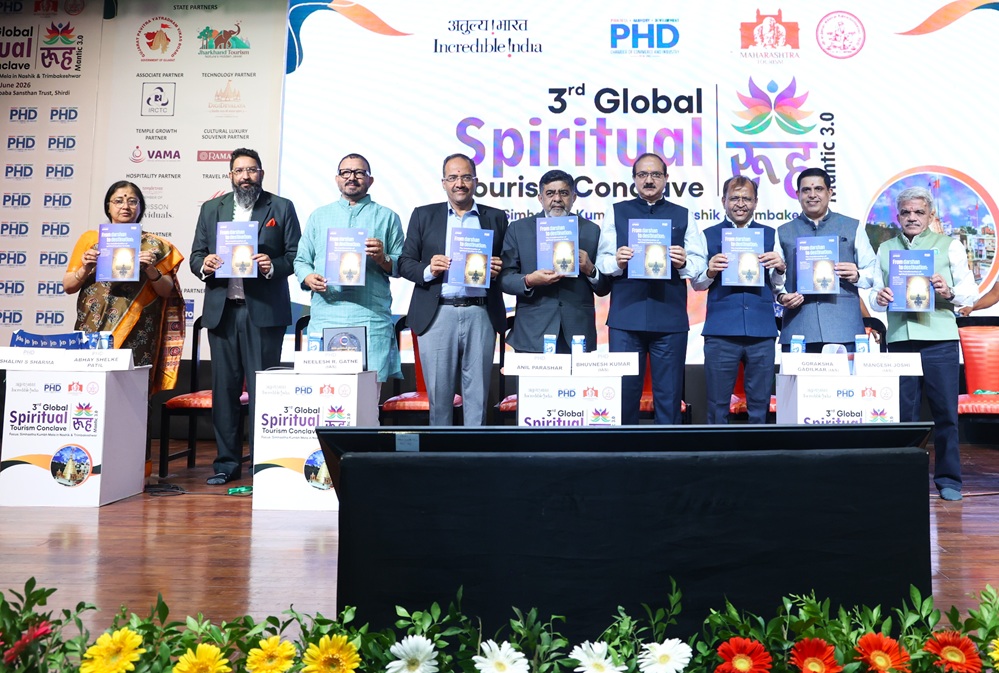
SHIRDI: With preparations gathering momentum for Simhastha Kumbh Mela 2027–28, policymakers, tourism leaders, temple administrators, hospitality stakeholders and spiritual organizations came together in Shirdi to chart a long-term vision for Maharashtra’s spiritual tourism future at रूहmantic: PHDCCI’s 3rd Global Spiritual Tourism Conclave.
Organized by the PHD Chamber of Commerce and Industry (PHDCCI) in collaboration with the Ministry of Tourism, Government of India; Maharashtra Tourism; Maharashtra Tourism Development Corporation (MTDC); and Shree Saibaba Sansthan Trust, Shirdi, the conclave brought together more than 300 delegates from across the country to deliberate on strengthening India’s spiritual tourism ecosystem and leveraging major pilgrimage destinations as engines of sustainable economic growth.
Inaugurating the conclave, Mr. Bhuvnesh Kumar (IAS), Secretary, Ministry of Tourism, Government of India, emphasized that spiritual tourism is not merely a tourism segment in India; it is deeply embedded in our civilizational identity and way of life. Maharashtra, with its unique concentration of Jyotirlingas, Shakti Peeths, pilgrimage centres and sacred destinations, possesses immense potential to emerge as a globally recognized spiritual tourism destination. The need of the hour is to connect these destinations through integrated circuits that combine spirituality, heritage, culture and local experiences, enabling visitors to experience the full richness of the region,” he said.
“India’s rapidly growing domestic tourism market presents immense opportunities for local communities, entrepreneurs, homestay operators and tourism stakeholders. Technology, ranging from virtual experiences and live-streamed religious ceremonies to seamless digital travel solutions, will play an increasingly important role in making spiritual tourism more accessible, inclusive and engaging,” he said.
He further added, “As visitor numbers continue to rise, sustainable destination management becomes critical. Cleanliness, crowd management, carrying-capacity planning and quality civic infrastructure must remain central to our development strategy. Supported by initiatives such as the PRASHAD scheme and significant improvements in national connectivity, India has built a strong foundation for tourism growth. The next phase will require greater collaboration between government and industry to create world-class spiritual tourism experiences while preserving the authenticity and sanctity of our sacred destinations.”
Mr. Neelesh R. Gatne (IAS), Managing Director, MTDC, said, “MTDC will soon partner with Shri Sai Baba Sansthan Trust to further enhance visitor experiences and strengthen destination development initiatives in Shirdi. We are actively upgrading tourism infrastructure through public-private partnerships and developing curated pilgrimage circuits that assure quality, reliability and seamless services for devotees. Spiritual destinations must evolve beyond darshan by creating meaningful experiences that encourage visitors to stay longer, engage with local culture and contribute to local economies.”
Welcoming delegates to Shirdi, Mr. Goraksha Gadilkar (IAS), Chief Executive Officer, Shree Saibaba Sansthan Trust highlighted Shirdi’s growing stature as a global spiritual destination, noting that devotees from more than 61 countries visit the sacred town inspired by the teachings and legacy of Shri Sai Baba. He emphasized that the Sansthan has developed extensive infrastructure and visitor facilities, including a modern darshan queue complex, dedicated services for senior citizens and differently-abled devotees, large-scale accommodation facilities and a Prasadalaya that serves tens of thousands of devotees daily. He called for greater collaboration among stakeholders to further enhance pilgrim experiences and strengthen the growth of spiritual tourism in the region.
Mr. Mangesh Joshi (IAS), Director – Directorate of Tourism, Government of Maharashtra, said Maharashtra is preparing for Simhastha with a long-term vision extending beyond the event itself. “Our objective is not only to successfully host millions of pilgrims during Simhastha, but also to create lasting tourism assets and experiences that continue to benefit local communities for decades. Shirdi, Nashik and Trimbakeshwar have the potential to emerge as an integrated spiritual tourism circuit of international significance.”
Mr. Abhay Shelke Patil, Vice President, Shirdi Nagar Parishad, emphasized the importance of civic infrastructure, cleanliness and community participation in supporting the sustainable growth of spiritual tourism destinations.
Delivering the theme address, Mr. Anil Parashar, Chair – Tourism & Hospitality Committee, PHDCCI, said, “India’s spiritual heritage is among its greatest competitive advantages. The challenge before us is to transform pilgrimage movements into opportunities for destination development, livelihood generation, cultural preservation and visitor experience enhancement. Simhastha offers a unique opportunity to demonstrate how faith-based tourism can become a driver of inclusive economic growth.”
Mr. Rajan Sehgal, Co-Chair – Tourism & Hospitality Committee, PHDCCI, remarked that the conclave had brought together a unique blend of policymakers, destination managers and industry leaders to create actionable recommendations for the sector.
The inaugural session, moderated by Ms. Shalini S Sharma, Assistant Secretary General, PHDCCI, brought together senior government officials to deliberate on the opportunities emerging from Simhastha Kumbh Mela 2027–28 and the future of faith-based tourism in India.
A major highlight of the inaugural session was the release of the PHDCCI-KPMG Report on Spiritual Tourism, titled ‘From Darshan to Destination: The Transformation of Spiritual Tourism in India’. The report examines evolving pilgrim behaviour, technology adoption, sustainability imperatives, destination planning frameworks and emerging opportunities for creating integrated spiritual tourism ecosystems across the country.
Delivering a virtual keynote address, Mr. Amrit Abhijat (IAS), Additional Chief Secretary – Tourism, Culture and Religious Affairs, Government of Uttar Pradesh, shared lessons from Uttar Pradesh’s successful transformation of destinations such as Varanasi, Ayodhya and Prayagraj. “The success of spiritual tourism lies in balancing faith, infrastructure, heritage conservation and visitor experience. Large religious events should be viewed as opportunities to create long-term tourism assets and destination value. The transformation witnessed in Uttar Pradesh demonstrates how strategic planning and stakeholder collaboration can create lasting impact.”
The day-long deliberations featured a series of thought-provoking sessions:
· Simhastha 2027 – From Kumbh to Spiritual Tourism Corridor: Moderated by Mr. Giresh Vasudev Kulkarni, Founder, Temple Connect, the session featured Mr. Goraksha Gadilkar (IAS), CEO, Shree Saibaba Sansthan Trust Shirdi and Mr. Shekhar Singh (IAS), Commissioner, Nashik-Trimbakeshwar Kumbh Mela Authority. The discussion focused on leveraging Simhastha as a catalyst for regional development through improved connectivity, visitor infrastructure, destination branding, crowd management systems and integrated tourism circuits. Speakers emphasized that the true legacy of Simhastha would be measured not by the event itself, but by its ability to transform Nashik, Trimbakeshwar and Shirdi into vibrant year-round spiritual destinations.
· Creating Round-the-Clock Spiritual Experiences: Chaired by Mr. Gyan Bhushan, Senior Economic Advisor, Ministry of Tourism and moderated by Mr. Aalap Bansal, Partner, KPMG India, the session explored how pilgrimage destinations can enhance visitor engagement through evening aartis, cultural performances, digital interpretation, sacred food streets and immersive tourism experiences. Panelists Dr. Kiran Shinde, Professor – Planning, La Trobe University Australia; Mr. Prasad Ajgaonkar, Managing Director, iRealities; Mr. Vikash Mishra, Founder & CEO, Trip to Temples; and Mr. Sameer Bajaj, Head – Corporate Communications & Corporate Affairs, MakeMyTrip highlighted the importance of creating experiences that encourage longer stays and deeper destination engagement.
· The Architecture of Faith: Hosted by Ms. Shalini S Sharma, Assistant Secretary General, PHDCCI, this conversation featured Mr. Kiran Kalamdani, Conservation Architect and Prof. Manoj Mathur, Architect. The discussion highlighted how India’s temples represent a unique confluence of architecture, science, symbolism and storytelling. Speakers stressed the need for heritage conservation, interpretation centres and immersive storytelling initiatives that enable visitors to better appreciate the cultural significance of sacred spaces.
· Roohmantic Reflections: In a deeply engaging session, Sister Deepa of Brahma Kumaris reflected on the growing convergence of spirituality, wellness and mindful travel. She noted that modern travellers are increasingly seeking journeys centred on self-discovery, emotional well-being and inner transformation, creating new opportunities for meditation retreats, wellness tourism and conscious travel experiences.
The conclave concluded with delegates participating in darshan at Shri Saibaba Temple, a devotional Bhajan Sandhya and a familiarization visit to Nashik and the Trimbakeshwar Jyotirlinga, providing firsthand exposure to destinations that will play a pivotal role during Simhastha Kumbh Mela 2027–28.
The conclave was supported by Gujarat Pavitra Yatradham Vikas Board; Jharkhand Tourism; IRCTC; DigiDevalaya; Vama; Ramalaya; Hotel Radisson Individuals, Shirdi; Mann Fleet Partners; KPMG; Temple Connect; Association of Domestic Tour Operators of India (ADTOI); Indian Association of Tour Operators (IATO); and Travel Agents Association of India (TAAI).
