


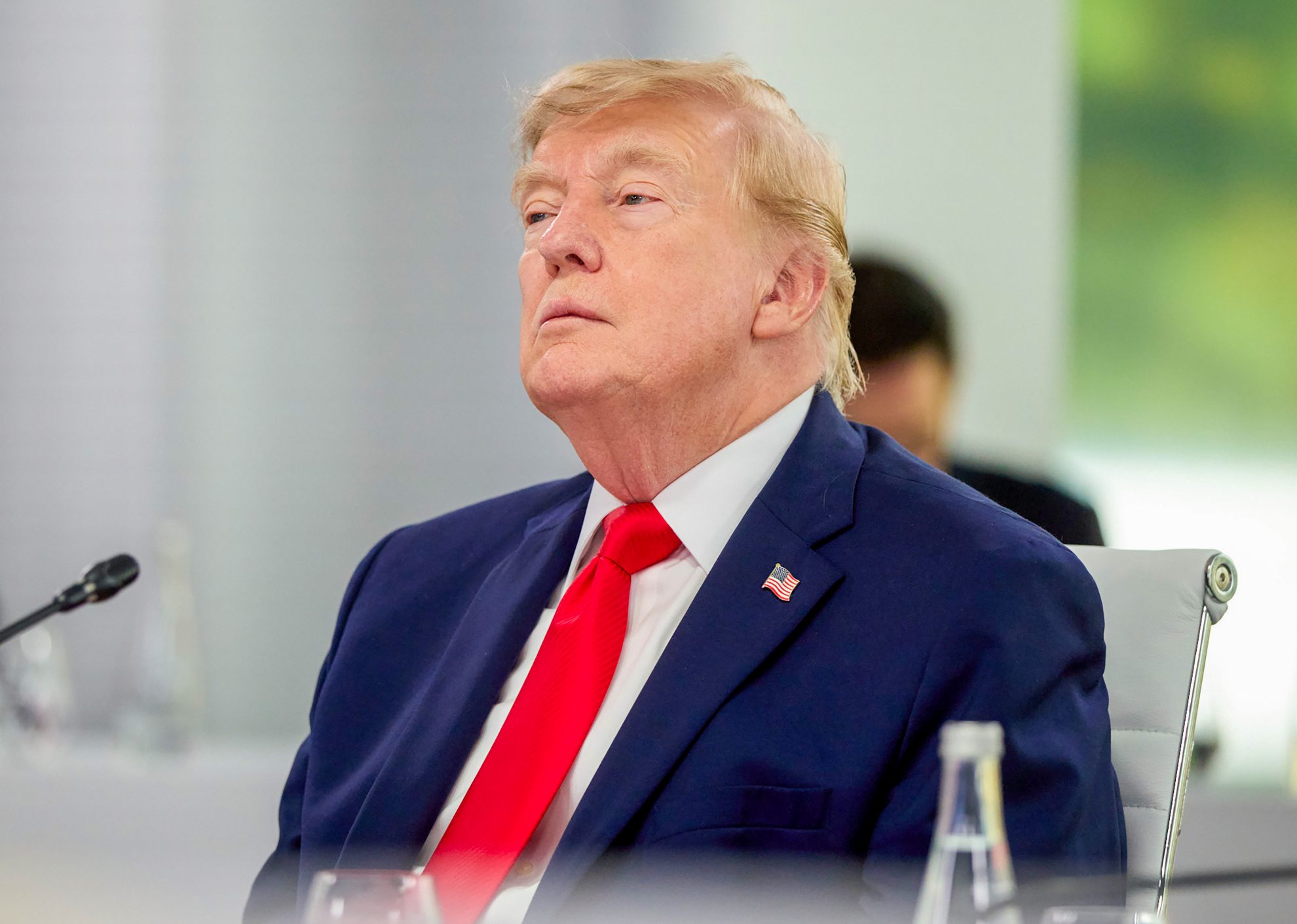
North Carolina: President Donald Trump on Wednesday threatened the European Union with “very serious tariffs”—or a halt to trade “on many things”—if he judged Brussels’ invitation to make Canada the bloc’s first associate member a “hostile act.”
The warning came in Charlotte, North Carolina, hours after European Commission President Ursula von der Leyen, speaking in Strasbourg with Canadian Prime Minister Mark Carney in the chamber, said she wanted to “open the door for Canada to be the first associate member of the EU.”
Trump called the idea “laughable” and branded Canada a “terrible trade partner.” Then he set his own test. “If they do that, if I think it’s at all a hostile act, I will put very serious tariffs or stop trading with Europe on many things,” he told reporters. “If Europe does that with a bad intention—if it’s a good intention, that’s fine—if it’s a bad intention, we’ll put very heavy tariffs on Europe.”
The remark is not a side comment. It lands inside an already open U.S.–Canada trade war. Washington has slapped 50 percent tariffs on a wide list of Canadian goods under Section 338 of the Tariff Act of 1930, accusing Ottawa of discriminating against American autos, dairy and alcohol. Canada has hit back with duties of 15 to 50 percent on about 700 U.S. products worth some $20 billion—steel, dairy, appliances, farm equipment, pulp and paper, and selected electronics. Trump has also ordered federal agencies to strip Canadian-origin goods from U.S. procurement. Further bans on selected Canadian dairy, alcohol and other products are due later this month.
Von der Leyen presented the Canada offer as a response to what she called a “fracture” in the international order and “an openly hostile world.” She said the two sides would lift their existing CETA trade pact into an “Alliance for the Future”: shared work on manufacturing, technology, energy, critical minerals, batteries, AI, quantum, cybersecurity, defence industry and the Arctic. She insisted the partnership was “not against anyone else, but for our common strength.” A Commission spokesman repeated that line after Trump spoke.
The label itself is still a slogan more than a statute. “Associate member” does not exist in the EU treaties. Any such status would have to be invented, negotiated and ratified by member states—a process measured in years, not news cycles. Ottawa welcomed the ambition while cooling talk of instant membership. Addressing the European Parliament on Thursday, Carney said Europe and Canada were “stronger together” against “geopolitical rupture,” and that the point was sovereignty, not a new bloc aimed at Washington.
The stakes are plainer than the legal fine print. Canada still sends roughly 70 percent of its goods exports to the United States. Carney has spent months trying to shrink that exposure after talks with Washington collapsed and after Trump’s repeated talk of Canada as a “51st state.” Europe wants energy, minerals and defence-industrial partners it can count on. Trump’s message is that any detour around the American market can be priced at the American border—if he decides the intention is hostile.
The unresolved question is the one he left hanging: who judges “good intention,” and how fast a standing ovation in Strasbourg becomes a tariff schedule in Washington.
