


By Geetha V P
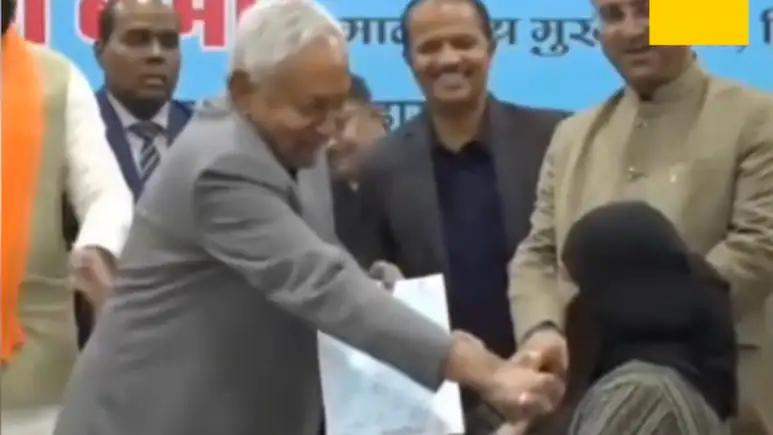
In a brazen act of violation and disrespect, Bihar Chief Minister Nitish Kumar publicly humiliated a qualified Muslim lady Ayush doctor, by forcibly pulling down her naqab during an appointment letter distribution ceremony in Patna on December 15, 2025. This behaviour is utterly unbecoming of a Chief Minister, a public leader entrusted with upholding democratic values and protecting citizens’ rights. Nitish has openly committed a crime, outraging a woman’s modesty under Section 354 of the Indian Penal Code and hurting religious sentiments under Section 295A. The pertinent question now looms: Is he fit to continue as CM? Why hasn’t the Governor issued a show-cause notice under relevant constitutional provisions, demanding accountability for this egregious misconduct?
The incident, captured on video and viral across social media, unfolded as the lady doctor approached Kumar to receive her job letter. With a curt “What is this?”, he reached out and pulled out her veil, exposing her face in front of a crowd. A trained medical practitioner committed to serving the community, she was left stunned. Reports confirm she has rejected the appointment and left Bihar, citing trauma and safety concerns. Her brother revealed to media outlets that she is “determined not to join the service,” a decision that underscores the profound impact of Kumar’s actions on her professional and personal life.
As the controversy enters its fifth day on December 19, 2025, outrage has intensified globally, transcending religious and political boundaries. Opposition figures, civil society, and international bodies have united in condemnation. PDP leader Iltija Mufti has filed a police complaint in Srinagar seeking an FIR against Kumar, accusing him of assault and religious insult. Feminist groups have petitioned the National Commission for Women (NCW) to intervene, demanding action for the public humiliation of a Muslim woman. The Indian American Muslim Council (IAMC) labeled it a “public humiliation of a niqabi woman,” while Amnesty International earlier termed it an “assault on dignity, autonomy, and identity” that normalizes discrimination.
Even allies and neutral voices have recoiled. National Conference leader Omar Abdullah hit back at defenders, questioning the hypocrisy: “Had a Muslim lifted the veil of a Hindu woman?” Congress MP Tariq Anwar called Kumar and his supporters “third-rate people with a cheap mindset,” stressing India’s secular ethos. NCP MP Fauzia Khan equated the act to “disrobing a woman,” a personal violation that demands a public apology—which Kumar has stubbornly withheld. Veteran lyricist Javed Akhtar, despite his critiques of conservative practices, insisted on an unconditional apology, rejecting accusations of selective outrage.
Yet, defenses from Kumar’s camp reveal a disturbing communal underbelly. Union Minister Giriraj Singh dismissively claimed Kumar acted as a “guardian” in “India, not some Islamic country,” suggesting Parveen could “refuse the job or go to hell.” Bihar Health Minister Mangal Pandey touted Kumar’s women’s empowerment record, while Uttar Pradesh Minister Sanjay Nishad’s misogynistic quip—”What would have happened if he touched her somewhere else?”—drew widespread revulsion. These remarks not only justify the indefensible but expose a mindset that prioritizes majoritarian control over individual rights.
Kumar’s act isn’t an isolated lapse; it’s a symptom of deeper issues in Indian politics, where leaders aligned with certain ideologies target minority customs under the guise of “uniformity.” Critics accuse him of advancing an “RSS agenda,” eroding the secular fabric. In a democracy like India, where the Constitution guarantees freedom of religion under Article 25 and equality under Article 14, such intrusions are intolerable. Parveen’s naqab was her choice, a symbol of faith and modesty—no public official has the right to strip it away.
The legal ramifications are clear. Complaints have been lodged, including one reported in Dawn newspaper, highlighting the ceremony’s context. Under the law, this constitutes criminal assault and intentional insult. Yet, enforcement lags. Why the silence from Bihar Governor Arif Muhammad Khan as the constitutional head? He should have, by this time, issued a show-cause notice under Article 163, questioning Kumar’s conduct and potentially recommending President’s Rule if it threatens communal harmony. His inaction raises suspicions of political complicity, especially with Kumar’s alliance with the BJP.
This scandal demands more than rhetoric. The lady doctor deserves justice: a formal apology, compensation, and protection. Nitish Kumar must face investigation, and if unfit, step down. India cannot afford leaders who brazenly flout the law and dignity. As condemnations mount—from West Asia to global rights groups—the veil has been torn not just from her, but from the pretence of equality in Bihar’s governance. Will accountability prevail, or will impunity veil the truth?
