

World Interior Day Special ft. Merino: Why Future Interiors Will Be Defined by Health, Durability & Everyday Performance

For more than six decades, Merino Industries has quietly shaped the way millions experience interior spaces across homes, workplaces and hospitality environments around the world. Right from surfaces that become part of everyday family moments all the way upto advanced chip boards that strengthen kitchens and furniture systems from within, the company’s journey has always remained deeply connected with how people truly live inside their spaces. As World Interior Day brings larger conversations around design, comfort and functionality into focus, Merino believes the future of interiors will increasingly be defined by materials that combine aesthetics with endurance, wellness and dependable everyday performance.
This shift has become visible across almost every corner of contemporary living. Homes have grown far more dynamic over the years. Kitchens witness continuous heat, moisture and movement throughout the day whereas wardrobes, study spaces and dining areas absorb constant handling through changing family routines. Interior materials therefore carry responsibilities far beyond appearance alone. The true quality of a space increasingly depends on how gracefully it performs through years of everyday usage.
Merino has particularly observed a growing preference for interiors that feel calmer and more tactile while continuing to remain highly functional. Loud glossy environments are gradually making way for softer and more understated surfaces that create visual warmth without overwhelming a space. This changing aesthetic language has contributed to the rising relevance of haute matte finishes and feather-touch laminates across wardrobes, wall panels and modular kitchens.
Collections such as Luvih capture this movement through surfaces engineered with near-zero reflectivity that allow light to diffuse softly across interiors. The result is a quieter and more refined visual atmosphere that feels comfortable within modern homes. Alongside their tactile appeal owing to their haute matte finishes, these advanced laminates also support practical everyday living through anti-fingerprint properties and abrasion resistance that help surfaces retain their finish despite repeated handling and continuous usage.
At the same time, decorative materials themselves are becoming increasingly performance-driven. Homeowners and architects now seek surfaces that continue looking elegant while handling years of friction, scratches and demanding conditions. This has encouraged stronger interest in specialised laminates designed around durability as much as aesthetics.
Metallic laminates featuring real metal surfaces are helping designers introduce richer accents into hospitality and premium residential environments while continuing to offer impact resistance suited for high-contact spaces. Decorative laminates infused with textured detailing and layered visual effects are similarly bringing greater material depth into interiors while remaining practical for long-term maintenance and usability. Such materials allow spaces to feel expressive and sophisticated while continuing to support the realities of everyday life.
Among all interior spaces, kitchens perhaps reveal the importance of material engineering most clearly. Heat, steam and moisture constantly challenge cabinetry and furniture structures from within. While decorative surfaces shape the visible personality of a kitchen, the structural board beneath often determines whether the space continues performing reliably years later.
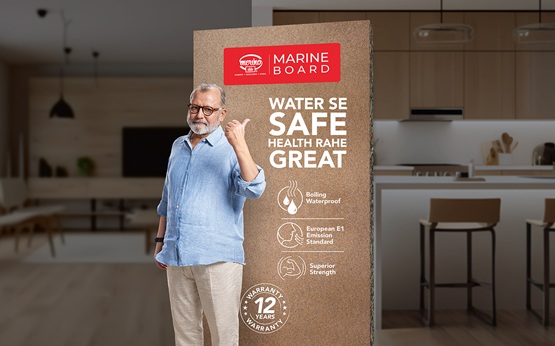
This growing awareness has significantly increased the relevance of chip boards developed specifically for demanding environments. Merino Marine Board has emerged as a strong solution within modular kitchens, wardrobes and utility areas where structural stability becomes essential over long periods of usage. Developed through dense chip-weave core construction, the board delivers superior screw-holding capability together with enhanced load-bearing strength and dimensional stability. Its boiling waterproof properties (even after being submerged in water for over two hours) help cabinetry and furniture systems retain their structural integrity despite prolonged exposure to moisture and continuous usage conditions.
Alongside strength and durability, healthier indoor environments are also becoming central to material conversations. Homeowners & architects are becoming increasingly conscious about the relationship between interiors and overall wellbeing. Low-emission engineered boards aligned with stringent E1 standards are therefore gaining stronger relevance as indoor air quality and healthier living environments continue becoming important considerations across modern homes.
Speaking about this larger transition shaping contemporary interiors, Mr. Manoj Lohia, Director, Merino Industries Ltd. said, “Interior spaces are becoming far more experience-driven and performance-oriented. A lot of our customers & clients increasingly value materials that combine aesthetics with durability along with healthier indoor environments and long-term reliability. The future of interiors will belong to solutions that quietly support everyday living while continuing to perform beautifully through years of use.”
As World Interior Day celebrates the growing influence of thoughtful design within modern life, one thing is becoming increasingly evident. Beautiful interiors will always remain timeless. Yet the spaces that truly endure are often built upon materials that continue supporting everyday life with quiet strength, comfort and reliability long after trends begin to fade away.
