

Danger at The Doorstep: How Illegal Sand Mining Is Wiping Out Alappad, a Kerala Fishing Village

By Geetha V P
(Photos: Suresh Unnithan)
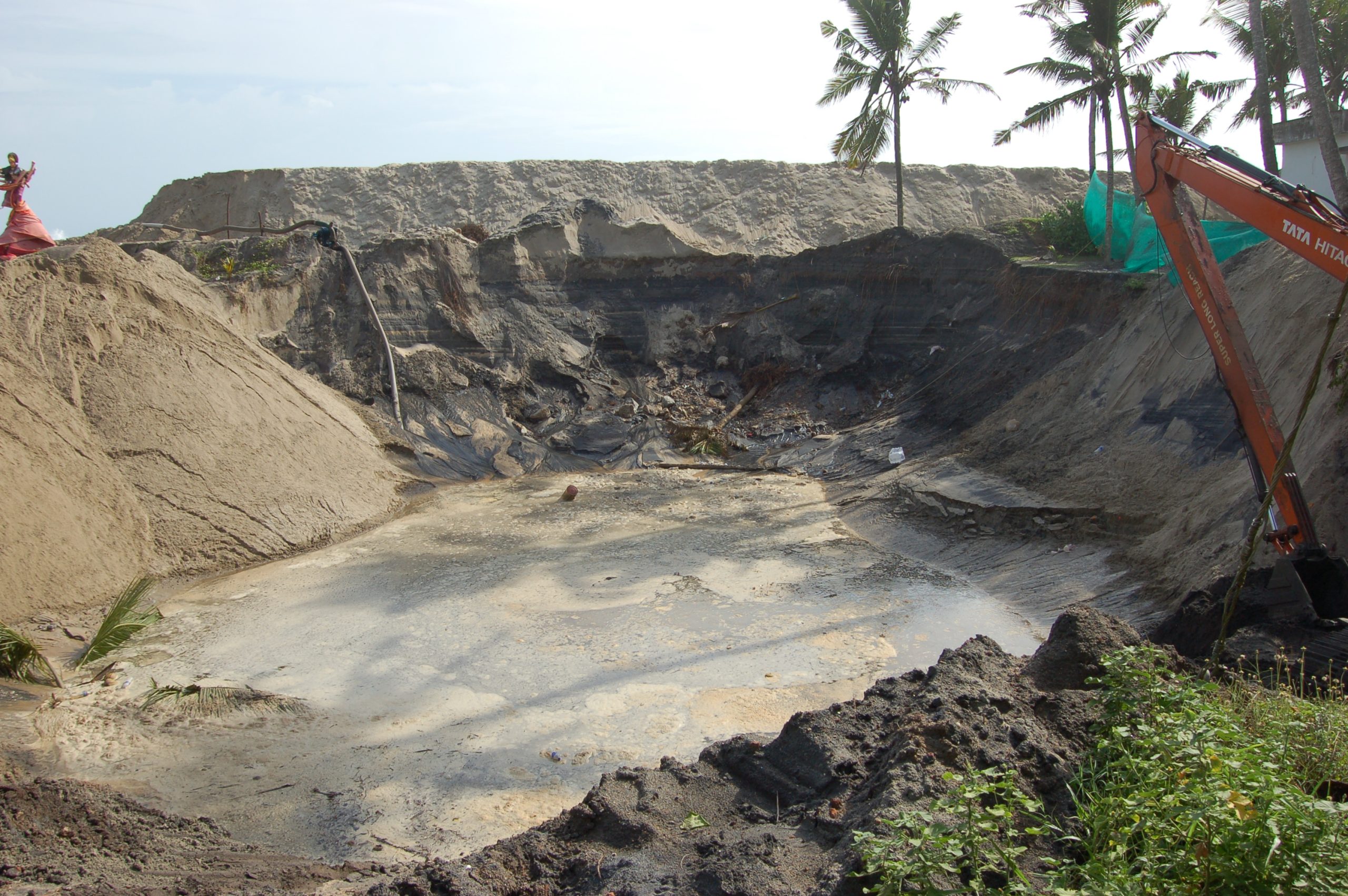
In a modest white house in Alappad — a narrow coastal fishing village in Kerala now facing an existential crisis due to decades of indiscriminate and illegal sand mining — an elderly resident sits quietly on the porch, watching the world. Just a few feet from where he sits, a massive Tata Hitachi excavator operates inside a deep, steep-sided pit that has been carved into the earth directly in front of his home.
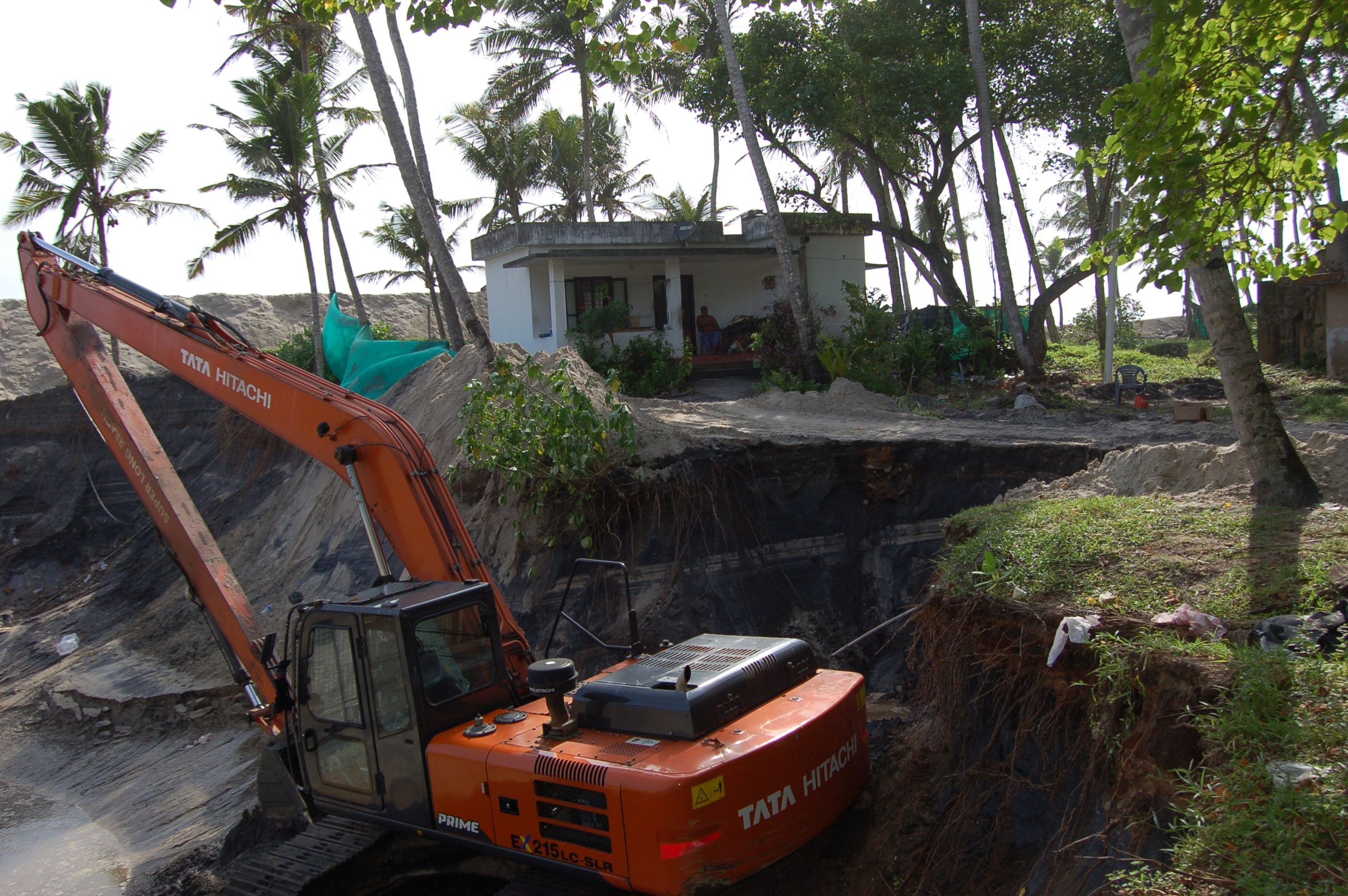
This is not distant mining. This is machine-driven extraction happening at his doorstep, relentlessly stripping away the protective sand layer that once shielded the village from the sea. The walls of the excavation expose layers of soil and tangled roots. Water pools at the bottom. The excavator’s arm swings without pause, removing the very foundation that has kept this fragile coastal strip intact for generations. The photographs taken at the site capture this scene with painful clarity — an elderly man on the porch, the excavator operating metres away, and his house standing precariously on the threatened edge of what remains of Alappad.
This is not an abstract environmental crisis. This is the lived reality of a coastal village being systematically erased — not by natural forces alone, but by unchecked illegal sand mining and the sustained failure of authorities to protect it.
A Village That Has Already Lost Most of Itself
Alappad was once a broad and fertile coastal panchayat spread across nearly 90 square kilometres. Lithographic maps from 1955 recorded an area of approximately 89.5 sq km. Today, that same panchayat has been reduced to barely 7.6 to 8.7 sq km. More than 80 square kilometres — over 20,000 acres — have been lost to the sea.
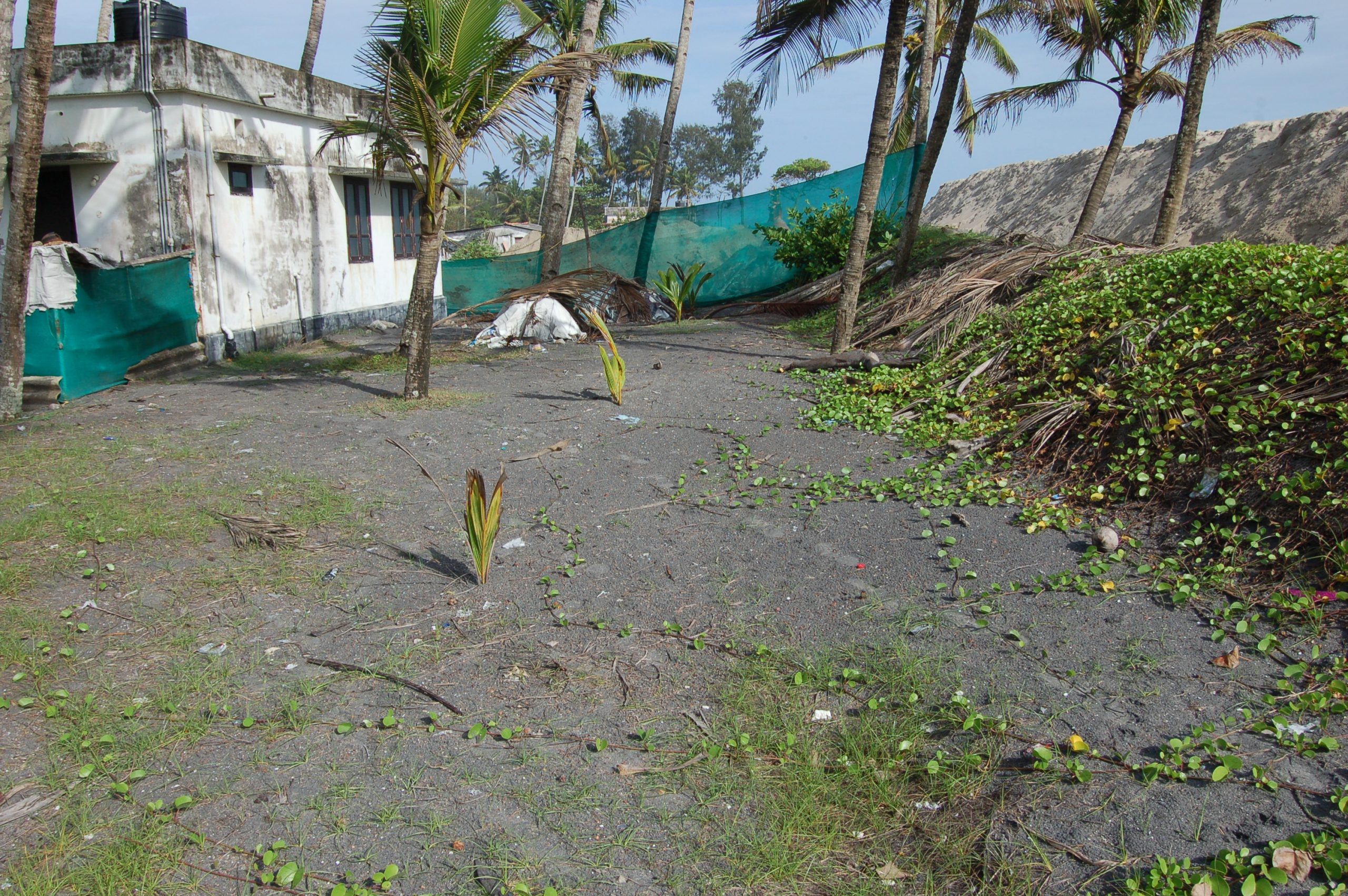
Geospatial studies reveal an even more alarming picture at the ground level. In one monitored coastal stretch, the land area fell by 33.25% between 1985 and 2021. If current trends continue, projections indicate a further 73.5% depletion by 2070. Between 2001 and 2012 alone, 42.81 hectares were lost from a coastal section of 671 hectares, with 85 hectares stripped from the Alappad beach itself.
Shoreline retreat has been equally devastating. In parts of Alappad, the coast receded by 92 metres between 2005 and 2010. During periods of intense mining, erosion rates reached between 13 and over 21 metres per year in affected segments — rates far beyond what natural processes alone would cause.
The Human Cost of a Dying Fishing Village
Alappad was a fishing village. Its identity, its economy, and its culture were woven into the sea. More than 6,000 fishing families have already been forced to abandon their homes. Those who remain live with collapsing livelihoods, saline wells, and the constant fear that the monsoon or high tide could take what little is left.
The elderly resident on the porch represents the quiet suffering of an entire community. These are people who survived the 2004 tsunami, only to watch their village slowly erased in the years that followed. The mining weakened the natural barriers that once protected them. Continued mechanical excavation has made every storm more dangerous. What was once a self-reliant fishing village is now a narrow, precarious strip of land where homes stand on the brink of collapse.
Mechanical Mining Continues Despite Court Orders and Warnings
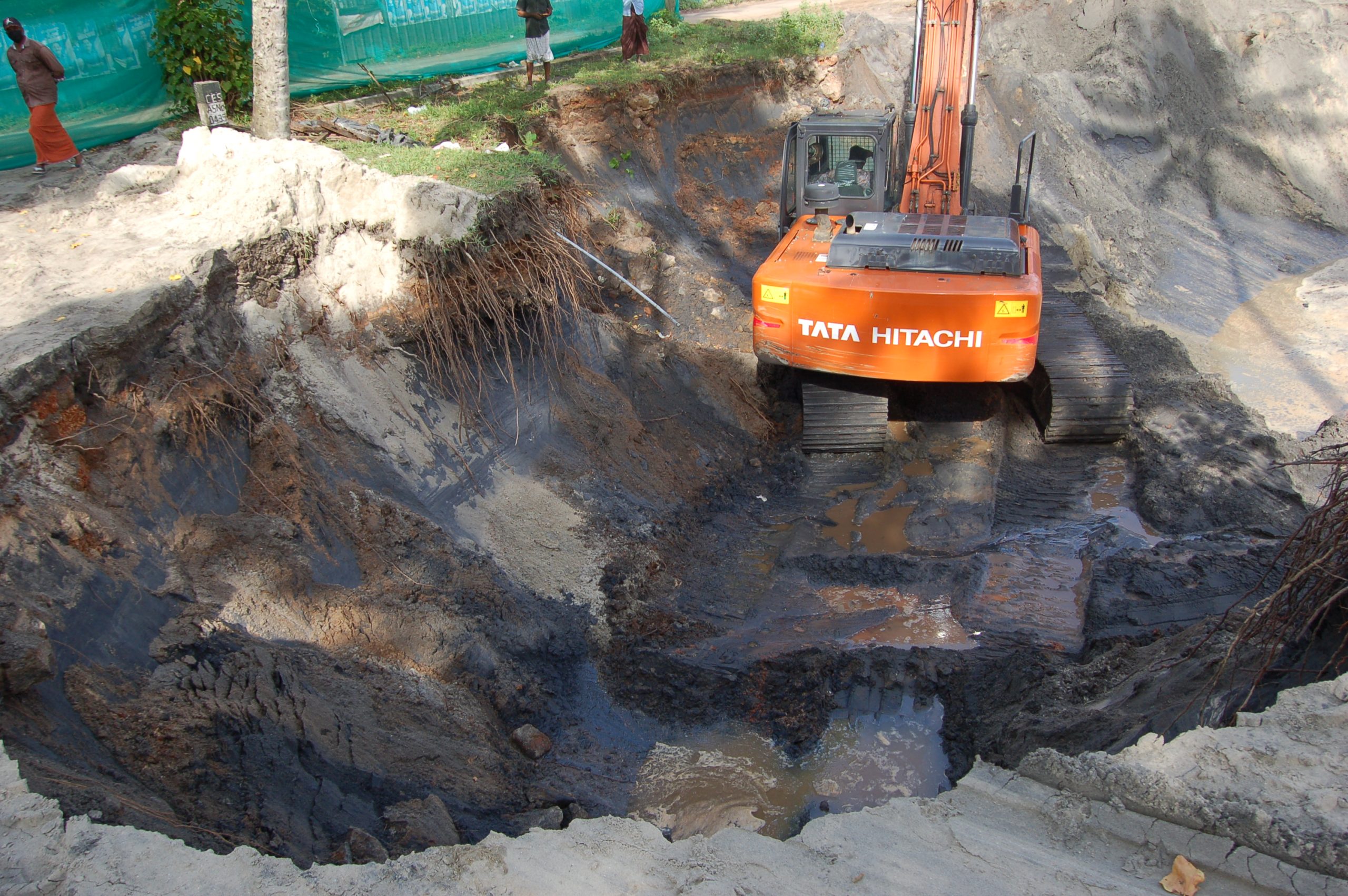
The photographs from the site show heavy machinery operating in direct violation of the spirit of judicial directions and environmental safeguards. Courts and the National Green Tribunal have repeatedly stated that mining in fragile coastal zones must be scientific and must not endanger lives or habitations.
In NGT Original Application No. 76 of 2019, the Tribunal noted that mining volumes in Alappad had “far exceeded the sustainable mining quantity proposed.” It criticised weak enforcement and pointed out the lack of proper Environmental Clearance in some operations. A 2019 petition before the Kerala High Court warned that unscientific excavation was threatening the very existence of Alappad panchayat.
Despite these orders, expert recommendations, and repeated public protests, the excavator continues to work just metres from occupied homes. Deep pits are dug, protective sand is removed, and the remaining land grows narrower with each passing day. The neglect has been consistent — through court cases, hunger strikes, and clear evidence of danger to residents.
A Pattern of Neglect That Has Brought a Village to the Edge of Extinction
The data tells a consistent and painful story: over 80 sq km of land lost, shoreline retreat rates of 10 to 21+ metres per year in hotspots, and the displacement of thousands of fishing families. This is not an unavoidable natural process. It is the result of prolonged mechanical sand mining combined with the repeated failure of authorities to enforce safeguards, implement court directions, or protect a vulnerable community.
The elderly resident sitting on his porch, watching the excavator dig just feet from his home, is the human face of this institutional failure. He and thousands like him are being asked to bear the consequences of decisions — and inactions — made by those in power.
Alappad was never meant to vanish. It was a living, breathing fishing village with deep roots and a strong community. Today it stands on the verge of extinction — not because nothing could be done, but because for too long, not enough was done.
The photographs from the site are not just records of environmental damage. They are evidence of prolonged neglect that has brought a once-flourishing coastal village to the brink of erasure.
A Warning to Those in Power
To the politicians who arrive in Alappad seeking votes: Do not dare to ask for the trust or support of a community whose land you have allowed to be stolen from beneath their feet. The same sand mafia you have failed to confront — or have quietly enabled — is digging the graves of homes, livelihoods, and an entire way of life. Your campaign promises will echo hollow when the next monsoon or high tide claims more families because the protective sand barrier no longer exists.
To those in power and the authorities who have compromised the village’s safety to facilitate the sand mafia: You are not neutral observers. Your inaction, your weak enforcement, and your willingness to look the other way while mechanical excavators operate illegally metres from occupied homes have turned Alappad into a death trap. The NGT and courts have issued clear orders. The science is unambiguous. The human suffering is visible in every photograph. By permitting this plunder to continue, you have not merely failed in your duty — you have become complicit in the endangerment of lives and the erasure of a village.
The elderly man on the porch watching the excavator is not a statistic. He is the living witness to your collective failure. Over 80 square kilometres gone. More than 6,000 families displaced. Erosion rates that no natural process can explain. Every bucket of sand removed without scientific limits brings the sea closer to swallowing what remains.
This is no longer a matter of debate or delay. The illegal mechanical sand mining in Alappad must stop immediately. Court orders must be enforced without exception or political interference. Those who enable or protect the sand mafia — regardless of their position or connections — must be investigated and held accountable under the law. The people of Alappad have already paid with their land, their homes, and their peace. They will not pay with their lives while those responsible escape consequences.
The photographs stand as irrefutable testimony. They show not only environmental destruction, but institutional betrayal. The sea is relentless, but so is the demand for justice. Those who hold power today will be remembered tomorrow — either as the ones who finally acted to save what was left of Alappad, or as the ones who stood by while a fishing village was wiped off the map.
The time for meaningful intervention is now. Before the last homes, and the last elders who still remember what Alappad used to be, are lost forever.
