


By Team PNI News
On 4 August 2026, Kerala Health Minister K. Muraleedharan announced the constitution of a four-member committee to draft legislation for an independent AYUSH University. Chaired by the Principal Secretary of the AYUSH Department, with the State Mission Director of the National AYUSH Mission as convener, and including the Director of Ayurveda Medical Education and the Principal and Controlling Officer of the Government Homoeopathic Medical College, the panel has been given two months to submit the draft Bill. The university is proposed to be headquartered at the School of Fundamental Research in Ayurveda (SFRA) in Tripunithura and is intended to bring all AYUSH educational institutions currently affiliated to the Kerala University of Health Sciences (KUHS) under a single umbrella. Official statements describe the move as a “historic step” to strengthen education, research, clinical services and drug development in Ayurveda, Homoeopathy, Siddha, Unani and related systems.
On paper, the rationale appears plausible. Kerala has a significant AYUSH ecosystem comprising roughly 17–18 Ayurveda colleges (government, aided and private), about six Homoeopathy colleges, and limited Siddha and Unani institutions. A dedicated university could, in theory, offer focused academic governance, specialised research pathways and clearer institutional identity. Yet the announcement has triggered strong opposition from the All Kerala Government Ayurveda College Teachers’ Association and the Ayurveda Medical Association of India (AMAI). Both organisations have pointed out that no demand for a separate university ever came from teachers, students or professional bodies in the AYUSH sector. The decision was taken without meaningful consultation. Critics warn that detaching AYUSH from KUHS will isolate these systems from interdisciplinary collaboration, shared research platforms and the mainstream health sciences ecosystem, while imposing heavy administrative costs on a relatively small number of institutions. Apprehensions have also been expressed that the land and infrastructure of the SFRA, meant for fundamental research, may be diverted.
The Legal and Administrative Process
Establishing a state public university is primarily a legislative act of the State. The sequence is clear: government decision and formation of a drafting committee (already done); preparation of the draft Kerala AYUSH University Bill covering objects, powers, authorities, officers, affiliation rules, finances and transitional provisions; Cabinet approval; passage by the Kerala Legislative Assembly; assent by the Governor (or the President if reserved under Article 200); and Gazette notification, after which the university comes into existence as a body corporate. No prior central permission is required to legislate a state university. Once established, however, further regulatory compliance becomes essential.
UGC Norms for Recognition
Under the University Grants Commission Act, 1956, a university established by a State Act is included under Section 2(f) after the UGC receives a copy of the Act. This recognition is largely automatic. Eligibility to receive central grants under Section 12(B) is a separate and more rigorous process. The university must apply, after which UGC examines infrastructure, faculty strength and quality, libraries, laboratories, academic programmes and financial sustainability. An expert committee usually conducts an on-the-spot assessment. Only after the Commission is satisfied is the university declared fit under Section 12(B). Without this status, access to most central funding and research grants remains closed. The university must also comply on a continuing basis with UGC regulations on teacher qualifications, minimum standards of instruction, specification of degrees and related norms.
NCISM Requirements and MESAR 2024 Norms
For AYUSH professional education, the National Commission for Indian System of Medicine (NCISM) and its Medical Assessment and Rating Board exercise primary regulatory control under the NCISM Act, 2020. The new university will function as the affiliating body, but affiliation alone does not confer the right to run courses or award recognised degrees. Existing colleges transferring from KUHS will require formal consent of affiliation from the new university and continuous permission from NCISM. New colleges or increases in seats must comply with Section 29 procedures, including Essentiality Certificate from the State Government, consent of affiliation, and full adherence to the Minimum Essential Standards, Assessment and Rating (MESAR) Regulations, 2024.
Infrastructure norms under MESAR 2024 (scaled to intake of 60, 100, 150 or 200 seats) include:
Land: 3.0 / 5.0 / 7.0 / 9.0 acres in general areas; lower thresholds (2.5 / 3.5 / 5.0 / 6.0 acres) in Tier-II cities, North-Eastern States, hilly and tribal areas; calculated on constructed-area basis in mega/metro cities. Land must be owned or held on long-term lease (minimum 30 years), not more than two plots, and clearly demarcated exclusively for college, hospital and hostels.
Teaching hospital: Beds broadly aligned with intake (approximately 1:1); minimum average daily OPD of 120 / 200 / 300 / 400 patients respectively; prescribed bed occupancy; required clinical units including Panchakarma, Kriyakalpa, operation theatres and labour facilities.
Campus requirements: Scaled built-up area, biometric attendance, CCTV, functional IT cell/digital library, proper compound wall and security. Faculty rooms must provide minimum constructed areas of 15 sq m (Professor), 13 sq m (Associate Professor/Reader) and 10 sq m (Assistant Professor/Lecturer).
Faculty norms under MESAR 2024: Fourteen teaching departments are mandated. Minimum teaching staff is prescribed in Schedule IV and scales with intake. Each department generally requires a combination of Professor, Associate Professor/Reader and Assistant Professor/Lecturer (with additional posts in some subjects such as Samhita & Siddhanta). Excess higher faculty may compensate for lower faculty, but not the reverse. Qualifications and experience follow the NCISM (Minimum Standards of Undergraduate Ayurveda Education) Regulations, 2022. Teachers must hold unique NCISM teacher codes, maintain at least 75 per cent attendance of working days, and be provided individual rooms. Postgraduate programmes require additional dedicated faculty beyond undergraduate norms. Degrees must satisfy Section 35 criteria for national recognition.
Homoeopathy institutions fall under the parallel National Commission for Homoeopathy framework with analogous requirements.
Documented Gaps in Kerala’s Existing AYUSH Colleges
Any new university must confront the concrete deficiencies already present. The CAG Performance Audit on Public Health Infrastructure and Management of Health Services (Report No. 6 of 2024) recorded teaching-staff vacancies of approximately 20 per cent against sanctioned strength at the Government Ayurveda Medical College, Thiruvananthapuram, and around 32 per cent at the Government Homoeopathic Medical College. Across the wider AYUSH department, vacancies stood at 8.15 per cent for doctors, 16.69 per cent for nurses, 5.49 per cent for paramedics and 14.36 per cent for other staff.
NCISM annual visitations routinely flag shortfalls. Recent inspections have recorded non-teaching staff availability as low as 80 per cent of required strength, with multiple laboratory technician posts vacant across core departments. Several colleges have received only conditional, extended or yearly permissions, and in some cases seat reductions. At the Government Ayurveda College, Tripunithura, the academic block was designed for a much smaller intake; space constraints persist and a new academic block remains unfunded. Operational incidents, including temporary hostel closure following water contamination linked to maintenance and staff shortages, underline fragility. Self-financing colleges under the Kerala State Indian System of Medicine Self Financing College Management Association have stated that meeting MESAR 2024 requirements for additional teachers, expanded non-teaching cadres, larger OP and classroom spaces, upgraded laboratories and IT infrastructure imposes costs they cannot sustain. Many already operate with substantial vacant seats.
Financial and Administrative Realities
A functional university requires adequate land, academic and administrative buildings, examination infrastructure, specialised laboratories, libraries, hostels, staff housing and teaching hospitals meeting MESAR norms. Using the existing SFRA campus raises questions about expansion capacity and protection of its research mandate. Capital costs for construction or major upgradation, plus recurring expenditure on a full university hierarchy, will be substantial. Without firm multi-year state budgetary commitment, the institution risks remaining under-resourced and unable to bring its affiliated colleges into full MESAR compliance.
Hurdles and the Question of Intent
Practical obstacles are formidable: Kerala’s fiscal constraints, the cost of creating a new administrative structure for a limited number of colleges, the complexity of affiliation transfer, recruitment of the full cadre of qualified faculty required under MESAR 2024, simultaneous satisfaction of UGC 12(B) criteria, and the need to close existing quantified gaps. The absence of prior demand from the AYUSH academic community itself, and the lack of consultation, have fuelled legitimate suspicion.
Conclusion
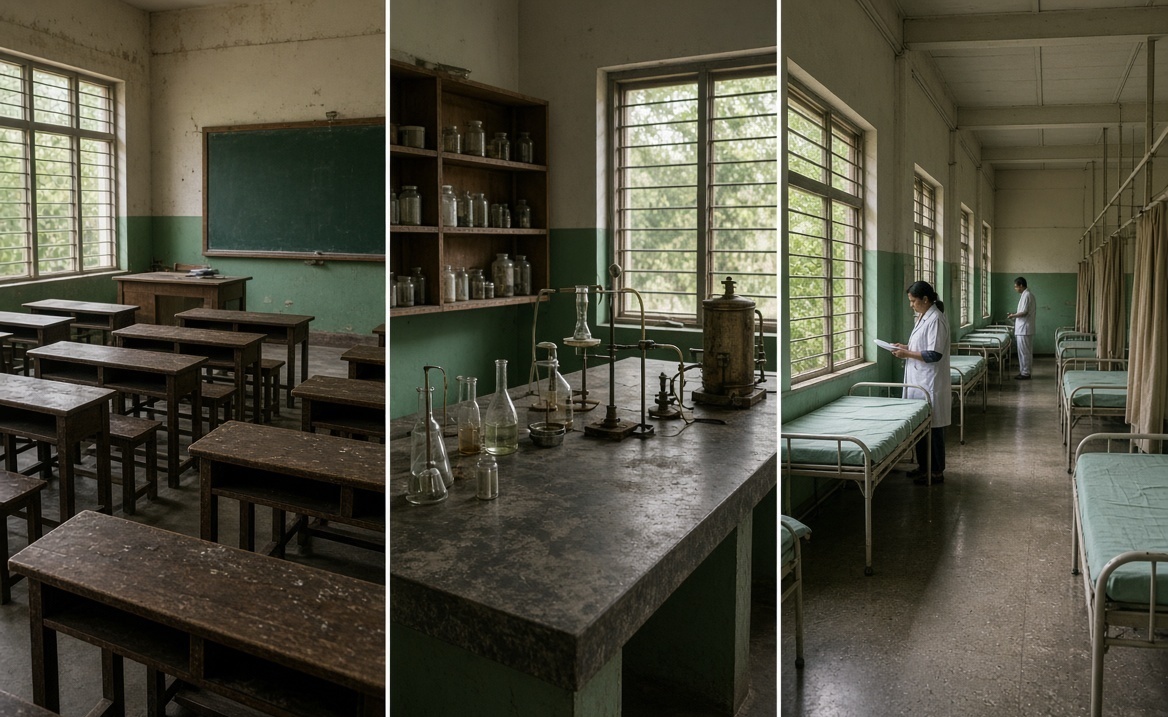
In its present form, the proposed AYUSH University is poised to become a lasting liability on the State exchequer rather than an instrument of academic or clinical progress. Erecting a full-fledged university apparatus—Vice-Chancellor, Pro-Vice-Chancellor, Registrar, examination machinery and the accompanying bureaucracy—for a limited cluster of institutions will lock in substantial capital outlays and recurring expenditure. Set against the CAG-documented teaching vacancies of 20–32 per cent in major government colleges, the non-teaching shortfalls repeatedly flagged by NCISM inspections, and the persistent physical infrastructure deficits, this financial commitment appears both disproportionate and indefensible.
More damaging still is the growing suspicion that the project is designed, whether by calculation or by convenient default, to isolate AYUSH—particularly Ayurveda—from the mainstream health education and service architecture. By severing these disciplines from the Kerala University of Health Sciences, the move risks dismantling interdisciplinary collaboration, diluting shared research capacity and diminishing institutional voice. Such segregation does not strengthen traditional systems; it quarantines them. In doing so, it drives a wedge through the health system itself, fragmenting what ought to remain an integrated continuum of education, research and care.
The absence of any prior demand from the AYUSH academic community, the lack of meaningful consultation, and the haste with which the drafting committee has been constituted only reinforce this apprehension. A responsible government would pause, consult the teachers and practitioners who will actually bear the consequences, commission a transparent feasibility study that quantifies both MESAR 2024 compliance costs and existing gaps, and design an institutional framework that builds bridges rather than burns them. Without these elementary safeguards, the project risks becoming an expensive administrative manoeuvre that weakens the very systems it claims to elevate—while burdening the public purse for years to come.
*Edited By Suresh Unnithan
