


By Nanditha Subhadra
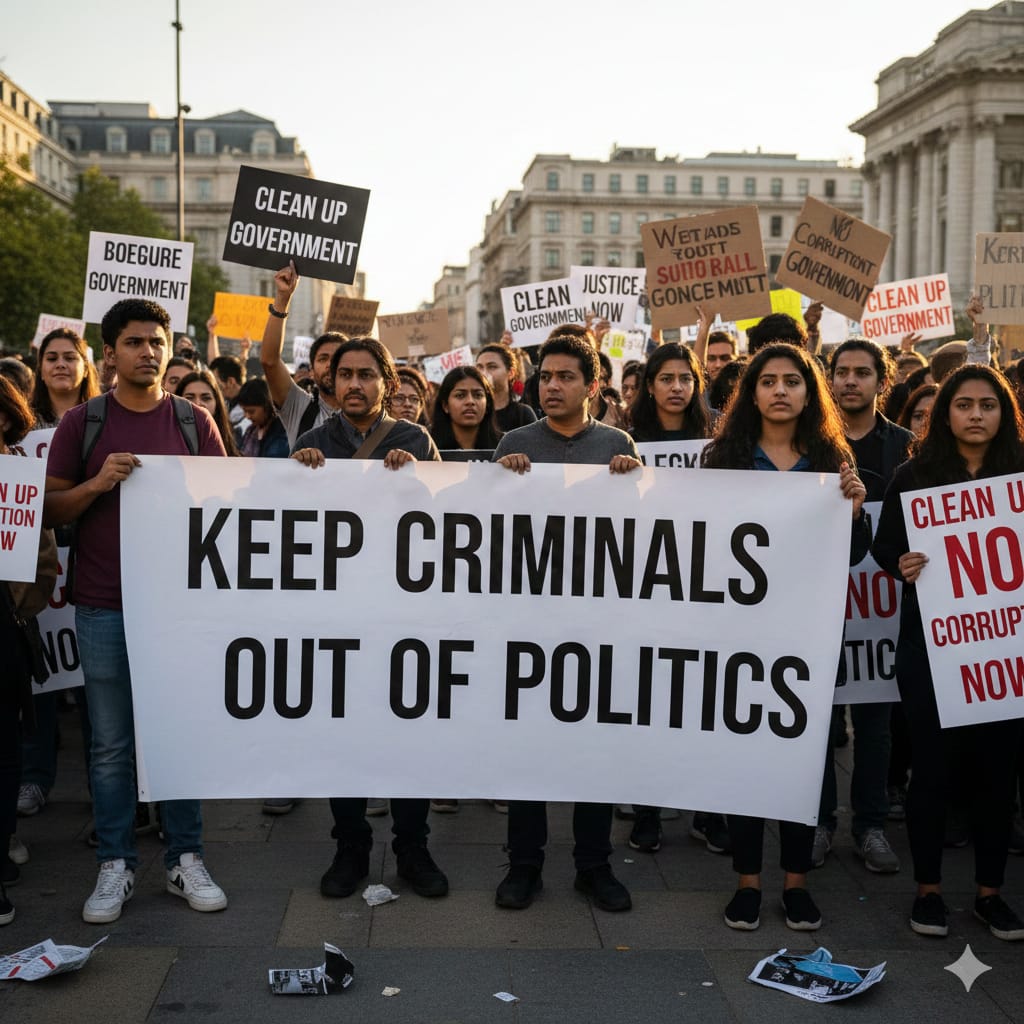
In a nation founded on the ideals of equality, justice, and accountable governance, India’s political landscape has increasingly come to resemble an arena dominated by money, muscle power, and impunity. What was envisioned as a vibrant democracy has, for many citizens, devolved into a system where elected representatives treat power as a licence for personal enrichment and where voters are reduced to mere subjects rather than sovereigns. As George Bernard Shaw once quipped, “Politics is the last resort of the scoundrel” — a phrase that rings painfully true for millions of Indians who see their leaders as parasites living off taxpayer-funded perks while delivering little in return. This is not just anecdotal frustration; credible data paints a stark picture of criminalisation, unchecked wealth accumulation, and democratic backsliding that undermines the very foundations of the Indian Constitution.
The Criminalisation of Politics: Lawbreakers Becoming Lawmakers
One of the most disturbing trends in Indian politics is the rising presence of individuals with criminal backgrounds in legislative bodies. Recent reports from the Association for Democratic Reforms (ADR) highlight the depth of this crisis:
• In 2025 analyses, nearly 47% of ministers across the Union Cabinet, state assemblies, and Union Territories declared criminal cases against themselves, with 27% facing serious charges such as murder, attempt to murder, kidnapping, and crimes against women.
• Among MLAs, around 45% (1,861 out of over 4,000 analysed) have criminal cases, with particularly high rates in states like Andhra Pradesh, Bihar, Kerala, and Telangana.
• In the 2024 Lok Sabha elections, 46% of winning MPs (251 out of 543) declared criminal cases, marking a steady increase from previous terms.
This issue transcends party lines, affecting the BJP, Congress, regional parties, and others alike. Alarmingly, candidates with criminal records enjoy higher “winnability” — a success rate of around 15% compared to just 4-5% for those with clean backgrounds — often due to muscle power, financial clout, and voter perceptions of “strongman” leadership. Politicians frequently delay trials through legal tactics, enjoying near-impunity while in office. Despite Supreme Court concerns and calls for reforms like lifetime bans on convicted leaders, meaningful change remains elusive.
No Qualifications Required: The Unqualified Ruling the Qualified
India stands out globally for requiring no minimum educational or professional qualifications to contest elections or hold high office. An illiterate individual or one with a criminal history can oversee portfolios managing highly qualified IAS/IPS officers, judges, or the armed forces.
While education levels among MPs have improved — with 77-80% of 2024 Lok Sabha members being graduates or higher — this remains voluntary. Many leaders lack even basic familiarity with the Constitution they swear to uphold, leading to inefficiency, policy missteps, and opportunities for corruption. Civil servants, selected through rigorous exams, often face transfers or harassment for resisting political interference, inverting the hierarchy of merit and accountability.
Explosive Wealth Growth: From Servants of the People to Billionaires
The rapid accumulation of wealth by politicians during their tenure is a glaring red flag of systemic corruption. ADR data reveals:
• Ministers’ collective assets exceed ₹23,929 crore, with an average of ₹37.21 crore per minister and several billionaires in the mix.
• Examples include Andhra Pradesh CM Chandrababu Naidu (₹931 crore) and others whose assets surge 200-500% in a single term, far outpacing legitimate income from modest salaries (₹1-2 lakh/month for MPs/MLAs).
Disproportionate assets cases rarely lead to convictions due to political influence over investigations. The nexus of black money in elections and post-power rewards perpetuates this cycle, turning public service into a lucrative enterprise.
Public Cynicism: Tax-Funded Parasites in a Compulsory Democracy
Deep-seated distrust is evident in public perception. India’s score on the Corruption Perceptions Index hovers around 38-40/100, signalling rampant corruption. Surveys show a majority viewing politicians as corrupt, yet elections feel like choosing the “lesser evil” — with NOTA irrelevant and controversies surrounding EVMs. Taxes fund lavish perks for leaders who prioritise self-enrichment through scams, kickbacks, and cronyism.
In a poignant example, actor-turned-politician Suresh Gopi referred to voters as “praja” (subjects) in Malayalam, a term evoking monarchy rather than democracy — yet it provoked little outrage, suggesting a weary acceptance of this power imbalance.
Democratic Backsliding: From World’s Largest Democracy to Electoral Autocracy
Global watchdogs confirm the regression:
• Freedom House (2025) rates India as “Partly Free”, citing discriminatory policies, press intimidation, and restrictions on civil society.
• The V-Dem Institute (2025) classifies India as an “Electoral Autocracy” since 2018, with democracy levels akin to the 1975 Emergency era, marked by declines in expression, media freedom, and institutional autonomy.
Multiparty elections persist, but their fairness is undermined by money, muscle, and institutional capture.
An Inevitable Reckoning?
Trapped in a system where alternatives are scarce or equally compromised, public frustration simmers. Past movements like Anna Hazare’s anti-corruption campaign yielded limited results, but high voter turnout, rising NOTA votes, anti-incumbency swings, and social media dissent hint at brewing discontent. Economic stagnation fuelled by corruption could spark wider unrest.
India’s democracy is not failing because of its people, but because of those entrusted to protect it. Decriminalising politics, enforcing wealth scrutiny, mandating qualifications, and restoring accountability are urgent imperatives. Until then, the scoundrels will continue to thrive — and the public will bear the cost. The question is not if change will come, but whether it will heal or further fracture the nation.
