


By Nanditha Subhadra
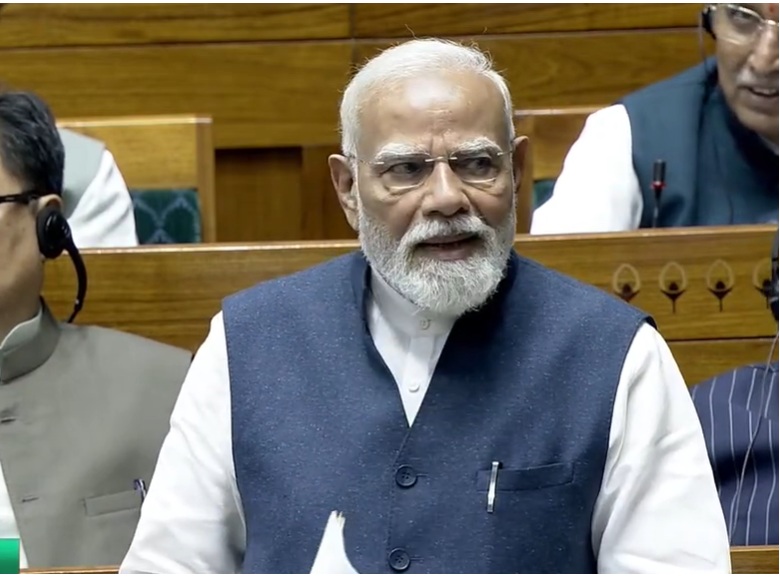
When Prime Minister Narendra Modi addressed the nation yesterday, the people of India saw something they had rarely witnessed before: a visibly shattered leader. Gone was the trademark over-confidence, the assertive swagger, the chest-thumping certainty that had defined his public appearances for over a decade. Instead, viewers were treated to a nervous, almost pleading Modi – a lost warrior desperately appealing to the women of India to rescue him from the looming electoral fiasco triggered by Friday’s parliamentary debacle. His body language betrayed deep anxiety: shoulders slightly hunched, eyes flickering with unease, voice carrying an uncharacteristic tone of supplication rather than command. For the first time, the “strongman” of Indian politics sounded less like a conqueror and more like a cornered politician begging for a lifeline.
This rare moment of vulnerability came barely 24 hours after the Constitution (131st Amendment) Bill, 2026 – a clever cocktail of one-third women’s reservation mixed with the potent poison of delimitation – crashed spectacularly in the Lok Sabha. For the first time in twelve years, a major constitutional amendment piloted by the Modi government failed to secure the required two-thirds majority. The bill managed only 298 votes in favour against 230 nays. The opposition, long dismissed as a quarrelsome bunch, suddenly discovered the joys of unity and voted in near-perfect harmony. The BJP’s grand strategy to redraw the electoral map under the pious banner of “Nari Shakti” had been unceremoniously shown the door. And the man who once boasted he never loses parliamentary battles found himself staring at an unfamiliar sight: defeat.
In Saturday’s address, Modi offered a dramatic “sorry” to the mothers and sisters of India whose “dreams were crushed” by the heartless opposition. With the sincerity of a schoolboy who forgot his homework, he lamented that the bill’s failure amounted to “bhrun hatya” – foeticide – of women’s empowerment itself. The subtext was loud and clear: the villainous opposition had blocked Nari Shakti, and Indian women should now rise in righteous anger against those who dared oppose their great benefactor. Never mind that the original Women’s Reservation Bill had already been passed in 2023 with broad support. Never mind that this new package was cleverly handcuffed to a contentious delimitation exercise that would have used older census data to expand and redraw Lok Sabha seats, raising genuine fears among southern states about losing political influence to the more populous north. In Modi’s narrative, inconvenient facts were airbrushed away; raw emotion and guilt-tripping took centre stage.
The delicious, unintended comedy lay in the selective amnesia on full display. This was, after all, the same Narendra Modi who in 2019 had looked solemnly into the camera and urged first-time voters to honour the Pulwama martyrs by pressing the lotus button. National security, Balakot strikes, and emotional patriotism were deployed with surgical precision to secure victory. Fast-forward to 2026, and here was the same leader, back on national television, this time trying to mobilise women by framing a simple arithmetic failure as a grand conspiracy against their empowerment. When numbers fail, invoke guilt and division – the old playbook remained intact. Only this time, the audience seemed far less enchanted. Indian women, it turns out, are not politically forgetful. They remember who supported the core idea of reservation and who tried to bundle it with a delimitation package that smelled more of electoral engineering than genuine gender justice. Selective feminism, much like selective nationalism before it, appears to have a rather short expiry date.
What made the Saturday speech truly priceless was the unmistakable evaporation of the once-impenetrable aura of invincibility. For years, Modi has cultivated the image of the unflappable strongman – the leader who stares down global powers, hugs world leaders, and turns every crisis into a perfectly lit photo-op. Here, suddenly, was that same figure sounding less like a statesman addressing 1.4 billion people and more like a desperate candidate fighting for political survival. The anxiety was palpable: the voice carried an edge of panic, the rhetoric felt forced, and the attempt to split the opposition through clever bill drafting had spectacularly backfired. Instead of dividing the INDIA bloc, the bill had strengthened their unity. Parties that rarely agree on anything closed ranks during the voting, turning what was meant to be a wedge issue into unexpected glue. The opposition that was supposed to fracture emerged smelling of victory, while the government that prides itself on tactical brilliance found itself tactically outmanoeuvred in its own House.
There is an almost Shakespearean tragicomedy to the entire episode. The master tactician, long celebrated for reading the pulse of the voter with uncanny accuracy, now appears shaken by the realisation that the ground beneath his feet is shifting faster than expected. The bill was designed to paint the opposition as anti-women; instead, they successfully framed the move as anti-federalism and anti-south. The masterstroke intended to redraw boundaries in the ruling dispensation’s favour has instead redrawn the political narrative in deeply uncomfortable ways. For a leader who has spent years projecting the “never blink” persona, the address revealed something refreshingly, hilariously human: even the sturdiest 56-inch chests can develop nervous tremors when parliamentary majorities prove elusive and the road to 2029 looks increasingly foggy.
Indian voters – particularly the women being so earnestly courted with pleas and apologies – are not politically naïve. They can easily distinguish between authentic empowerment and a hastily repackaged electoral gambit. They remember the 2019 emotional appeals invoking martyrs to sway first-time voters. They notice when a Prime Minister’s address shifts from governance and vision to grievance and victimhood. Saturday’s speech was not merely an acknowledgment of legislative failure; it was an unwitting broadcast of political vulnerability. The anxiety that once remained hidden behind layers of confident oratory was now on full, unfiltered display – raw, visible, and laced with the kind of dark humour that only real-life Indian political theatre can provide.
The delimitation debacle has achieved what years of opposition speeches could never manage: it has humanised Narendra Modi in the most unflattering light possible. Not as the eternal victor or the invincible leader, but as a politician who has finally glimpsed the limits of power, the fragility of majorities, and the reality that even the most meticulously crafted narratives can collapse when the votes simply refuse to align. The panic is no longer concealed. It is there for the entire nation to witness – awkward, exposed, and, in its own awkward way, comically revealing.
In the end, the biggest joke of the week wasn’t written by any opposition cartoonist or stand-up comedian. It unfolded live on national television, delivered straight from the highest office in the land. The punchline? Even the strongest of strongmen occasionally stumble when their own masterstroke turns out to be a self-inflicted tripwire. And for once, the legendary 56-inch chest seems to be measuring a little closer to ordinary human proportions – complete with the occasional, very visible tremble of a leader who realises that power, like confidence, can dwindle faster than expected.
