

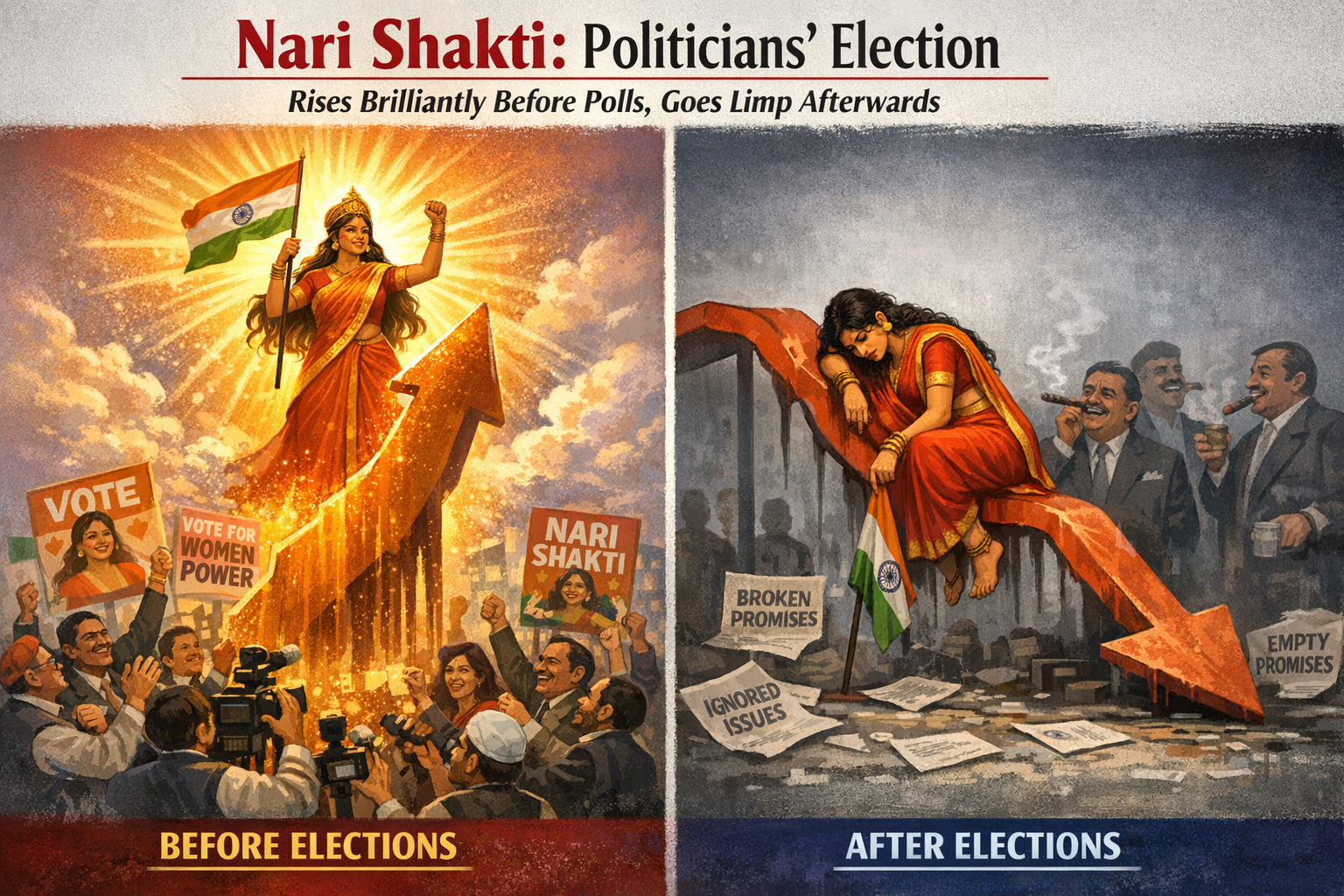
Nari Shakti: Politicians’ Election Viagra – Rises Brilliantly Before Polls, Goes Limp Afterwards

By Suresh Unnithan
In the dazzling circus of Indian politics, nothing elicits louder applause than politicians declaring eternal love for women. They croon Nari Shakti with the passion of a Bollywood hero in the climax scene—chest puffed, eyes misty, voice quivering with fake emotion. Yet the moment the credits roll (or rather, the votes are counted), the heroine is back in the kitchen, dodging slaps, acid, and worse, while the hero jets off to the next rally. It is the world’s longest-running romantic scam: boy promises quota, boy delays quota, boy blames rival boy, girl pays the price in blood and tears. Hilarious? Only if your sense of humour includes black comedy where the punchline is another NCRB statistic.
The latest blockbuster is the Women’s Reservation Bill saga. In 2023, the NDA government, led by the Prime Minister Narendra Modi himself, thundered that this was the golden ticket to Nari Shakti Vandan—33% seats for women in Parliament and assemblies. Speeches flowed like Ganga in monsoon: empowerment! History in the making! Selfies with women in traditional attire flooded timelines. The bill passed with much back-slapping and unanimous nodding. Fast-forward to 2026: the law has been “notified,” but implementation remains tied to the sacred ritual of delimitation and a fresh census. Suddenly, a shiny new package of bills appears—Constitution amendments, Delimitation Bill—perfectly calibrated to redraw maps using convenient old data. Opposition screams “gerrymandering for 2029!” Ruling side insists it is pure constitutional piety. Women? Still waiting in the queue, like always. The bill meant to “strengthen” them has become the ultimate political condom: protective in rhetoric, useless in practice.
This is not new. The script was written decades ago by the maestros of duplicity. Remember Shah Bano? In 1985, the Supreme Court had the audacity to say an elderly divorced Muslim woman deserved maintenance. Rajiv Gandhi’s Congress, masters of minority management, rushed a bill to overturn it—pleasing clerics, burying women’s dignity, and securing votes. Congress wept for “secularism” while sacrificing a poor old lady on the altar of electoral arithmetic. Today, the same party lectures others on women’s rights. The BJP, meanwhile, has turned Nari Shakti into a sleek marketing slogan—slicker than any startup pitch. Both sides play the same game: use women as electoral Tinder swipes—right for power, left for actual safety.
The real laugh riot begins when you juxtapose the lofty slogans with the ground reality. While leaders compete to be crowned “Champion of Women,” the National Crime Records Bureau quietly tallies the body count. In 2023, India recorded 4,48,211 crimes against women—a marginal but steady rise from 4,45,256 in 2022. That is roughly 51 cases every hour. Cruelty by husband or relatives still dominates at nearly 30% (over 1.33 lakh cases), followed by kidnapping and abduction (88,605 cases), assault to outrage modesty (83,891), and rape (around 29,670–32,000 depending on the exact slice). The national rate hovers at 66.2 per lakh women. NFHS data adds the domestic horror: over 30% of ever-married women have faced physical, sexual, or emotional violence. Under-reporting? A national sport. Most bruises never make it to a police station because the system is slower than a politician’s integrity.
The past two decades read like a never-ending horror franchise, with politicians providing only trailer-level outrage. 2012: Nirbhaya—nationwide protests, new laws, promises of fast-track justice. Mindsets? Unchanged. 2017-18: Unnao, where power allegedly shielded the accused. 2018: Kathua— an eight-year-old raped and killed in a temple, communal politics turning justice into a circus. 2019: Hyderabad veterinarian raped and set ablaze—more vows of “zero tolerance.” 2020: Hathras—Dalit woman gang-raped, body hurriedly cremated. Then RG Kar in Kolkata (2024), a doctor murdered on duty, exposing how even hospitals are unsafe. Each horror sparks marches, hashtags, and prime-time tears from every party. Each time, a new committee or ordinance is announced with fanfare. Each time, the next year’s NCRB report laughs in their faces. Dowry deaths, acid attacks, POCSO cases— they climb while Nari Shakti speeches multiply like rabbits.
What makes this satire deliciously dark is the breathtaking hypocrisy. Congress pioneered the art of shedding crocodile tears while gutting women’s rights for vote banks. BJP refined it into a high-decibel brand campaign. They bicker like divorcees in public, yet unite in the noble cause of keeping real change perpetually pending. Reservation bills have been dangled since Rajiv Gandhi’s time—always “almost there,” always stalled under some noble pretext: consensus, delimitation, census, federalism, or “not the right time.” The only thing that arrives on time is the next election manifesto with fresh promises.
Politicians, after all, are evolution’s masterpiece of selfishness—cold-blooded survivors who treat every issue as raw material for power. Nari Shakti requires zero heavy lifting: no police overhaul, no functional fast-track courts (where pendency laughs at five years plus), no cultural chemotherapy against deep-rooted misogyny, no accountability for their own ranks when MLAs or netas are accused. Just a catchy two-word mantra, a delayed bill, and a few photo-ops with empowered-looking women. It placates, postpones, and perpetuates. Women remain the perfect soft target—half the population, twice the vulnerability, infinite utility at election time.
The duplicity is almost artistic. One side once betrayed Shah Bano to appease clerics. The other side now calibrates women’s quotas to future seat arithmetic. Both treat women’s safety as a seasonal flu—apply slogan, ignore root causes, blame patriarchy or previous government, move on. While rapes, beatings, and killings continue in bedrooms, buses, and workplaces, leaders compete to out-scream each other on women’s development. It is a tag-team match where the only winner is the political class. The ring? Indian women’s daily lives.
So the next time you hear a neta wax eloquent about Nari Shakti, do not clap—chuckle. It is the soundtrack of the oldest con in the democracy business. A pickup line so well-rehearsed that even the mirror blushes. The plight of women worsens not despite politicians, but partly because of their exquisite self-interest. Laws are passed for optics, implementation is postponed for strategy, and crocodile tears flow freely before every poll.
Until voters stop buying this tired rom-com, the tragicomedy will continue in endless sequels. Nari Shakti will keep rising in speeches, while actual safety keeps sinking in statistics.
