

SIMS Hospital Treats Spinal Compression in 84-Year-Old with Pacemaker Through Single-Incision Endoscopic Surgery

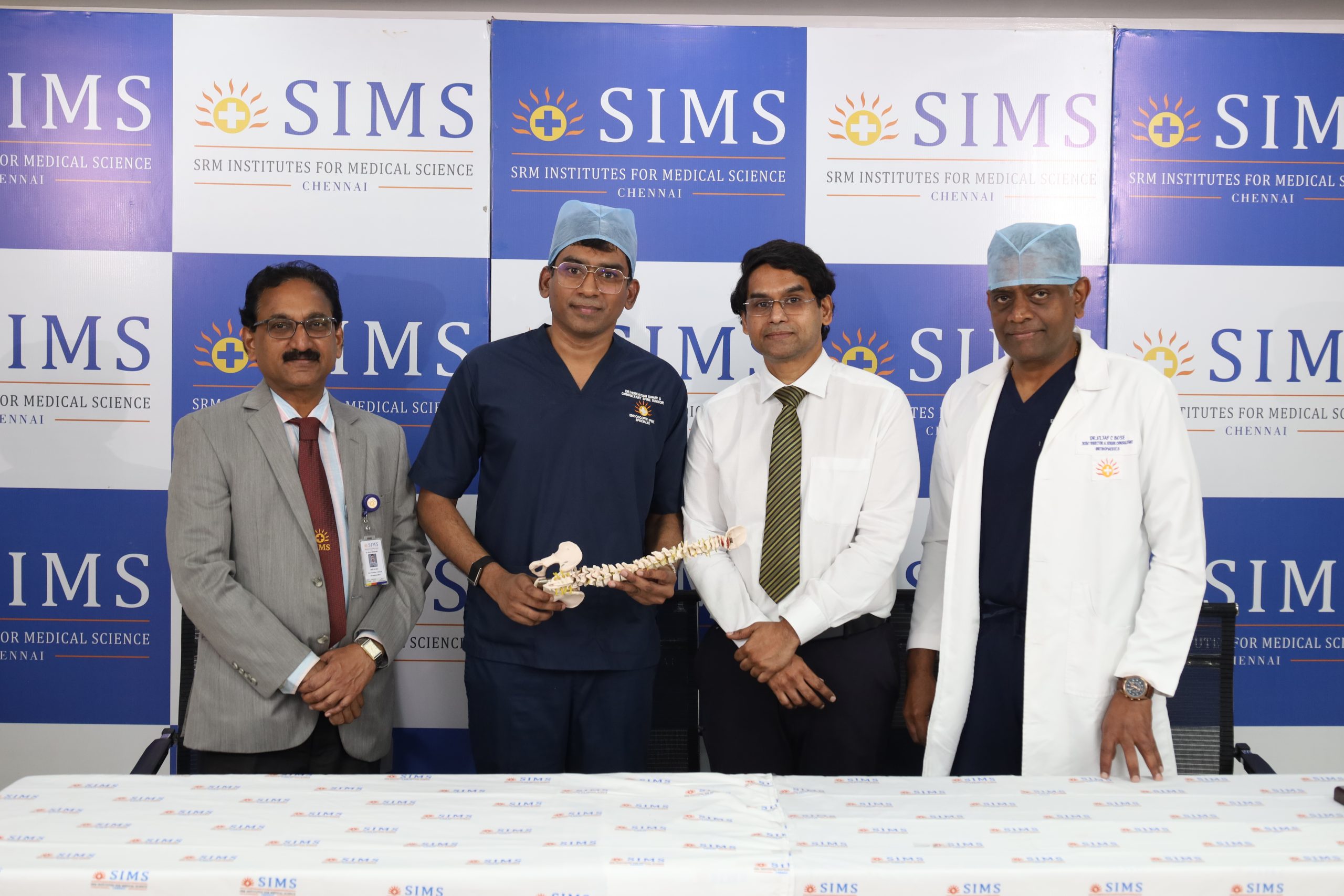
Chennai : Averting the need for traditional open spine surgery, expert orthopaedic surgeons at SIMS Hospital successfully performed an advanced single-incision endoscopic procedure on an 84-year-old patient with multi-level spinal stenosis and degenerative scoliosis, a spinal deformity that had caused severe lumbar nerve compression and left him unable to walk. The advanced uniportal endoscopic spine procedure, performed through an 8 mm incision, relieved the compression and enabled the patient to regain mobility and get back on his feet.
The surgery was particularly challenging for several reasons. The patient’s severe degenerative scoliosis had significantly distorted the normal alignment of the spine and narrowed the spaces surrounding the spinal nerves. This anatomical distortion made the uniportal endoscopic spine surgery technically demanding, requiring exceptional precision to safely navigate the compressed neural structures through a single 8 mm portal.
The patient’s pre-existing cardiac condition added another layer of complexity. He had previously undergone coronary artery bypass graft (CABG) surgery and had a permanent cardiac pacemaker. These factors increased both surgical and anaesthetic risks, necessitating meticulous multidisciplinary planning and seamless intraoperative coordination to ensure patient safety while achieving effective nerve decompression.
The procedure was performed by a multidisciplinary team comprising Dr. G. Venkatesh Kumar and Dr. Vignesh Jayabalan, Senior Consultants in Orthopaedics, along with a cardiologist.
In his comments, Dr. Venkatesh Kumar said, “The patient presented with severe functional limitations. He suffered from debilitating leg pain and was unable to walk more than a few steps. Our evaluation revealed severe degenerative scoliosis, a spinal deformity that had caused significant nerve compression in the lumbar region. Traditionally, patients with this condition often require extensive deformity correction surgery using pedicle screws and rods. However, advances in spine surgery enabled us to perform a full endoscopic uniportal lumbar stenosis decompression through a single 8 mm incision. The procedure successfully relieved the nerve compression, and the patient was mobilised pain-free shortly afterwards.”
Dr. Vignesh Jayabalan commented, “One of the biggest advantages of this advanced endoscopic technique over conventional open spine surgery is that it achieves the desired outcome with minimal disruption to normal tissues. The procedure involves negligible blood loss, no muscle stripping, less postoperative pain, no sutures, faster recovery, and precise decompression of the pain-generating pathology while preserving the spine’s normal anatomy. Our philosophy is simple: to preserve the spine’s natural supporting structures while removing only the diseased tissue responsible for nerve compression and pain.”
Dr Vijay C Bose, Joint Director and Senior Consultant, Department of Orthopaedics said, “Medical knowledge in orthopaedics is vast, and research continues to expand it further. It’s impossible for one person to be an expert in everything. At SIMS, we have five sub-units under the Department of Orthopaedics. Each unit focuses on a specific area such as joint replacements, sports injuries, trauma, and foot and ankle conditions. Very few institutions across the country have this kind of in-house expertise, and we are fortunate to be one of them. In this context, this particular case marks a breakthrough in spine surgery.”
Dr. Ravi Pachamuthu, Chairman of SIMS Hospital, said, “This case exemplifies SIMS Hospital’s commitment to delivering advanced, patient-centric care through innovation and multidisciplinary collaboration. With only a handful of specialists in the city performing uniportal endoscopic spine surgery, we are proud to offer patients access to cutting-edge treatment that enables faster recovery, reduced surgical trauma, and an early return to mobility. We remain committed to investing in advanced technologies and clinical excellence to provide world-class care, even for the most complex cases.”
