


By Suresh Unnithan
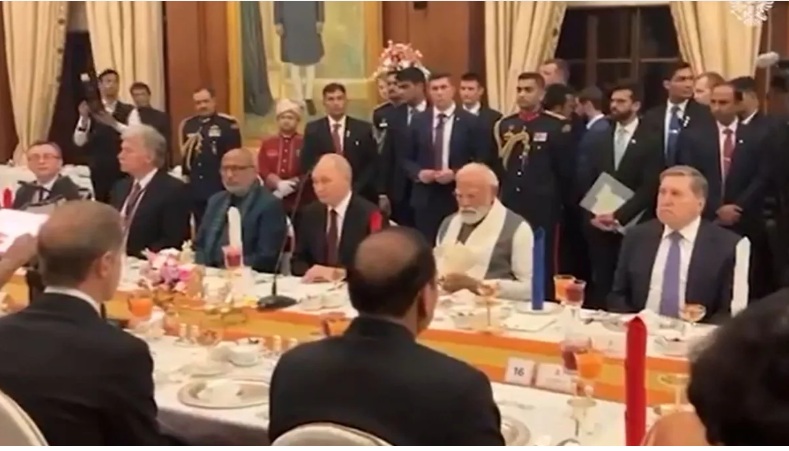
In the glittering halls of Rashtrapati Bhavan, where India’s diplomatic grandeur unfolds over crystal chandeliers and meticulously curated menus, a simple guest list has ignited a firestorm. The State banquet hosted by President Droupadi Murmu on Friday evening in honor of the visiting Russian President, Vladimir Putin, – a cornerstone of the annual India-Russia summit – excluded two vital figures: Mallikarjun Kharge, Leader of the Opposition (LoP) in the Rajya Sabha and Congress president, and Rahul Gandhi, LoP in the Lok Sabha. Adding fuel to the flames, Congress MP Shashi Tharoor, chairman of the Parliamentary Standing Committee on External Affairs, confirmed his attendance, drawing sharp rebukes from his own party. What should have been a seamless showcase of Indo-Russian bonhomie has instead exposed fault lines in India’s democratic etiquette, raising questions about inclusivity, tradition, and the subtle art of exclusion.
Decoding the Protocol: Tradition Over Rules
State banquets in India are more than mere dinners; they are ceremonial affirmations of sovereignty and international camaraderie. Hosted by the President at Rashtrapati Bhavan, these events typically accommodate over 100 guests, blending protocol with symbolism. The venue often shifts to the opulent State Dining Room or the Mughal Gardens for outdoor elegance, with proceedings kicking off in the North Drawing Room where the host greets the visiting head of state.
At the core, these banquets adhere to a framework outlined by the Ministry of External Affairs and Rashtrapati Bhavan protocols. Mandatory invitees include constitutional heavyweights: the Vice-President, Prime Minister, Speakers of both Houses of Parliament, and the Chief Justice of India. These are non-negotiable, reflecting the institutional pillars of governance. Business leaders, diplomats, and select cultural figures round out the list to underscore economic and soft-power ties.
But here’s where protocol blurs into convention: there is no ironclad rule mandating invitations to opposition leaders. As a former Rashtrapati Bhavan official noted during a similar controversy at the 2023 G20 summit, “though there was no protocol to invite LoPs for State banquets but they were generally invited.” This practice stems from democratic ethos – ensuring foreign dignitaries witness India’s pluralistic voice, not just its ruling chorus. During the tenures of Atal Bihari Vajpayee and Manmohan Singh, opposition figures routinely graced such events, fostering an image of unity in diversity. LoPs are also standard at post-Independence Day and Republic Day “At Home” receptions, reinforcing this norm.
In essence, while the guest list is curated by the President’s office in consultation with the Prime Minister’s Office (PMO) and MEA, exclusions risk being perceived as slights against the opposition’s representational heft. For Putin – a leader whose visit symbolizes enduring strategic ties amid global turbulence – the optics matter doubly. Snubbing LoPs doesn’t just breach unwritten rules; it whispers of insecurity in a democracy that prides itself on robust debate.
A Timeline of Turmoil
The controversy simmered to a boil on December 5, as Putin touched down for bilateral talks with Prime Minister Narendra Modi. Congress sources leaked that neither Kharge nor Gandhi received invitations, a departure confirmed by party communication chief Jairam Ramesh on X: “The two LoPs have not been invited.” Tharoor, however, was extended a courtesy extended to him in his committee role – a practice reportedly lapsed in recent years but revived here. Speaking to reporters outside Parliament, he affirmed, “I will definitely go,” while professing ignorance of the broader selection process.
This juxtaposition – a backbencher in, party titans out – amplified the discord. Rahul Gandhi, addressing the media, lambasted the government for flouting “tradition,” alleging it stems from “insecurity.” He recounted how foreign delegations are dissuaded from meeting him abroad, a pattern he traced back to Vajpayee and Singh eras: “LoP provides a second perspective; we also represent India.” The invitation to Tharoor, perceived by many as ideologically drifting toward the BJP, only deepened the rift, with whispers of “political intentions” echoing the user’s query.
A Chorus of Discontent
The backlash has been swift and multifaceted, transcending party lines to ensnare independent observers in a web of indignation.
Within Congress, the outrage was visceral. Spokesperson Pawan Khera decried it as a “breach of all protocols,” quipping, “This comes as a surprise, but we should not be surprised because this government is used to breaching all protocols.” He turned the spotlight on Tharoor: “Everyone’s conscience has a voice… When my leaders aren’t invited, but I am, we should understand why the game is being played.” AICC Secretary Gaurav Pandhi escalated it further on X, framing the exclusion as emblematic of Prime Ministerial “fears and insecurities,” with the President’s office “reduced… entirely under the thumb of the PMO.” Karti Chidambaram, another Congress MP, called it “bad form,” lamenting that “Protocol & Precedent have been given a go by.”
Independent voices amplified the echo. Senior Congress leader Rashid Alvi, speaking to NDTV, labeled it a “deliberate insult” that undermines India’s global stature. Political analyst Shiv Aroor, in a late-night debate, dissected the trifecta: “Breach of protocol? Deliberate small-minded insult? Totally justified snub?” On X, users like @capksharma decried it as “spite” from a “small” leadership, while @Arunpankar27 mocked the selective invite as “protocol garnish.” Even BJP’s Manoj Tiwari weighed in, slamming Congress for internal drama amid the row.
These critiques paint a picture of a government alienating allies in the name of control, with Tharoor’s presence – seen by detractors as a BJP olive branch – intensifying perceptions of opportunism.
In fact, the Modi government’s track record on opposition engagement is checkered: from halting delegations’ meetings with LoPs to this banquet blindside. By sidelining Kharge and Gandhi, it invites accusations of authoritarian drift, eroding the “whole-of-nation” narrative peddled in foreign policy. Inviting Tharoor, a vocal Modi admirer on global stages, smacks of divide-and-rule – rewarding perceived “moderates” while punishing the core. This not only fractures opposition unity but also hands critics a narrative of pettiness, especially when Indo-Russian ties demand unblemished optics.
In a multipolar world, such missteps amplify domestically: they fuel media cycles, social media storms, and international whispers about India’s democratic health. The government risks painting itself as insecure, precisely the charge Rahul Gandhi levels – a self-fulfilling prophecy that diminishes its stature.
Oversight or Orchestration? Unpacking the Intent
Was this a mere administrative miss, or a calculated gambit to corner the ruling dispensation? The evidence tilts toward deliberation.
An oversight strains credulity: Guest lists for such events are PMO-vetted with surgical precision, and precedents abound. The 2023 G20 snub drew similar ire, suggesting a pattern rather than a glitch. Tharoor’s inclusion – tied to his committee chairmanship – feels engineered, a nod to his pro-India-Russia stance amid Ukraine tensions. As one X user quipped, it’s “peak New India: separation of powers by WhatsApp guest list.”
Yet, the fix? It boomerangs. By spotlighting internal Congress fissures (Tharoor vs. the High Command), the move inadvertently bolsters the Opposition’s victimhood, rallying them around a shared grievance. If deliberate, it’s a high-stakes ploy to isolate “disloyal” voices like Tharoor while marginalizing threats like Gandhi. But in doing so, it puts the BJP on the defensive, inviting scrutiny over the President’s autonomy and Modi’s micromanagement. A tactical win, perhaps, but a strategic own-goal in the theater of democracy.
As Putin departs with handshakes and accords, the real banquet served up was one of bitter irony: a feast for headlines, famine for harmony. In India’s evolving playbook, protocol may bend, but perceptions? They snap back with force
