

Tobacco Board Urges Government to Reconsider Tax Hike Amid Rising Illicit Cigarette Trade and Severe Impact on Millions of Farmers and Workers

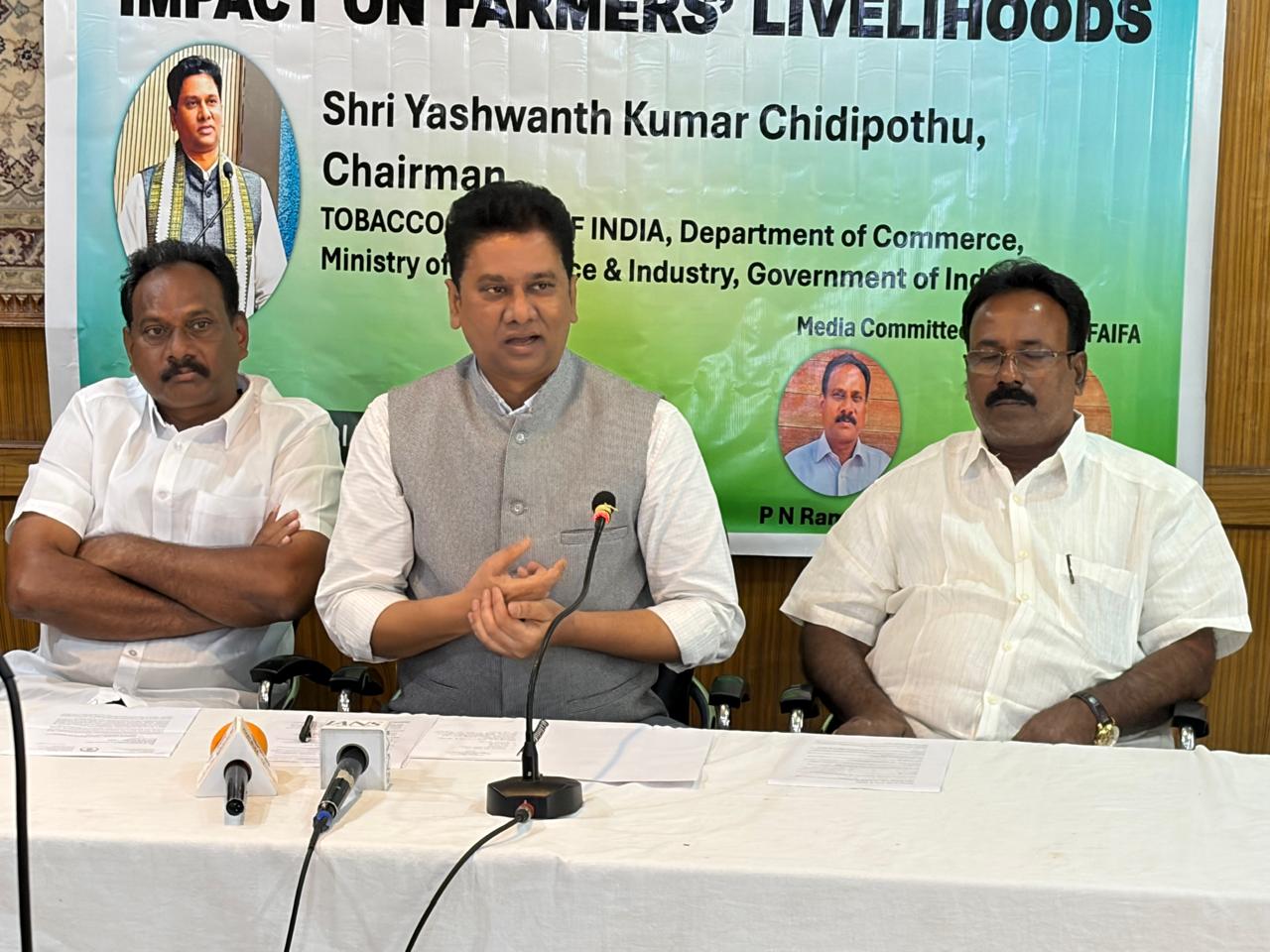
New Delhi: The Tobacco Board Chairman, Shri Yashwanth Kumar Chidipothu has written to Smt. Nirmala Sitharaman, Minister of Finance, and Shri Piyush Goyal, Minister of Commerce and Industry, highlighting the adverse impact on the industry, as well as on millions of farmers and workers, arising from the unprecedented increase in excise duties on cigarettes notified on 31 December 2025, which has effectively resulted in a 60 per cent increase in prices in real terms.
“Considering the urgent industry situation and the significant impact on the farming community, I have requested the Honourable Ministers to intervene and revise the excessive duty rates on tobacco products,” said Shri Chidipothu.
Shri Chidipothu stated that he was writing on behalf of FCV (Flue-Cured Virginia) tobacco farmers who had approached it to express their serious concerns over the tax hike. He further reiterated that, as reported in the media, farmers have begun staging protests and submitting representations to their respective Members of Parliament.
Steep tax increases risk significantly accelerating the growth of the illicit cigarette trade, which has emerged globally as a serious economic and governance challenge. The unregulated market deprives governments of substantial tax revenues, undermines legitimate businesses, fuels organised criminal networks, and poses risks to public health and security.
He further said, “High tax and price differentials create strong incentives for smuggling, particularly when enforcement capacity is constrained. Weak border controls, fragmented oversight, and the absence of effective tracking and tracing mechanisms allow illicit operators to exploit policy gaps, while illicit cigarettes increasingly serve as a conduit for organised crime and money laundering.”
The consequences extend beyond revenue loss, with global evidence suggesting that billions in excise and tax revenues are diverted annually to the illicit economy, reducing funds available for public services. At the same time, legitimate manufacturers face shrinking market shares, job losses, and plant closures, while consumers are exposed to products that bypass health regulations, lack age-verification safeguards, and are often linked to other illegal goods such as counterfeit cigarettes, illicit vapes and nicotine pouches.
The Tobacco Board Chairman emphasised that addressing the illicit cigarette trade requires a balanced and coordinated policy approach, including strengthened enforcement, effective track-and-trace systems, coherent and enforceable regulations, and enhanced international cooperation. The communication underlined that the issue is not merely fiscal in nature but has wider implications for farmers’ livelihoods, employment, public health, and law enforcement, warranting urgent and comprehensive attention.
He said, “The unprecedented increase in excise duties on cigarettes has created serious distress across the tobacco value chain, affecting millions of farmers, workers and small shops who depend on this sector for their livelihoods. International experience clearly shows that sharp and uncalibrated tax hikes risk accelerating the growth of illicit trade, eroding legitimate industry and diverting revenues away from the exchequer. A balanced and enforceable tax and regulatory framework is essential to safeguard farmers’ interests, protect employment, and prevent organised criminal networks from exploiting policy gaps”.
The tax hike is expected to severely depress farmer incomes, as the legal cigarette industry, the primary domestic buyer of FCV tobacco, is likely to sharply curtail its offtake. This would leave farmers unable to recover even the basic cost of cultivation, currently estimated at around Rs. 200 per kilogram. There is widespread concern that market prices could collapse, pushing farmers into acute and potentially irreversible debt. Farmers point out that a 22 per cent tax increase in 2014 resulted in a price decline of Rs. 20 to 30 per kilogram. Given today’s significantly higher input costs and an existing global surplus of tobacco, prices are now feared to fall by Rs. 60 to 70 per kilogram, substantially deepening farmer distress.
Farmers have also voiced serious concerns about the new tax system, warning that it could significantly boost illicit trade. With cigarette prices in India potentially rising to around Rs. 400 per pack compared to Rs. 75 to 80 in neighbouring countries, smugglers could gain a major advantage. Currently, nearly 26 per cent of India’s cigarette market is already illegal, ranking fourth largest globally, and higher taxes are likely to expand this share. This not only reduces government revenue and domestic demand for Indian tobacco but also threatens the livelihoods of farmers and workers, leading to an estimated loss of 40 million man-days and shifting value chain benefits to foreign producers.
Citing international experience, the Board Chairman pointed to developments in South Africa, where illicit cigarettes are estimated to account for 60–75 per cent of the market, leading British American Tobacco South Africa to announce the closure of its only local manufacturing plant by the end of 2026. The expansion of illicit trade has rendered domestic production economically unviable, reduced legal capacity utilisation to around 35 per cent, and placed hundreds of jobs at risk. Experts have attributed the surge in the illicit market to enforcement gaps, regulatory weaknesses, and widening price differentials between legal and illegal products.
There were also enforcement actions in Australia, where authorities have intensified crackdowns on illegal tobacco. In 2025 alone, more than 16 million illicit cigarettes and related products were seized, dozens of retail outlets were shut down, and offenders were subjected to significant penalties, including imprisonment. Investigations have revealed strong links between illicit cigarette smuggling and organised criminal activity, including extortion, arson, and violence in major cities such as Melbourne.
