


By Suresh Unnithan
In India’s vibrant democracy, the heartbeat of the nation resonates through the collective will of its voters, who stand as the ultimate sovereigns, wielding the sacred power of their vote to shape the country’s destiny. Elected representatives, entrusted as humble servants, are bound to honor and uphold this democratic mandate. Yet, a gathering storm threatens to erode this sacred trust, as allegations of voter manipulation cast a long shadow over the integrity of the electoral process. Disturbing claims of suspicious voter additions and systematic “vote chori” (vote theft) through mass deletions from electoral rolls have surfaced, raising fears that the very mechanism empowering India’s voters may be under siege. Such attempts to tamper with voter lists strike at the core of democracy, endangering the hard-won freedom those generations of Indians have fought to secure. The accusations, levelled by Leader of the Opposition Rahul Gandhi in August and again on September 18, 2025, backed by data visualizations and alleged insider leaks, underscore the urgency of safeguarding the voters’ rights. However, the Election Commission of India’s responses—marked by denials, partial disclosures, and a refusal to share critical probe data—have only deepened public skepticism, risking the erosion of faith in the world’s largest democracy.
Rahul Gandhi’s August intervention focused on anomalous surges in voter registrations, particularly in BJP-leaning areas during the lead-up to state polls. He argued that these “additions” followed no logical demographic patterns and suggested a deliberate inflation of favourable voter bases. Fast-forward to his September 18 press conference in New Delhi, where Gandhi escalated the narrative, unveiling what he called irrefutable evidence of deletions targeting opposition voters. Using the 2023 Karnataka Assembly elections in the Aland constituency as a case study, he demonstrated how over 15,000 names—disproportionately from Congress strongholds—were scrubbed from rolls just days before voting, only for replacements to mysteriously appear.indiatoday.in
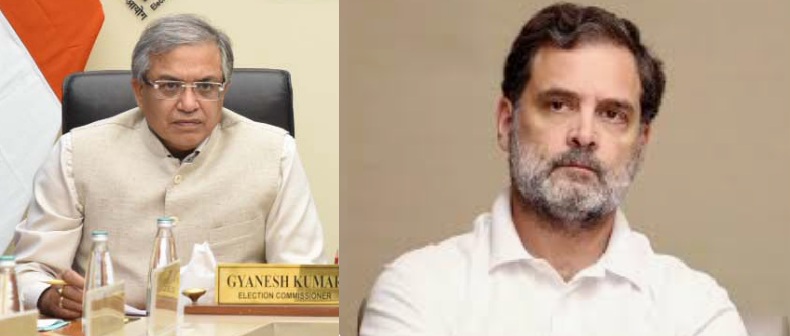
Gandhi didn’t stop at data dumps; he issued a direct challenge to Chief Election Commissioner (CEC) Gyanesh Kumar, labelling him the “protector of vote thieves” and vowing to release an “H-bomb” of further evidence if the ECI failed to act within seven days. Drawing from whistle-blowers within the ECI itself, Gandhi claimed a nationwide modus operandi: deletions via manipulated Form-7 submissions, often routed through obscure IP addresses, followed by rapid re-registrations under false identities. “This is not a glitch; it’s a heist,” he thundered, warning that undetected, such tactics could swing entire elections.
The ECI’s rebuttal was swift but selective. In a fact-check statement, the commission asserted that “no vote can be deleted online by the public” and that all deletions require physical verification. It denied complicity, emphasizing procedural safeguards. However, this defense rang hollow to critics, as it sidestepped the core issue: the opacity surrounding the digital trails that could expose foul play.sabrangindia.in
At the epicentre of this controversy lies the Aland voter fraud investigation, handed over to the Karnataka Criminal Investigation Department (CID) following an FIR filed by local ECI officials after irregularities surfaced. What began as a routine probe into 15,000 suspect deletions has devolved into a saga of bureaucratic stonewalling. Over the past 18 months, the CID has dispatched no fewer than 18 letters to the ECI, pleading for essential technical details: static IP addresses, server logs, and timestamps of Form-7 submissions linked to the deletions.
A trickle of dynamic IP addresses—ephemeral identifiers that change with every session and offer no forensic value—while withholding the static IPs that could trace submissions to specific actors. Karnataka’s Chief Electoral Officer has claimed “all data handed over,” but CID sources contradict this, revealing that pivotal logs remain under lock and key. Rahul Gandhi seized on this in his address, accusing the CEC of “blocking” the probe to protect the perpetrators, potentially including ruling party operatives.
This refusal isn’t isolated. Similar patterns emerged in earlier probes, such as the 2024 Mahadevapura bypoll irregularities, where ECI data-sharing delays hampered investigations. Each instance chips away at the ECI’s mantle of impartiality, transforming a guardian of polls into a perceived accomplice in subversion.timesofindia.
When the referee withholds the replay footage in a high-stakes match, fans don’t just question the call—they doubt the game itself. The ECI’s actions—or inactions—risk precisely this outcome. Public trust in electoral institutions is the bedrock of democracy; erode it, and participation plummets, polarization surges, and authoritarian whispers grow louder. A 2025 Pew survey already shows 42% of urban Indians harboring “moderate to high” doubts about ECI neutrality, up 15% from 2023—a trend accelerated by these scandals.
In Aland, where the alleged fraud nearly cost Congress the seat, local voters express a chilling apathy: “Why bother queuing if names vanish overnight?” This isn’t hyperbole; post-poll analyses in Maharashtra and Haryana revealed a 7-10% dip in turnout among affected demographics, correlating with deletion spikes. Nationally, Gandhi’s campaign has ignited a youth-led “Vote Guard” movement, with over 500,000 signatures demanding ECI reforms. Yet, without transparency, such fervor could sour into cynicism, alienating the very electorate that powers India’s pluralistic ethos.timesofindia.
The fallout extends beyond ballots. International observers, including the Carter Center, have flagged these episodes in their 2025 India report, cautioning that unresolved probes “undermine global perceptions of Indian democracy.” Domestically, opposition unity—rare as it is—coalesces around this issue, with allies like the Samajwadi Party and Trinamool Congress echoing calls for a judicial audit.
So, what restrains the ECI from unleashing the data deluge? On paper, several barriers loom. The Official Secrets Act, 1923, casts a wide net over “official” information, often invoked to classify electoral metadata as sensitive. Voter privacy under the Aadhaar Act and DPDP Bill 2023 further complicates disclosures, mandating anonymization that could inadvertently shield fraudsters. Procedurally, the ECI operates under the Representation of the People Act, 1951, which empowers it to withhold data during active probes to prevent “tampering”—a noble intent twisted into a shield against scrutiny.
Critics argue these are excuses, not explanations. The ECI has shared granular data with courts in past cases, like the 2019 VVPAT challenges, proving selective transparency is feasible. Moreover, as a constitutional body, it reports to the President, not the government, freeing it from partisan loyalty—yet perceptions of post-2014 politicization linger, fueled by appointments skewed toward bureaucracy over civil society.
At root, inertia and fear of exposure may bind tighter than law. Releasing full logs could unravel not just isolated fraud but systemic vulnerabilities, inviting lawsuits, parliamentary grillings, and a cascade of resignations. As one anonymous ECI insider told The Wire, “Transparency is a double-edged sword; it heals trust but exposes wounds.”
The ECI stands at a precipice. Rahul Gandhi’s deadline looms, and with it, the promise—or threat—of more revelations. To reclaim its pedestal, the commission must pivot from defensiveness to decisiveness: furnish the CID with unredacted data under judicial oversight, commission an independent audit of 2023-25 rolls, and legislate real-time voter verification portals for public scrutiny.
India’s electorate deserves no less. In a nation where democracy is not inherited but fiercely defended, every withheld IP address is a crack in the foundation. The ECI must choose: perpetuate the shadows, or illuminate the path forward. The ballot box awaits its verdict.
