


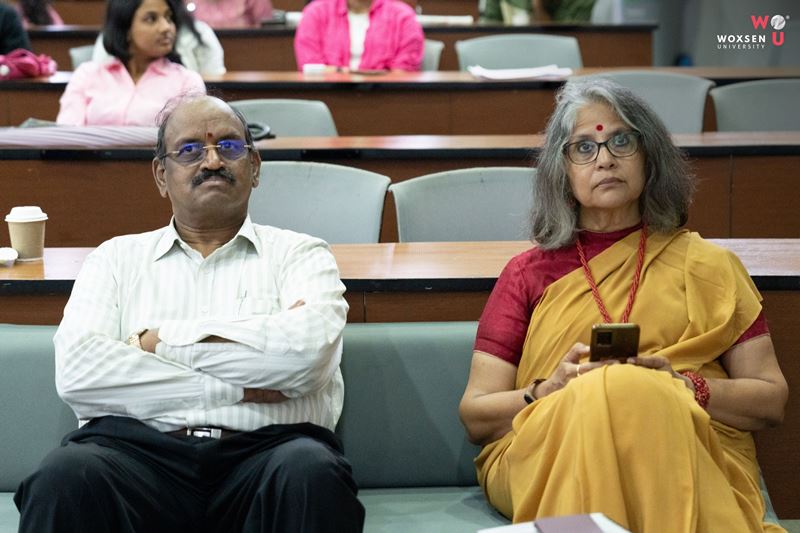
Hyderabad: The School of Architecture and Planning, Woxsen University, in collaboration with a consortium of national and international partners, co-hosted the pre-event for ADoBE’2025 Architecture and Design of Built Environment. Titled “The Historic Water Systems of Hyderabad”, the hybrid-format event served as a critical point of departure for the broader theme of ADoBE’2025: Reimagining the Lakefront.
The Chief Guest, Mr. K. Suresh Kumar, Chief Engineer, Musi River Front Development Corporation Limited (MRDCL), shared insights grounded in ongoing policy interventions and emphasized the need for multi-stakeholder engagement in river and lakefront revitalization. Reflecting on Hyderabad’s changing landscape, he said, “Hyderabad once had around 500 tanks, and now about 185 remain. This workshop is a great opportunity to explore ideas for restoring and improving these lakes.”
The convening brought together urban planners, conservationists, environmentalists, and academic leaders to interrogate the future of Hyderabad’s water heritage through the lens of the Historic Urban Landscape (HUL) approach. Anchored in the understanding that water systems are not only ecological resources but also cultural assets, the event highlighted the pressing need for integrative, heritage-sensitive urban strategies.
Complementing the discourse, an exhibition featured conservation efforts by GSV Suryanarayana Murthy and a curated collection of architectural thesis projects by students of Woxsen University. These exhibits underscore the critical intersection between traditional ecological wisdom and contemporary conservation practices.
Vishal Khurma, CEO at Woxsen University, shared institutional strategy & positioning, “We live in a time where green cities are built with grey concrete, smart cities rely on IoT systems that often fail during monsoons, and we speak of progress while urban homes shrink, and rural ones expand. Architecture today is shaped by these contradictions.
As we turn to AI, 3D printing, and other emerging tools to ‘revive’ design, the real need is to pause and question the direction itself. This session is a step toward helping the next generation of architects make sense of this paradox and to bring greater clarity, intent, and balance into urban planning across India.”
The day’s discussions were shaped by an eminent lineup of speakers, including Matthias Ripp, World Heritage Coordinator, City of Regensburg, Germany and International Adjunct Professor at Woxsen University; Sajjad Shahid, historian, columnist, and conservation advocate; GSV Suryanarayana Murthy, South Zone Representative, ICOMOS India; Maheep Singh Thapar, Urban Planner and Director, ADAPT Technologies; and Madhulika Choudhary, Environmental Activist and Founder, Dhruvansh NGO.
An engaging panel discussion “Water, Heritage, and Urban Futures” brought to the fore the multidimensional relevance of water heritage in shaping equitable and resilient urban futures.
